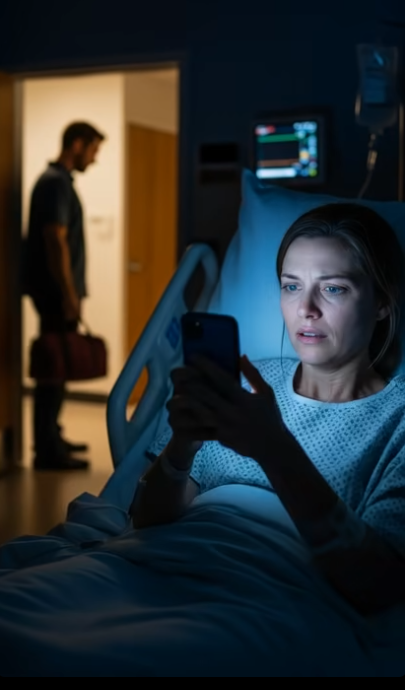
I was in my third round of chemotherapy when I noticed something strange on the bank app. I don’t know exactly why, but I decided to check the joint account statement, something I never do. That day, however, something told me to look. Three large transfers stood out, stark and undeniable. One of them was for a staggering $346,200. My stomach turned to ice, and my soul nearly left my body. The money had been sent directly from our joint account to a name I unfortunately recognized: Allison Monroe, the same name as the “wellness consultant” my husband had hired to take care of me during my treatment.
These past few months, he had barely touched me. He said he needed space, that it was too hard for him to see me like that, that it was all “too heavy.” At first, he came with me to my sessions, held my hand, brought me juice, and promised everything would be okay. But after the sixth round of chemo, the excuses started. He said the environment was “too dark,” that it was draining his energy, making him emotionally exhausted and traumatized. Then, one day, he just stopped coming. That same week, he went on a “spiritual retreat” to come back renewed and better prepared to support me, according to him.
What he didn’t know is that while he was “recharging”—probably beside his mistress, draining our life savings without shame—I was gathering strength from a place he would never understand. And when he came back, he found out I was capable of things he wouldn’t imagine, not even in his worst nightmares.
My name is Clare Mitchell, and this is my story of retribution.
I thought I was prepared for anything, but nothing truly prepares you for the day your own body becomes a battlefield. Chemotherapy hit my system like a hurricane. My skin burned with a constant, low-grade fever. My hair fell out in chunks on my pillow, a daily, heartbreaking reminder of the war raging within me. And still, I was the one apologizing—for being weak, for being emotional, for needing help. My husband, Ethan, said he was there for me, that it was all temporary, but his eyes told a different story.
In the beginning, he was the model of a supportive spouse. He hugged me, made dumb jokes in the waiting room, and told me I was strong, that this would all pass. But once the treatment intensified, he began to pull away. First came the delays, then the silences, then the excuses: meetings, traffic, “bad energy.” Until one day, there was no message at all. I knew then that I was going through this alone, even though his name still showed up under “husband” in my phone.
The day I decided to shave my head completely, I asked him to be there. It was symbolic to me, a mark of courage in the face of surrender. He said he’d rather not watch, that he couldn’t handle seeing me like that. I pretended to understand, smiled through the phone, and went alone to the salon. The woman who shaved my head cried more than I did. I came home with my head wrapped in a red scarf, one my mother had given me. Ethan wasn’t home; he’d sent a text saying he needed to “clear his head.” That night, I slept alone with a throbbing scalp, a cold pillow, and a silence in the room that felt like it was mocking my pain.
The doctor suggested I stop working, that I take a break from the stress of my marketing job. Ethan loved the idea. “I’ll handle everything,” he’d said, his voice full of feigned nobility. “Bills, groceries, medications. As long as I’m around, you’ll only have to focus on getting better.” I believed him because, in that fragile state, you cling to any gesture of care. I started sleeping more, letting him handle the finances, not checking anything. The joint account, where my inheritance from my mother was also held, was being used only by him. I thought I was in good hands.
And for a while, I was. Until I started noticing things. He seemed far too happy, like someone living a parallel life, untouched by the pain of the woman he had promised to love. He started going out more, attending “breathwork courses” and “meditation workshops.” He claimed he was learning to be a better support system, to care for someone in pain. Honestly, it sounded noble. But along with this “new Ethan” came a total absence. Chemo sessions were long, the tests exhausting, and the worst part was having no one to share it with. Even his texts became short, devoid of affection.
It was in that emptiness that he came up with his “miracle solution.” “I’ve hired a holistic consultant,” he announced one evening. “She’ll accompany you, take care of you. Her name is Allison Monroe.”
At first, I thought he was genuinely trying. Allison was sweet, soft-spoken, and made excellent ginger and lemon tea. But something about her bothered me. She was too present. Her perfume was too sweet. She knew too much—where my test results were, what meds I took and when. Ethan started quoting her constantly. “Allison said this,” “Allison thinks that,” “Ask Allison.” I was the one who was sick, but she was the one filling every space in our lives. When the two of them disappeared for two days for a breathwork retreat, I started connecting the dots.
Looking back now, I see he didn’t even try to hide it. But I was still missing one thing: solid proof that I wasn’t losing my mind.
During a chemo session, all alone, I paid for a test using the bank app. It wasn’t something I usually did; Ethan always told me to let him handle it. But that day, something compelled me to check the statement after the payment. That’s when I saw it: three large transfers. One for that staggering sum of $346,200. It felt like everything inside me just stopped. And there, in the clinic’s waiting room, with the needle still in my arm, I realized he hadn’t just betrayed me. He’d stolen from me.
The nurses walked past without even noticing. I just sat there, frozen. The phone slipped from my hand, the screen still lit. My world was made of tests, injections, and fragile hope; his was made of spas, transfers, yoga, and fresh starts. But what Ethan didn’t know is that even with a weak body, my soul was waking up. And a woman who wakes up is a force no one can stop, especially when she carries pain and the will for retribution in the same chest. I promised myself I’d make him feel a thousand times worse than I felt in that moment. But for that, I needed a well-structured plan and ice-cold focus.
He started treating me like someone he was sure would pass away soon. He took long naps, went out to “de-stress,” and bought expensive wines, as if he had something to celebrate. I spent my days in bed, nauseous and dizzy, while he said he needed to “clear his mind.” In his mind, I wouldn’t live more than three more months. He had already accepted my passing, already lived like a widower to someone still alive. And worse, he started spending like he was already on his own, as if my mother’s inheritance was some kind of lottery prize he’d just won.
The inheritance my mother left was all the security I had. She used to say, “Clare, this money is your shield. Never depend on any man.” But when I got sick, I couldn’t manage everything. I let Ethan handle the finances because I loved and trusted him. I never thought he’d take advantage of a wife going through chemo. But now, everything made sense: the expensive purchases, the disappearances, the joy I hadn’t seen in his face in years. While I was fighting to stay alive, he was already using my money to fund a new life.
I remembered my mom and the promise I made at her funeral: I won’t be weak. I won’t let anyone erase me like they did to you. I took a deep breath, felt a cold rage rise up my spine. For the first time, I didn’t just want to survive. I wanted to come back, with everything, to make him pay for every second he treated me like I was already gone.
When he returned from that so-called retreat, he came in smiling, bringing me a weird necklace with colorful stones. He said it was to “align me with my healing purpose,” that I had attracted this illness into my life but could cure myself with “positive energy.” I thanked him with a calm smile, and when he went upstairs to shower, I opened his laptop. Shaking, still weak, I started checking every statement, every transfer, every detail. And that’s when I found it: a name, a number, an address—none of it mine, but all of it paid for with what was. In that moment, with cold skin and burning eyes, I decided that if my end was circling, it would have to wait. Because before I left this world, I was going to destroy his first.
One of the statements showed a recent payment of $2,800 as a deposit, plus two months paid in advance. The account name was Allison Monroe. The destination, an address I’d never seen before. It stuck in my mind until I remembered something: Ethan had this awful habit of saving receipts in random folders on his computer. I opened the folder labeled Future Projects and there it was: a PDF titled Lease Unit 1702. The contract was under Allison’s name, but the one who paid was him. The apartment was far away, on the other side of town—a balcony, a lake view, brand-new appliances, all picked out with my money. My stomach turned because on that paper was the truth he never had the guts to say out loud. He was already starting over, assuming I wouldn’t be around to see it.
The next day, I asked my sister to drive me to the address. I didn’t tell her why, just that I needed to get out of the house. When we got there, I stayed across the street, watching from inside the car. Ethan came out shortly after, wearing light, expensive clothes, laughing on the phone. Behind him, Allison, holding his hand. She was wearing one of my necklaces. In that moment, I didn’t cry. I didn’t scream. I just felt one thing with absolute clarity: This wasn’t going to end like that.
And so, with a weak body and a soul on fire, I started building the plan that would destroy both of them publicly, with the same coldness they used to erase me in my most fragile moment.
The next day, Allison showed up with fresh juice, a little flower in her hair, and a calm smile that made me sick. “You need to keep your mind peaceful, Clare,” she said, as if talking to a child. As if she wasn’t the one sleeping with my husband while I fought for my life.
I pretended it didn’t hurt, pretended I didn’t know. But every one of her gestures, every touch, was a disguised insult. She cared for me the way someone feeds a wounded bird, just waiting for it to pass. I didn’t cry anymore. I just observed. She made my bed like it was hers, stored my medication in the same cabinet where I kept old letters. It was like she was rehearsing to take my place, with my permission.
When she left to buy flowers—of course, flowers—I opened the laptop and created a new folder. I named it Evidence. Every receipt, every bank statement, every email screenshot Ethan had forgotten to delete. I gathered it all calmly, coldly, strategically. Because if they thought I was going to fade quietly, they were wrong. I was still here. And now, I was dangerous.
I reached out to the lawyer who handled my mother’s inheritance. I went to his office in person, even though I was trembling with weakness, handed him the folder with the evidence, and told him everything. He looked at me with the seriousness of someone who knows what’s at stake. “You have a strong case, Clare. If you take this to court, he’s going to come out of it worse than you can imagine.”
That was it. I didn’t want a scandal; I wanted strategy and justice.
In the days that followed, I kept up the act. I let Ethan kiss me on the forehead like he was the hero of the story. I let Allison make chamomile tea and fill the house with her sweet, venomous voice. She didn’t do it out of compassion; she did it because she already felt like she owned the place. But I let her, because now I was collecting evidence. She was good at pretending, but I was better. I faked gratitude, weakness, ignorance. Meanwhile, my evidence folder kept growing.
Until one night, she left her phone unlocked on the counter. Pretending to look for medicine, I walked up quietly. The chat name: Ethan. I opened it with a quick swipe, and the first sentence knocked the air out of my lungs: “She’s getting worse fast. Soon we’ll have it all wrapped up.”
I scrolled slowly. They were talking about me like I was already buried, an obstacle, a nuisance. They were discussing money, the final transfer, closing everything out. Ethan said the next step was getting everything “squared away with the lawyer.” Allison replied with a heart emoji. At that moment, I snapped a picture of the screen and emailed it to myself. I went back to the living room and sat on the couch like nothing had happened. She brought me tea, tucked me in, and wished me good night. I thanked her, almost smiled, but inside, something had shifted. I was no longer just a betrayed wife; I was a victim with proof of a conspiracy.
The next morning, I reached out to an old friend of my mother’s who worked in security systems. I explained I needed a discrete camera installed in the hallway. She didn’t ask questions. By the end of the day, it was all set up. Little by little, I got addicted to the footage. I’d watch from my bed in silence as they moved through the house like I was a piece of furniture. Ethan would pull her close in the kitchen, talking about the new apartment. Allison would rifle through my things like she already owned them. Now, it was all being recorded.
A week later, I caught an entire scene. They were talking about the inheritance. Allison suggested Ethan should “speed things up.” He hesitated, saying he needed to wait for the final medical report. She snapped back, “What are you waiting for? For her to pass naturally?” The camera caught everything.
I started saying I was more tired, weaker. I faked more coughing, spoke slower. “Do you want Allison to sleep over tonight?” Ethan would ask. I’d shake my head with a sad smile. “I’d rather be alone.” They believed it because they wanted to believe it. Meanwhile, I was getting better in secret. Every fake groan was a disguise, every dramatic sigh a shield. Ethan let his guard down. Allison, more cautious, watched me sideways, but she had no proof. And me? I had plenty.
Then came the final move. Ethan knocked on my door holding an envelope, a “security document.” “Leave it on the dresser,” I said, my voice weak. “I’ll sign it tomorrow, if I’m still alive.”
It was a formal request to move the only money still under my name, not in our joint account. He’d invented an “incredible treatment” overseas, a clinic in Toronto. He said they needed an upfront deposit, that if I wanted to live, I couldn’t waste time. But I looked it up; the clinic didn’t exist. The email was fake. He really thought that on top of being weak, I was stupid. He wanted to leave me with nothing, truly believing I was going to pass and planning to drain every last cent.
The next day, I told him I was confused by the terms and needed help understanding them. He hugged me tight, saying he’d take care of everything, that I just needed to trust him. Later that day, I went back to the lawyer. I brought the document, showed him every detail. “This man is trying to wipe out everything that’s yours,” he said bluntly.
In that moment, I wasn’t just a recovering patient; I was a woman about to strike back.
I made myself a cup of tea, put lipstick on my cracked lips, and opened my computer. The lawyer had messaged me: “It’s all here, Clare. We’ve got enough.” The statements, the recordings, the fake contract, the attempt to move my personal fund—it wasn’t just betrayal, it was premeditated. It was criminal.
Ethan left, saying he was going to the pharmacy. I knew exactly where he was headed. Before the door even shut, I was on the phone with the bank, freezing funds, activating locks. The lawyer guided me step-by-step. Meanwhile, I sent a short message to Allison from my number: I know everything. Then I turned off my phone.
I changed clothes. No headscarf, no sick face. I put on my mother’s red blouse, a firm pair of jeans, and lipstick. For the first time in months, I looked at myself in the mirror without fear and saw me, whole, alive. I arrived at the lawyer’s office at exactly 2:00 PM. The complaint was filed right then, with all evidence attached and a request for immediate freezing of assets in his and her name. The plan wasn’t just mine anymore; now, it was the law.
When Ethan came home, he found the locks changed and a note: You thought I was weak. Now you’ll feel the weight of my strength.
It took less than an hour. His phone started ringing non-stop: the bank, the accountant, his lawyer. From the couch at my sister’s house, I watched it all unfold. The joint account was frozen. The evidence was forwarded to the financial fraud unit. Within two days, the assets in the mistress’s name were also pulled into the investigation. Allison tried to act fast, to withdraw, to hide, but it was too late. Ethan tried calling me ten times. Then came the messages, begging, accusing, crying. Clare, what did you do? You’re going to destroy everything out of spite. He was the one who destroyed everything; I just protected myself.
Allison disappeared off the map. Ethan went after her, only to find out she was already looking for her own lawyer. That’s how fear works: when it hits, everyone runs.
I went back to the hospital, no tears, no fear. My latest test showed something different: stable, promising. The doctor looked at me, surprised. “You look stronger.” And I smiled, because it was true. My body still carried scars, but my soul was standing tall.
Ethan was formally summoned to testify. The case proceeded on two fronts: civil for asset misappropriation, and criminal for fraud and embezzlement. He tried calling, sending voice notes: “It was a mistake. I was lost. Allison manipulated me.” But none of it shook me.
At the preliminary hearing, he played the victim, saying he’d acted out of desperation. But the judge looked him straight in the eyes and said, “You didn’t seem so desperate when you were buying nine-hundred-dollar French wine.” The room went silent.
My lawyer called at the end of the day. “Clare, it’s just a matter of time. He’s going to pay for everything.”
The judge made it clear when delivering the sentence: three years in prison, no parole, and full restitution of the stolen funds. Ethan cried, begged, said prison would ruin him. But by that point, no one cared. The victim of that story had a name, a face, and was standing tall, staring her abuser in the eye. Allison had vanished, but the police found her; she got two years.
At my final chemo session, the nurses applauded me. The tumor had shrunk.
Today, Ethan lives with his mother, the one who always hated me but now calls him “the shame of the family.” And me? I sleep in peace, with clean scans and a clean name. Slowly, I got everything back: my body, my self-worth, my will to live. I got a new tattoo on my wrist, the letter M for Mitchell, my mother’s last name. I started walking in the park again, cooking for myself, and I realized revenge wasn’t watching him suffer. It was seeing myself happy again—without fear, without pain, and without him.
My mother always said, “The most powerful kind of revenge is the one carried out with dignity.” Watching Ethan be judged, humiliated, and lose everything without me lifting a finger—that was it. All I had to do was survive. And I did, more alive than ever.