Then, it happened.
We were walking down the garden path toward the reception marquee for the photographs. The path was narrow, lined with jagged slate. Clara was ahead of us, the train of her white gown sweeping the stones like a conqueror’s banner. Elena stepped forward to help adjust the veil which had caught on a rosebush.
It was fast—a blur of motion that my brain struggled to process. A sharp shove. It was clumsy enough to be written off as an accident by the casual observer, but deliberate enough to send a chill down my spine. The force was precise.
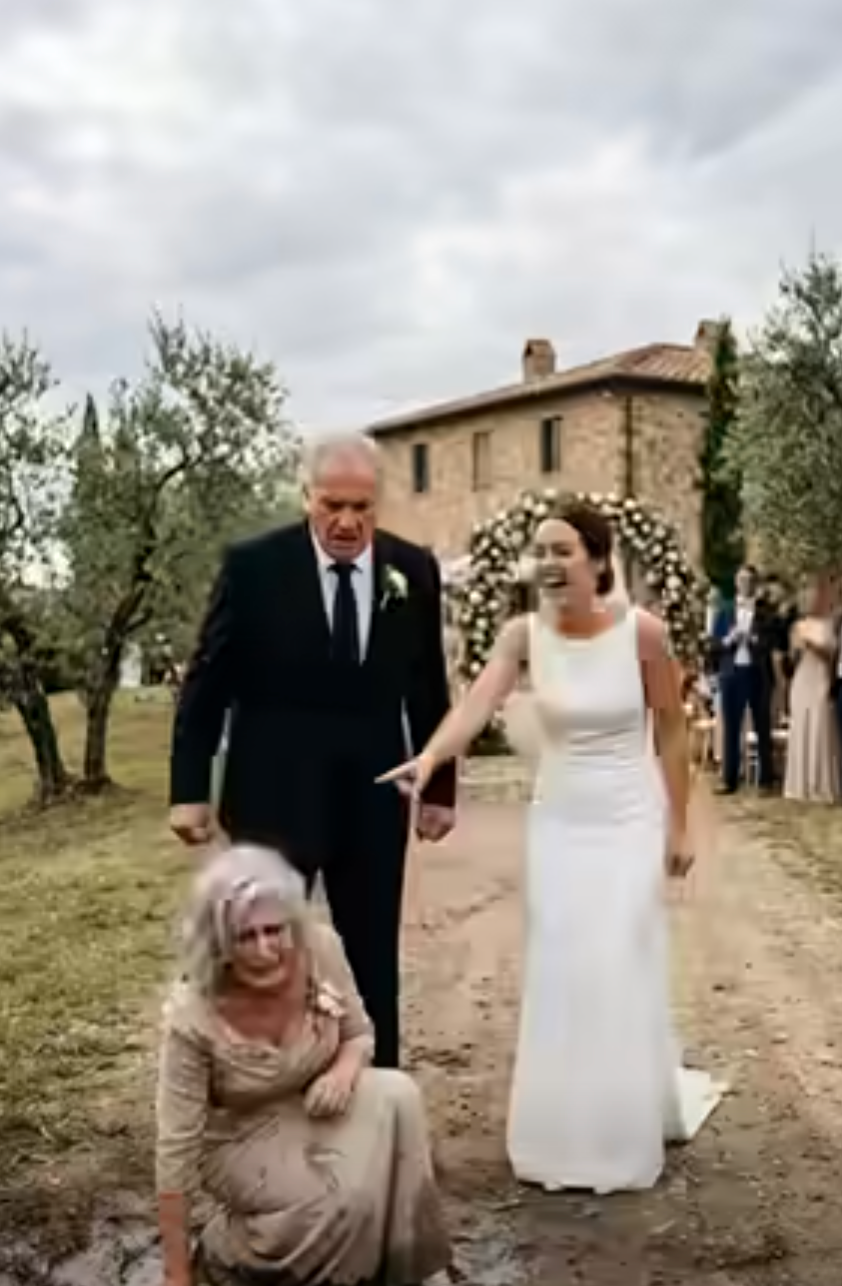
Elena lost her footing. She stumbled back, her heel catching in the soft earth, and she fell hard into the rain-soaked flowerbed beside the path. The mud was unforgiving. It splashed instantly across her lavender skirt, turning the delicate fabric into a heavy, dark ruin.
Time didn’t just stop; it shattered.
I froze. It is a reaction I have hated myself for ever since—the paralysis of shock. I expected a gasp. I expected hands reaching out. I expected Daniel, my son, to rush to his mother.
Instead, I heard laughter.
It wasn’t the nervous titter of someone trying to diffuse tension. It wasn’t an awkward chuckle. It was a clean, sharp sound. A sound devoid of guilt.
Clara looked down at Elena, who was struggling to push herself up from the grime, her face crumbling in humiliation.
“Oh, honestly,” Clara said, her voice carrying clearly over the hushed whispers of the nearby guests. “Don’t make a scene just to steal the spotlight, Elena. It’s pathetic.”
I felt something ignite in the center of my chest. It was a physical sensation, like swallowing a hot coal. Rage, yes—volcanic and consuming. But beneath the anger was a suffocating layer of shame. Shame for not catching her. Shame for being surrounded by people—friends, family, business partners—who suddenly found the architecture of the villa fascinating, pretending not to see the matriarch of the family on her knees in the dirt.
I frantically searched the crowd for Daniel. I needed to catch his eye. I needed to see his outrage mirroring mine. I needed him to be the man I raised.
He looked away.
He adjusted his cufflink, his gaze fixed on a distant point near the horizon. He chose his wife’s cruelty over his mother’s dignity. That betrayal hurt more than the mud.
I knelt and helped Elena up. Her hands were trembling violently, her skin cold and clammy.
“I’m fine,” she whispered, though her voice was breaking. “Please, Arthur. Don’t.”
No one apologized. Clara turned on her heel, signaling for the photographer to continue, surrounded by a sycophantic circle of bridesmaids who forced laughter to cover the silence. They walked on as if nothing had happened, leaving us behind like discarded props.
That was the moment I chose silence.
A younger version of me might have shouted. I might have grabbed Clara’s arm and demanded an apology. I might have caused the scene she accused us of making. But as I wiped a smear of mud from Elena’s trembling arm, a cold clarity descended upon me.
Impulsive anger is a fire that burns itself out. It leaves you with ash, while the enemy remains standing.
I looked at Clara’s retreating back, her posture rigid with triumph. She thought this was a display of dominance. She thought she had broken us.
I straightened my tie, took Elena’s hand, and led her quietly toward the restrooms to clean up. I didn’t know it yet, but the war had started. And while Clara was fighting with noise and humiliation, I would fight with the deadliest weapon of all: patience.
The reception was a blur of forced smiles and hollow toasts. I watched. For the first time, I truly watched.
I observed how Clara spoke to the catering staff, snapping her fingers at them as if they were stray dogs. I noticed how she corrected Daniel in front of his colleagues, cutting him off mid-sentence to offer a “better” version of his own stories. I saw the way her jokes always had a target, and the target was always someone who couldn’t fight back.
No one confronted her. Not even me.
When it was my turn to toast, I stood. The room went quiet, expecting the doting father-in-law speech. I smiled. I raised my glass. I spoke of love and future and family. To the untrained ear, it was a standard blessing. But to me, it was a camouflage.
“To the truth,” I said softly at the end, looking directly at Clara. “May it always find its way to the surface.”
She smirked and drank, thinking I was a harmless old fool spouting platitudes.
That night, back in our quiet home, Elena refused to discuss the incident. She scrubbed her skin in the shower until it was red, trying to wash away the feeling of the fall.
“It’s not worth it, Arthur,” she said, sitting at her vanity, avoiding her own reflection. “She is Daniel’s wife. We have to keep the peace. If we fight her, we lose him.”
“We won’t fight,” I promised, kissing her forehead. “We will simply… observe.”
But I lied. I wasn’t just going to observe. I was going to dismantle.
In the days that followed, the dynamic shifted. Clara took Elena’s silence for submission. She became bolder. She stopped asking for advice and started issuing demands. She rearranged family dinners, dictated holiday plans, and even began making comments about the Valdez Family Trust, the holding company that managed our assets.
“Daniel needs to take a more active role in the finances,” she announced one Sunday over lunch, swirling her wine. “The portfolio is stagnant. It needs… fresh eyes.”
I nodded slowly, chewing my roast beef. “Perhaps you are right, Clara.”
She beamed, mistaking my agreement for capitulation.
The next morning, I went into my study and locked the door. I didn’t go to the office. I didn’t go to the club. I opened the safe behind the painting of my grandfather and pulled out the leather-bound dossiers that hadn’t seen the light of day in a decade.
I began to review everything. Property deeds, company bylaws, pre-nuptial agreements (which Daniel, in his infatuation, had made remarkably weak), and the foundational documents of the family estate.
I wasn’t looking for revenge in the emotional sense. I was looking for leverage. I was looking for the details Clara—in her arrogance—had never bothered to learn. She saw the wealth, the cars, the estate. She didn’t see the structural steel that held it all up.
I spent weeks meeting with lawyers. Not the family lawyer, whom Daniel knew, but a specialist in Madrid named Mercer. A shark in a bespoke suit.
“You understand what this means if you activate this clause?” Mercer asked me one rainy afternoon, tapping a yellowed document from 1998. “It’s the nuclear option, Arthur.”
“I understand,” I said, staring at the rain hitting the window. It reminded me of the mud on Elena’s dress. “She thinks power is something you take. She needs to learn that power is something you are granted, and it can be revoked.”
Meanwhile, Clara grew reckless. She felt untouchable. She began insulating Daniel from us. She insulted a long-time family friend at a gala. She fired the housekeeper who had been with us for twenty years because she “walked too loudly.”
One evening, Elena found me in the library, surrounded by papers.
“Why are you so calm?” she asked, her voice trembling. She had been crying again; Clara had made a comment about her cooking earlier that day. “She is erasing us, Arthur. And you just sit here.”
I took off my reading glasses and looked at my wife. The woman who had built this life with me.
“I am calm, Elena, because I no longer have doubts,” I told her. “The trap is set. We are just waiting for the beast to step into it.”
And step into it she did.
The catalyst wasn’t a family argument. It was business. Clara, pushing Daniel to be more aggressive, convinced him to sign off on a massive renovation project for the Villa Dorada, intending to turn part of the historic estate into a modern boutique resort. She wanted her name on it. She wanted to be the queen of a new empire.
She signed contracts. She made promises to contractors. She insulted the zoning board chairman. She humiliated a supplier publicly when he questioned her budget.
She was radiant with power. She thought she owned the world.
Then came the invitation to the Annual Family Gala in Madrid. This was the night she planned to unveil her grand vision for the estate. It was to be her coronation.
I put on my tuxedo. I checked my pocket for the folded document Mercer had prepared.
“Are you ready?” I asked Elena.
She looked nervous, clutching her purse. “I just want tonight to be over.”
“It will be,” I said, a cold certainty settling in my bones. “Before the night is out, everything will change.”
We got into the car. As we drove toward Madrid, the city lights flickering like distant stars, I knew we were driving toward a guillotine. The only question Clara hadn’t asked herself was: whose neck was on the block?
The ballroom in Madrid was suffocatingly opulent. Crystal chandeliers the size of small cars hung from the frescoed ceiling, casting a golden light over the guests. This was the inner circle of our society—politicians, investors, the old families of Castile.
Clara stood at the center of the room, wearing a dress that cost more than most people earned in a year. She held court, her hand resting possessively on Daniel’s shoulder. Daniel looked tired. There were dark circles under his eyes, the fatigue of a man constantly walking on eggshells.
I watched from the periphery. I saw Clara point to the architectural models displayed on a velvet table. Her “vision” for our home.
“It’s going to be magnificent,” I heard her boast to a banker. “We are finally dragging this family into the twenty-first century. The old ways are dead.”
She laughed. It was the same laugh from the wedding. Clean. Sharp. Cruel.
The time had come.
I signaled the band to stop. The music died down, replaced by a murmur of confusion. I walked to the microphone at the front of the room.
Clara looked annoyed. She whispered something to Daniel, rolling her eyes. She expected a toast. She expected me to fawn over her brilliance.
“Good evening,” I said. My voice was steady, amplified through the hall. “I won’t take much of your time. But there are some clarifications that need to be made regarding the announcements we’ve heard tonight.”
The room went silent. No one ever listened to me. I was just the father. The checkbook. The background noise.
I reached into my pocket and unfolded the paper.
“Clara has spoken passionately about her plans for the Valdez Estate,” I continued. I didn’t look at the crowd. I looked straight at her. “She has signed contracts. She has made guarantees.”
“Arthur, sit down, you’re drunk,” Clara hissed, her smile faltering. She took a step toward me. “Daniel, get him.”
Daniel didn’t move. He was staring at me, sensing the shift in the air.
“I am not drunk,” I said, my voice dropping an octave, becoming hard as iron. “I am simply… literate.”
I held up the document.
“This is the Deed of Trust established by my grandfather in 1952. It contains a clause—Clause 14B, to be exact. It states that the title of Villa Dorada and the controlling interest in the Valdez Group are not hereditary rights.”
A ripple of whispers went through the room. Clara stopped walking. Her face went pale.
“The ownership is a ‘Lifetime Usufruct’ granted to the head of the family,” I read calmly. “Transfer of executive power requires a unanimous vote of the Board of Trustees. And, more importantly, it contains a ‘Morality and Conduct’ provision. Any beneficiary who brings ‘public disrepute or discord’ to the family name can be stripped of all executive authority and access to funds immediately.”
I looked up. “Clara, you didn’t just shove my wife into the mud on your wedding day. You shoved your way into a role you never bothered to understand. You assumed Daniel owned the estate. He doesn’t. You assumed you had the power to sign those renovation contracts. You don’t.”
Clara stood abruptly, knocking over a glass of red wine. It stained the white tablecloth like blood.
“This is a joke!” she shouted. Her voice cracked, losing its polished veneer. “This is insane! Daniel, tell him!”
No one laughed. The silence was heavy, judging.
“I spoke with the Board this morning,” I said, delivering the final blow. “They reviewed the video footage of your behavior at the supplier meeting last week. They reviewed the unauthorized contracts you signed. They have voted.”
I paused. The tension in the room was tight enough to snap a neck.
“They have invoked Clause 14B. The contracts are void. The renovation is cancelled. And as of this moment, Daniel is removed from the executive committee pending a review of his judgment.”
I turned my gaze to my son. “And you, Clara, have no legal standing within the Valdez Group. None.”
Daniel looked at me—not with fear, but with a sudden, devastating clarity. The fog of her manipulation was lifting. He looked at the woman beside him, the woman screaming at his father, and for the first time, he saw her.
“You can’t do this!” Clara screamed. It was a primal sound, stripping away all her elegance. “I am the future of this family!”
“No,” I said softly into the microphone. “You were a mistake. And we are correcting it.”
Her scream echoed through the hall, bouncing off the crystals and the marble. But by then, it was far too late. The trap hadn’t just sprung; it had crushed her.
The aftermath was not a battle; it was a collapse.
Clara tried everything in the minutes that followed. She cycled through anger, then tears, then accusations. She claimed everyone was against her. She claimed I was senile. She grabbed Daniel’s arm, digging her nails into his tuxedo jacket.
“Do something!” she shrieked at him. “He’s humiliating us!”
Daniel pulled his arm away. The motion was slow, deliberate. He looked at the red marks her nails had left on his sleeve.
The room remained silent. The guests, the elite of Madrid, were not looking at Clara with sympathy. They were looking at her with the cold detachment of people who despise a loss of composure. She had broken the cardinal rule: never let the mask slip.
Elena walked up to me. She took my hand. Her pulse was steady for the first time in months. There was no triumph in her eyes—only a profound relief. The weight was gone.
Daniel stepped forward. His voice shook, but his words were firm.
“This didn’t start today, Clara,” he said. The room strained to hear him. “It started when I ignored what I shouldn’t have. When I let you treat my mother like dirt.”
Clara stared at him, stunned. Her mouth opened and closed, but no sound came out. The control she believed she had over him—the sexual hold, the psychological dominance—had evaporated in the harsh light of public exposure.
“I’m done,” Daniel said. “I’m done with the shouting. I’m done with the cruelty.”
He turned to me. “I’m sorry, Dad.”
I nodded. It was enough.
There was no applause. No celebration. Only the brutal, undeniable truth hanging in the air.
Security eventually escorted Clara out when she refused to lower her voice. It was a pathetic end to her reign. She didn’t leave like a queen; she left like an unruly patron at a dive bar.
Days later, Clara left the house. Quietly. Not in drama—but because she could no longer dominate the space. The locks were changed. The lawyers handled the rest. The marriage was annulled based on fraud and lack of disclosure regarding her own financial debts, which my investigation had also uncovered.
Six months have passed since that night in Madrid.
The Villa Dorada is quiet again, but it is a peaceful quiet, not a fearful one. Elena is in the garden, planting new hydrangeas along the path where she fell. She hums as she works. The mud is just mud now—fertile soil, not a site of trauma.
Daniel is working his way back up in the company. He starts in the archives, learning the history he ignored. We talk more now. We talk about legacy. We talk about respect. He is healing, slowly, from the toxicity he mistook for love.
I sit on the terrace, drinking my coffee, watching the sun set over the olive groves.
I learned that silence can be powerful—but only when it protects, not when it hides. Silence is not surrender. It is the gathering of breath before the strike. It is the deep water where the truth waits to rise.
Sometimes justice doesn’t arrive loudly, with guns blazing or fists flying.
Sometimes, it arrives steady, undeniable… and final.
Elena looks up from the garden and waves at me. I wave back.
The dress is gone. The stain is gone. And the laughter—that cruel, sharp laughter—has been replaced by the sound of the wind in the trees, whispering stories of a family that bent, but did not break.
Did this story resonate with you? Like and share this post if you find it interesting and believe that sometimes, silence is the loudest answer.