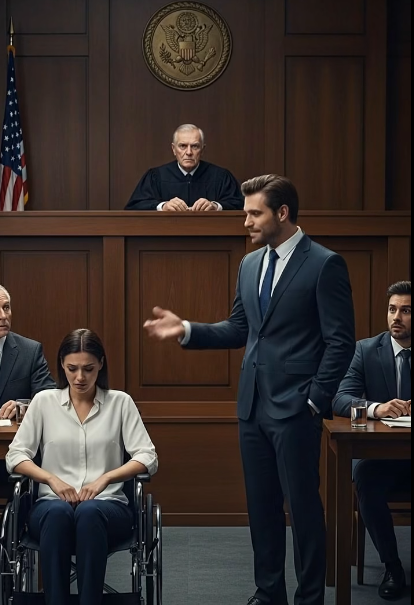
Arthur Gregory’s voice, a velvety and well-rehearsed instrument, trembled just enough to evoke sympathy but not suspicion. He stood slightly bent forward, resting his knuckles on the barrier. His suit was impeccably tailored, and the sorrowful expression on his face had been perfected in front of a mirror. “But Maria’s condition… it’s only getting worse. She doesn’t speak, hardly reacts to anything. I’m exhausted and broken. And now, this inheritance.” He sighed heavily. “Maria’s late father, bless his memory, has left her with so many complications that she simply cannot handle in her current state. It’s cruel to her. I only want to shield my wife from unnecessary stress, to protect her.”
The courtroom fell silent, listening to the confession of this respectable man. Judge Tamara Peterson, whose face seemed carved from granite, fixed him with a heavy, impenetrable gaze.
Maria Gregory sat in her wheelchair, resembling a broken porcelain doll. Her large eyes, once as bright as cornflowers, were now bottomless wells of pain. Her thin fingers clutched a folded piece of paper, turning her knuckles white. Next to her, straight as an arrow, sat her lawyer, Jennifer Svetlov. Jennifer compensated for her youth with a steely glint in her intelligent eyes.
“Mr. Gregory,” Jennifer’s voice rang out in the thick silence, cutting through it like a scalpel. “You say you want to protect your wife. Tell me, do you consider transferring one hundred and fifty thousand dollars to an offshore account two weeks before filing this lawsuit to be an act of ‘protection’?”
Arthur’s lawyer, Olga Larson, a woman with the aura of a polar night, lazily raised an eyebrow. “Objection, your honor. My client’s financial transactions are irrelevant to the matter of his wife’s competency.”
“Overruled,” the judge stated evenly. “The defendant has the right to explore the plaintiff’s motives. Answer the question, Mr. Gregory.”
Arthur forced a smile, feigning condescension toward feminine pettiness. “Ms. Svetlov, those were business operations. You understand—the pharmaceutical business, investments, contracts. I work tirelessly, partly to provide Maria with the best care, the best clinics. It’s all for her.”
“Of course,” Jennifer nodded, her gaze unwavering. “And I suppose your frequent business trips to the coast, where, by a strange coincidence, your colleague Valerie Sokolov resides, are also aimed at ensuring the best care for your wife?”
Arthur’s face momentarily turned to stone. “Those are vile insinuations. I will not allow you—”
“And what about your regular meetings with a certain Sergei Belov at a restaurant, where, judging by the receipts, you discussed certain ‘supply deals’ and kickbacks? Is that also part of your touching concern?”
The mask of the impeccable husband was cracking. Olga Larson shot her client a warning glance, but Arthur, inflamed by the unexpected attack, was losing control. “My personal life and my business are none of your concern!” he roared. “We are here to discuss my wife’s condition!”
“Precisely,” Jennifer continued, her voice soft but insistent. “We are discussing her condition and your desire to manage her inheritance. An inheritance that her father, Stephen, wisely protected with conditions, as if he foresaw this.” The lawyer paused, letting her words sink in. “Mr. Gregory, do you truly believe that your wife, in her state, cannot manage the inheritance left by her father?”
Arthur’s gaze darted to Maria, huddled in her wheelchair. There was no pity, no love, not even indifference in his eyes. Only a cold, cloying contempt. He smirked. Addressing the judge but looking directly at his wife, he uttered a phrase that took the breath away from many in the room.
“My wife is practically a vegetable. Why would she need an inheritance?”
A deathly silence fell, so thick it felt tangible. The court reporter froze, pen in the air. Olga Larson, his lawyer, momentarily lost her icy composure, her eyes widening in astonishment. The judge slowly, very slowly, shifted her gaze from Arthur to Maria. In her eyes was a contempt so cold that the air seemed to freeze and crack.
At that very moment, Maria, who had seemed completely detached, stirred. With visible effort, overcoming tremors and pain, she raised her hand and offered Jennifer the folded piece of paper. The one she had been clutching all this time.
The lawyer accepted it with the care one would afford a priceless treasure. She didn’t look at it herself. Instead, she approached the judge’s bench and placed the paper before her. “I request this be admitted into evidence, your honor.”
Judge Peterson gave Arthur another long look, then unfolded the message. It was not a plea for help, not an excuse, not a page of incoherent scribbles. It was a drawing. A stunningly detailed, vibrant, and touching portrait of a little girl, about five years old, with huge eyes full of hope and light. Every curl, every eyelash, the dimple on her cheek—all were drawn with incredible love. The little girl in the drawing smiled as if she knew the world’s greatest secret.
In the corner, in beautiful calligraphic script that could not possibly belong to a “vegetable,” was written: For my courageous Kate. Thank you for the light. Your Aunt Maria.
The room was frozen. The judge held up the drawing for everyone to see. It spoke for itself. This was the work of a mature, sensitive artist, whose inner world was still alive, bright, and full of love.
Just then, the heavy oak courtroom door burst open. Two uniformed police officers and a plainclothes man with a stern face stood in the doorway. “Apologies for the interruption, your honor,” the man said, flashing a badge. “Senior Investigator Peterson.”
Maria looked at the entering officers, then at her husband’s ashen face. In that instant, the tension of the past months—the pain, the fear, this final, desperate battle—all crashed down on her. The world swayed, sounds muffled as if underwater. Then, a black, merciful veil covered everything.
Maria slumped in her wheelchair, losing consciousness.
“An ambulance! Get an ambulance, immediately!” the judge’s voice boomed like a drum. Panic erupted in the courtroom, but Maria, already lost in the waves of her faint, was sinking into the past. Back to where it all began.
Six years earlier, an autumn downpour had hit the city, sudden and merciless. Five minutes ago, the sun had been peeking through the clouds; now, torrents of water had turned the avenue into a raging river. Maria tried to take shelter under the tiny awning of a bookstore. Her new suede shoes, bought with her first major fee for illustrating a children’s book, were soaked through.
She took a step to bypass a particularly deep puddle, and at that moment, the thin, elegant heel of her right shoe snapped with a treacherous crunch. Maria gasped and, losing her balance, began to fall backward into the giant puddle. She had already squeezed her eyes shut, anticipating the cold, dirty impact, but instead felt a strong hand catch her elbow, saving her from the fall.
“Careful,” a low, pleasant male voice said.
Maria opened her eyes. Before her stood a stranger, tall, in a perfectly tailored coat that seemed entirely waterproof. Raindrops glistened in his dark hair, and a playful light danced in his gray eyes. He held a large black umbrella over her, and under its dome, it suddenly became quiet and cozy.
“Oh, thank you,” Maria breathed, feeling her cheeks flush.
“I see you’ve broken a heel,” the stranger smiled. And his smile was dazzling, like something from a toothpaste ad. “Allow me. My name is Arthur, by the way.”
“Maria. It’s a pleasure, and very awkward.” She tried to lean on the broken heel, but her foot immediately gave way.
“Whoa, stop,” Arthur said decisively. “You won’t get far like this. Where are you headed?”
“Just around the corner, to Garden Avenue. I thought I could make a run for it.”
“Running won’t be an option now,” the man stated with a slight smirk. “But hobbling under my careful guidance should be quite possible. Allow me to escort you.”
He offered her his arm. Maria hesitated for only a second. The new acquaintance smelled of expensive cologne, rain, and confidence. She timidly placed her hand in his. “Only if you’re not a criminal who preys on girls with broken heels in the rain,” she joked.
Arthur laughed. “You’ve found me out. It’s my signature move, but for today, as an exception, I’ll just walk you home.”
They walked slowly, Arthur carefully supporting her, shielding her from the rain with his umbrella. They chatted about trivial things—the weather, poorly made shoes, the suddenness of autumn showers. Maria, usually a bit shy with strangers, felt surprisingly at ease with him. Arthur was charming, witty, and as gallant as a hero from an old movie.
“Are you an artist?” he asked, noticing the portfolio of sketches she clutched to her chest.
“An illustrator, mostly children’s books.”
“Oh, really?” His eyebrows rose in surprise. “I’ve always admired people who can create worlds on paper. I, myself, am in a world of numbers and formulas. Pharmaceuticals. Boring, but profitable.”
At her apartment building, he stopped. “Well, it seems the mission to rescue the beautiful stranger is complete.”
“Arthur, thank you so much. You’re my hero of the day,” Maria said sincerely, looking up at him.NextStay
“That was too easy. To earn such a title, I must perform another feat. Perhaps inviting the rescued princess for coffee—once the shoes are fixed, of course.” He handed her a business card: Arthur Gregory, Development Manager, PharmGlobal. “Call me. Unless, of course, you’re still afraid of strangers from the street.” He winked, turned, and strode away, disappearing into the gray curtain of rain.
Maria stood for a while, clutching his card, feeling her heart beat foolishly and happily. She didn’t know then that this charming rescuer in the expensive coat would become both her greatest love and her greatest disappointment.
The romance blossomed suddenly, without the slow burn or awkward getting-to-know-you phase. A month into their whirlwind relationship, Arthur decided to introduce Maria to his parents. “Don’t worry, they’ll love you,” he said, confidently driving down the highway. “Just be yourself. They’re simple people.”
Maria nervously clutched the edge of her silk dress. “Simple people” hardly seemed to describe Arthur’s parents, who lived in a massive three-story mansion in an elite suburb. She felt like an impostor, a girl from a tiny apartment heading for an inspection at a castle.
The house was exactly as she’d imagined: severe, majestic, and cold. They were greeted by a housekeeper in a starched apron. His parents were waiting in the living room, which more closely resembled a museum hall. Sergei Gregory was a tall, lean man with a heavy gaze and a habit of speaking as if giving orders. Irina Gregory was the quintessential socialite: perfect hair, a string of pearls, a taut smile, and an appraising look that seemed to see right through you, calculating the cost of your dress and jewelry.
“Mom, Dad, this is Maria,” Arthur announced, beaming as he put his arm around her.
“Hello,” Maria said quietly, feeling like a schoolgirl taking an exam.
“Maria,” Sergei drawled, barely touching her fingers with his cold, fish-like hand. “Arthur has told us a lot about you. You draw, I believe.”
“Yes, I’m an artist-illustrator. It runs in the family. My father is an artist, too.”
“Hmm, an artist,” Sergei said, his tone suggesting he was talking about butterfly breeding. “Such an unstable profession.”
Irina smiled a little wider, but her eyes remained cold. “Arthur has always been drawn to the bohemian type. Please, come to the table. Dinner is getting cold.”
The conversation was torture. Sergei questioned her about her parents, her education, her plans. Irina inserted cutting remarks about modern morals and how important it was for a man to have a reliable home front. “Family isn’t just about feelings, dear,” she lectured. “It’s a project, an investment. A woman should support her husband, create comfort, not float in the clouds with her little pictures.”
“Mom, Maria is very talented,” Arthur tried to interject. “Her books have large print runs.”
“Talent is fine,” Irina continued, relentless. “But a good soup is more important. Do you know how to make soup?”
Maria felt a flush of shame. “I do.”
“Excellent. At least there’s something practical.”
After dinner, Sergei took his son to his study to discuss business, leaving Maria alone with her future mother-in-law. “You do understand, Maria, our Arthur is a boy with a great future,” Irina began, examining her flawless manicure. “He needs a worthy partner. A woman who will match his status, who can bear healthy heirs. Are you healthy? There haven’t been any… unpleasant diseases in your family?”
Maria was stunned by the bluntness. “I am quite healthy.”
“Very good. Because Arthur needs a strong family. He works so hard, gives so much of his energy to his career. So, rest assured, Arthur deserves the very best.”
When they finally left, Maria was silent for a long time. “See? I told you they were simple,” Arthur said cheerfully, oblivious to her state.
“Your mother thinks soup is more important than my talent,” Maria replied quietly.
Arthur laughed. “Oh, don’t pay any attention to that. She’s just being old-fashioned, worrying about me. Besides, she can’t cook soup herself. We have staff for that. You’ll see, Mom will grow to love you. What matters is that I love you.”
He took her hand and kissed it. In that moment, Maria forced herself to believe him, convinced herself that his parents’ coldness was just a defense mechanism. She didn’t yet understand that to them, she would always be an outsider, a girl from the wrong side of the tracks.
Their wedding was a relatively modest affair by his parents’ standards, but behind the facade of well-being, the first cracks in their life together were already appearing. Arthur’s love was like a beautiful but cold cage. He admired Maria’s talent, but only as long as it didn’t interfere with his plans. “Masha, why do you need this bohemian crowd?” he’d say when she was getting ready to meet with fellow artists. “You have me.”
After her first miscarriage, he was the picture of attentiveness, but his eyes held disappointment, as if she had failed to deliver on an investment. After the second, he grew colder, more distant. The humiliations became more subtle. He might joke in front of friends about her “unwomanly” mind or how her paintings were “cute but naive.” Maria felt increasingly lonely in their huge, stylish apartment.
Her only solace was visiting her father at his country house. Stephen, a talented artist himself, often spent time there. Returning from these visits at night was her small freedom—an empty highway, music from the speakers, stars overhead. But her father’s health was failing. In their last conversation, he seemed to be saying goodbye. “Take care of yourself, my daughter. And don’t let anyone push you around. Paint, no matter what. Create and be happy.”
On that fateful night, she was returning home, exhausted. A light, drowsy rain was falling. The wipers moved lazily across the glass. Lost in thought, she didn’t see the deer leap onto the road. The animal, startled by the headlights, froze. Maria instinctively swerved, but too sharply. The car skidded on the wet asphalt. A moment of weightlessness, the screech of metal, the crack of shattering glass. The world turned upside down. An impact, followed by a thick, ringing silence.
She was found by a truck driver. The doctors’ diagnosis was a death sentence for her old life: a compression fracture of the spine with displacement. Spinal cord damage. She had survived by a miracle, but she would likely never walk again.
In the hospital, Arthur played the role of the devoted husband. He gave interviews to TV crews that suddenly appeared. “My wife is a very talented artist. I will do everything possible. We will fight.” He never left her side but spoke not to her, but on the phone, arranging her transfer to an exclusive private clinic, “New Life.”
Maria stopped speaking. The world shrank to the size of a hospital bed. She was moved to the beautiful clinic, where Arthur hired a quiet, attentive caregiver for her named Inna. Maria sank deeper into depression, refusing food, refusing to engage. Arthur visited daily, bringing fruit she didn’t eat and recounting his business successes.
The turning point came unexpectedly. One gray day, the door to her room creaked open. A small head with two funny pigtails peeked in. “Hello,” a tiny voice chirped. It was Kate, the five-year-old daughter of a nurse. The girl, born with a heart defect, spent most of her short life in hospitals.
“Why are you so sad?” the girl asked with childlike directness.
Maria didn’t answer, but Kate wasn’t deterred. She pulled a crumpled piece of paper and some colored pencils from her pocket. “Do you want me to draw you a sun?” She sat on the floor and created a bright yellow, crooked, but cheerful sun. “Here,” she said, handing it to Maria. “This is for you.”
Maria slowly looked down. Something inside her, long dead and petrified, stirred. She took the drawing, her fingers brushing against the warm, small hand.
From then on, Kate visited every day. “Do you know how to draw?” she asked one day. “Mom said you’re an artist.” Maria just nodded. “Then why don’t you draw? Your hands work.”
That simple, childish phrase struck harder than any psychologist’s advice. You have hands. Kate didn’t see a person with a disability; she saw someone who could draw. For the first time in months, the desire to live flickered within her.
Inna, her caregiver, was not only attentive but wise. She never pried, just did her job and observed. It was Inna who insisted on taking Maria for walks in the small park near the clinic. Across the street was a cozy cafe that always smelled of fresh pastries and good coffee. One day, while Inna was away buying water, a man approached Maria’s wheelchair.
“Escaping the hospital gruel?” the stranger asked with a warm, friendly smile. He was a man in his thirties with kind wrinkles at the corners of his eyes and hands stained with something that looked like cinnamon. “I’m Kyle,” he introduced himself, “the owner of that place over there. I’ve been watching you for a few days. You have such a thoughtful look.”
He didn’t look at her with pity, only calm, respectful interest. Maria, to her surprise, didn’t feel the urge to hide. Kyle talked to her as if they were old acquaintances. “I can see you’re not talking,” he said, unfazed. “I understand. Sometimes words just get in the way. Can I treat you to some tea? I have an amazing herbal blend. Relieves stress and restores faith in humanity.”
He ran to the cafe and returned with two paper cups. They sat in silence, drinking the tea. It was strange but incredibly peaceful. From then on, Kyle approached them every day. He didn’t try to make her talk; he just sat with her, telling funny stories about his customers or reading aloud from books.
“I was thinking,” he said one day, crouching in front of her wheelchair so their eyes were level. “Everyone needs their own thing, something that belongs only to them.”
The next day, he brought a large, beautiful sketchbook and a set of professional pencils. “I don’t know if these are right, but maybe…”
Maria looked at the clean white pages. Her hands remembered how to hold a pencil, but fear was stronger. She shook her head. Kyle wasn’t discouraged. A week later, he came back with a box. Inside was a new digital drawing tablet and a stylus. “Look,” he said, opening a program. “No need to press hard. A light touch. And if a line isn’t right, you can undo it. No one will see. Just you and a clean screen.” He placed the stylus in her hand. His fingers were warm and strong. “Your hands move,” he said, looking her straight in the eye. “That means not all is lost. Come on.”
That night, she took out the tablet. The first stroke was hesitant, crooked. The second, the third. They were scribbles of pain, black, jagged lines pouring her despair onto the screen. She drew for hours. Then, toward morning, out of the chaos, a shape began to emerge: a small, stubborn snowdrop, pushing through a layer of black snow.
Inspired, Maria began to create every day. She drew Kate. She drew Kyle with his kind smile. Drawing gave her back her voice, albeit a silent one for now.
Inna, meanwhile, had become more than a caregiver; she was Maria’s eyes and ears. She overheard Arthur on the phone in the hallway, thinking Maria was asleep. “Yes, Valerie, everything’s going according to plan. No, she doesn’t understand anything. Total vegetable. The main thing is that they declare her incompetent. Then I can manage everything. And we’ll sort out the supply deals. Belov has already prepared the kickback documents. Be patient, kitten. Soon we’ll be together and very rich.”
The next day, Inna quietly told her, “Your husband is not your ally. Be very careful.”
A week later, terrible news arrived. Her father had died. A heart attack. Arthur organized the funeral, playing the part of the grief-stricken son-in-law. Two weeks later, they were summoned to the notary for the reading of the will. Arthur went with her, confident he would now control his father-in-law’s entire estate.
The elderly notary began to read. All of Stephen’s property was left to his only daughter, but with conditions. First, the family country house and art studio could not be sold for five years. Second, access to the main portion of his funds would only be granted after she completed and presented to an expert committee a series of artworks titled “The Light Within.”
As soon as they left the office, Arthur’s mask fell away completely. “This is a farce!” he screamed. “Your father lost his mind! A series of artworks? You can barely hold a spoon! We have to challenge this immediately. You’ll go to court and claim your father wasn’t of sound mind.”
Maria looked at his face, distorted with fury, and felt not pain or fear, but a cold, clear rage. Her father had known. He had foreseen everything. This will was his final gift: insurance, a chance at salvation, and a weapon.
That evening, Maria used gestures to ask Inna for a phone and dialed a number she had long memorized—the number of her university friend, Jennifer Svetlov, now one of the city’s top lawyers. “Jen,” Maria whispered, her voice hoarse from disuse but firm. “It’s Maria Gregory. I need your help. I think my husband is trying to destroy me.”
From that day, a secret war began. With the help of Inna and Kyle, who became her loyal liaison to the outside world, Maria started gathering evidence. She pretended her condition was worsening, sinking into complete apathy. Arthur, seeing this, relaxed. He didn’t know that at night, Maria was not just drawing; she was preparing for the greatest battle of her life. The drawing of Kate became her manifesto, proof that her spirit was not broken.
A sudden smell of ammonia yanked Maria back to reality. “Easy, dear, breathe deeply,” a nurse’s voice said. It was just a faint from the stress.
Maria turned her head. Jennifer was holding her hand. The judge stood nearby, her expression unreadable but with a new hint of respect. And then she saw him again. Kyle. He stood by the barrier with the investigator. Not in a cozy coffee shop apron, but in a crisp shirt, focused and serious. His eyes were fixed on her, full of such tenderness and anxiety that her breath caught again.
“He’s going to sue,” Maria had told Kyle and Inna in the semi-darkness of her room weeks ago. “He’ll try to prove I’m incompetent to nullify my father’s will.”
“We won’t let him,” Kyle had said, covering her cold fingers with his warm, strong hand. “People like him always leave tracks. We just need to know where to look.” He then told her his own story of being unjustly fired as a firefighter after his best friend died in a fire caused by faulty, long-since-decommissioned equipment. “I know all too well what people with calculators for hearts are capable of. Your husband is one of them. He thinks he’s bought everyone, but he’s underestimated one thing.”
“What?” Maria whispered.
“You,” Kyle replied simply. “He doesn’t know how strong you really are.”
That night, they made a plan. Inna listened to Arthur’s calls. Kyle used old connections to investigate his partners. And Maria had to remember every detail. “The country house,” she said one day. “My dad’s studio. He was very worried in our last conversation. He told me to be careful. I think he knew something.”
The trip there was a clandestine operation. The old house greeted them with silence and the scent of apples. In her father’s studio, a sanctuary of canvases and turpentine, Maria’s fingers brushed against the spine of a thick, leather-bound book on a low shelf. It was her father’s journal. She opened it. The last entries were from the days before his death.
September 15: Spoke with my Masha today. Her eyes are so dim. This Arthur is draining the life out of her. I was against this marriage from the start.
September 20: Hired a private investigator, Igor Belsky. Call me an old paranoid, but my heart is uneasy.
October 2: The first report from Belsky came. I was right. Arthur has a mistress. Minor scams at work, some shady supply deals. Filth. I have to talk to Masha. But how? She loves him. It will destroy her.
Tears streamed down Maria’s face. Her father had seen everything. “Kyle,” she called, her voice trembling. “Look.”
He read the entries, his face hardening. “The investigator. If there was a report, it must be here somewhere.” Their eyes simultaneously fell on a homemade metal safe in the corner. After half an hour of tinkering, Kyle managed to open it. Inside was a single, thin folder.
The private investigator’s report. There were photos of Arthur with his mistress, copies of bank transfers, and on the last page, something that made Maria’s heart stop: an expert’s conclusion. An analysis of the brake line of Maria Gregory’s car showed micro-cracks and traces of deliberate mechanical tampering—a saw mark. The damage could lead to a gradual leak of brake fluid and complete system failure under sharp braking. Below the conclusion was a handwritten note from her father: My God, he tried to end her life.
The air in the studio turned to ice. “Dad… he wanted to…” Maria whispered.
“Shh,” Kyle knelt before her, taking her icy hands in his. “Now we know. We can fight this.”
At that moment, the front door slammed open. “What is going on here?” Arthur burst in, his face contorted with fury. Behind him slinked Valerie. “Decided to play detective, did you? A sleuth in a wheelchair.” His gaze fell on the open safe. He understood. “Give that to me!” he roared, lunging at Kyle. A fight broke out.
“Inna, call the police!” Kyle yelled.
Valerie tried to stop Inna, but she dodged past and ran out. Maria watched in horror. She saw Arthur slam Kyle’s head against a shelf. He staggered. In another second, Arthur would overpower him. Adrenaline, rage, and love for the man risking his life for her exploded inside Maria. Forgetting the pain, she pulled herself from the wheelchair and crawled toward the door, every inch an agony. At the threshold, she screamed. The cry made Arthur freeze for a fraction of a second. It was just enough time for Kyle to land a precise, measured blow, and Arthur collapsed.
Minutes later, the police arrived. Arthur and Valerie were detained, but released on bail after Arthur concocted a story about mistaking them for burglars. He then preemptively filed the lawsuit to declare Maria incompetent. But he didn’t know that Kyle had already taken copies of all the documents to the prosecutor’s office.
Now, as Maria looked at Kyle in the courtroom, the whole story flashed before her eyes.
Judge Peterson cleared her throat, bringing everyone back to the present. “And so,” her voice rang with steel, “having heard the parties and considered the evidence presented—especially this,” she held up Kate’s drawing, “as well as the materials just provided by Senior Investigator Peterson…” She paused, her icy gaze sweeping over the pale Arthur and his lawyer, who for the first time seemed at a loss for words. “The court denies the plaintiff’s petition to declare his spouse incompetent. Therefore, he cannot claim her inheritance.”
She turned her gaze to Maria, and for the first time, her face softened. “Maria Gregory, the court is in awe of your courage.” Then she looked back at Arthur, her voice turning to ice. “Mr. Gregory, before me sits a competent, incredibly talented woman who found the strength to create despite monstrous betrayal and pain. And over there,” the judge gestured with her chin, “stands a criminal. Senior Investigator, you may perform your duties.”
The investigator and two officers approached Arthur. “Arthur Gregory, you are under arrest on suspicion of attempted harm, fraud, and illegal distribution of medical products.” Handcuffs clicked onto his wrists.
“This is a mistake!” he screamed, looking at his wife. “You’ll pay for this!” But he was already being led away. In the hallway, the investigator turned to his mistress. “Sokolov, you’re coming with us, too. Either as an accomplice or a witness. If you’d like to lighten your sentence…”
Valerie threw one venomous look at her lover and immediately betrayed him. “I’ll tell you everything! It was all Arthur!”
A year later, a gallery buzzed with voices. The air smelled of fresh paint and champagne. On the walls hung Maria’s art from her series “Children, the Flowers of Life,” dedicated to young patients in cancer and cardiology centers. Maria sat in a new, lighter wheelchair, smiling and accepting congratulations.
Arthur and his accomplices had been sentenced to long terms. Maria had received a substantial compensation and, finally, full access to her inheritance. But her greatest treasures were the people around her: Dr. Andrei Semenov, the nurse Ludmila with a now-healthy Kate, Inna who had become a loyal friend, and Kyle, whose presence was as natural and necessary as air. This wasn’t just an art opening; it was the launch of her own art studio.
When the official part ended, Kyle took the microphone. “I won’t make a long speech,” he said, walking over to Maria. “I promise I’ll always be by your side. I’ll hand you paints, make you tea, or just be silent with you. And I’ll be there when you walk again.” He pulled out a small box. “Will you marry me?”
Tears streamed down her cheeks as her radiant eyes met his and she nodded. “Yes. Of course.”
Six months later, Maria walked slowly through her studio, leaning on an elegant cane. Each step was a small victory. She bent down to a little boy struggling with a paintbrush. “Let’s do it together,” she offered gently, her hand covering his. “See? You lead, and I’ll just help.” Her gaze was full of understanding and strength.
She looked out the large window. In the yard, Kyle was unloading boxes of new paints and canvases from the car. He caught her eye and smiled his warmest smile.
That evening, she laid her head on his shoulder. “Kyle,” she said, “I was thinking… we have so much light in our lives now. Maybe we could share it with someone else?” She told him about a boy named Egor at a local orphanage who loved to draw but hardly spoke.
The next day, they were in the director’s office. “Egor is a difficult boy,” the kind woman explained. “He was found at the train station a year ago. He said he was with a distant relative who just… never came back for him.”
They found Egor in a corner of the playroom, drawing trains. “Hello,” Maria said gently. “I’m Maria, and this is Kyle. That’s a beautiful train.”
The boy looked up, his eyes full of distrust and loneliness.
“Do you want me to show you how to mix colors to make the sky look alive?” she asked.
They started visiting Egor every weekend. Slowly, the ice in the child’s soul began to melt. One day, as they were leaving, Egor tugged on her sleeve. “I wasn’t alone at the station,” he whispered. “…Matvei. He’s like me, my twin brother. We were together. An aunt told us to wait. Then a train came. A lot of people pushed us. I got into one car, but Matvei… I don’t know where he went. I shouted, the train started moving, and I never saw him again.”
A new mission began. They alerted the police, volunteers, social services. They put up photos of Egor, since Matvei was his exact copy. Hope was fading when a call came from a small town in the next state. A local officer told them about an old woman who had taken in a quiet little boy she’d found crying at the station a year ago.
They drove there immediately. An elderly woman opened the door of a small, neat house. Peeking out from behind her skirt was a pair of frightened eyes—an exact copy of Egor’s.
“Matvei?” Maria whispered. The boy nodded.
The reunion of the two brothers was a scene that brought tears to even the sternest social workers. They just stared at each other, then rushed into an embrace they couldn’t break.
A month later, having navigated a mountain of bureaucracy, Maria and Kyle walked out of the courthouse. Maria held Egor’s hand on one side, and Matvei’s on the other.
A year after that, their daughter, Olga, was born.