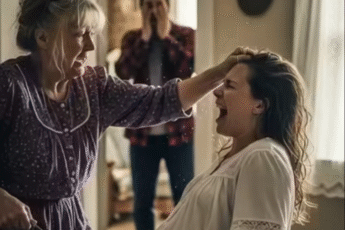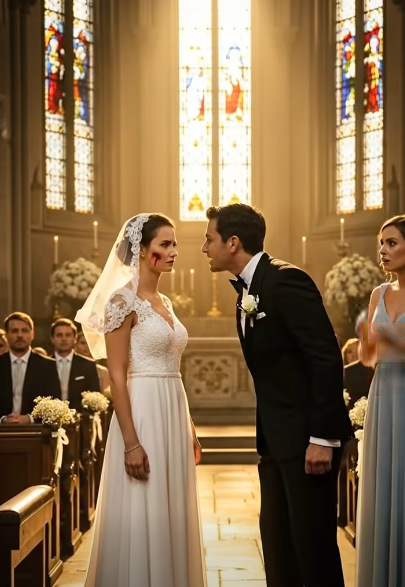
The champagne flutes trembled on their silver trays. Two hundred pairs of eyes burned into my skin. My left cheek throbbed with a heat that seemed to radiate through my entire body like ripples in poisoned water. The string quartet had stopped mid-note, their bows frozen. My wedding veil hung crooked, knocked askew by the force of his hand. I could taste copper in my mouth.
And there he stood, my husband of exactly forty-seven minutes, the man I had loved for three years, the man whose child I carried—though no one knew yet, not even him. His hand was still raised slightly, fingers curled. His sister stood behind him, her red lips curved into the smallest smile, her eyes glittering with triumph. What had she whispered to him? What words could shatter a man’s love so completely that he would strike his bride in front of everyone they knew?
The silence stretched, taut as a wire. Everyone leaned forward, waiting for me to cry, to run, to crumble.
But I didn’t cry. I smiled. And what I said next, in a crystal-clear voice that carried across the stunned garden, would destroy him in ways he couldn’t possibly imagine.
I met Julian Clark on the worst day of my life. My mother had just passed. Pancreatic cancer, swift and merciless. I was twenty-six, standing in the funeral home parking lot, trying to remember how to breathe. I couldn’t go back inside, couldn’t listen to one more person tell me she was in a better place. Time doesn’t heal; it just teaches you to walk around with the wound.
“You look like you need this more than I do.”
I looked up. A man stood there, tall and lean, with dark hair that fell across his forehead. His eyes were an unusual shade of gray-green, like sea glass. He was holding out a silver flask.
“I don’t drink with strangers,” I said.
“Good policy. I’m Julian.” He took a sip himself, then offered it again. “Now we’re not strangers.”
I took it. The whiskey burned, a cleaner pain than grief. We stood there for a long time, passing the flask, not talking, just existing in our separate griefs together. That’s how he slipped into my life, into the raw, open space my mother’s passing had left behind.
Julian was a real estate developer, successful, ambitious, with the confidence that comes from never having been truly broken. His family had old money, the kind that whispers rather than shouts. He courted me the old-fashioned way: flowers delivered to my office where I was a junior accountant, dinners at restaurants I couldn’t afford, weekend trips to Vermont.
“You’re different,” he told me once, his breath warm against my neck. “Everyone else just wants something from me. You just want me.”
I believed him. God help me, I believed every word.
He introduced me to his sister, Veronica, after six months. She was three years younger than Julian, with the same sharp cheekbones and calculating eyes, but where his gaze held warmth, hers was ice. We met for brunch. She arrived twenty minutes late, wearing a white dress that probably cost more than my monthly rent. She kissed Julian, then extended a limp hand to me.
“So, you’re the accountant?” she said, not nice to meet you, just a statement of my profession delivered with the faintest curl of her lip.
“That’s right,” I said, keeping my voice steady.
“How quaint,” she murmured, picking up her menu. “Julian always did have a thing for strays.”
“Veronica,” Julian said, his voice holding a warning.
That should have been my first clue. But I was so desperate to be loved, so eager to fill the void, that I ignored it. I told myself I could win her over. I was wrong about so many things.
Julian proposed on the anniversary of my mother’s passing. He took me back to the funeral home parking lot, the exact spot where we’d met. The whole area was transformed with string lights and rose petals. A violinist stood nearby, playing something soft and haunting. He knelt on one knee, holding a ring that caught the fading sunlight like a captured star.
“You’ve made me believe in second chances,” he said, his voice cracking. “Marry me.”
How could I not say yes? We set the date for June, eighteen months away. Veronica insisted on being my maid of honor. “We’re going to be sisters,” she said, squeezing my hand with surprising firmness. But at every dress fitting, every cake tasting, I caught her watching me with those cold eyes. Sometimes, she’d lean over to whisper something to Julian, and his expression would darken for a moment before smoothing back into a smile.
Three months before the wedding, I found out I was pregnant. Two pink lines. Unmistakable. The timing was terrible; we’d agreed to wait. But here it was, life refusing to follow our carefully laid plans. I decided to tell him that night. I bought a little onesie that said Worth the Wait and wrapped it in tissue paper.
I arrived at his apartment early, using the key he’d given me. The lights were off, but I heard voices from the bedroom: Julian’s and Veronica’s. I crept closer. The door was cracked open.
“You have to tell her before the wedding,” Veronica was saying. “It’s not fair to let her walk into this blind.”
“I can’t,” Julian said, his voice thick with guilt. “If she finds out, she’ll leave.”
“Then maybe she should leave. This is a disaster waiting to happen.”
“I love her.”
“Do you? Or do you love the idea of her? The sweet, broken little orphan who worships the ground you walk on.” Veronica’s voice was acid. “I’ve done the research, Julian. Her financial history is a mess. Credit card debt, student loans, a bankruptcy from when she was twenty-two. She saw dollar signs and a way out of her pathetic little life, and she latched on. Just like—”
“Don’t,” Julian’s voice cracked like a whip. “Don’t compare her to Mom.”
There was a long silence. Then Veronica’s voice, softer now, more dangerous. “I’m just trying to protect you. You know what happened to Dad after Mom died, how that woman swooped in and walked away with half his fortune. I won’t let the same thing happen to you.”
My hand was pressed against my mouth, holding back a sob. I’d had financial troubles, yes. But I’d never seen Julian as a meal ticket. Had I? The doubt crept in like poison gas. I backed away silently, left the apartment. The onesie stayed in my purse.
I told myself I was being paranoid, but the words echoed in my head for weeks. He’s using you. Just like Mom. The wedding preparations became a frenzied blur. My morning sickness worsened, but I hid it. Julian seemed distracted, working late, taking calls in other rooms.
“Are you happy?” I asked him one night, a week before the wedding.
He was quiet for a long time. Too long. “I love you,” he finally said, which wasn’t the same as yes. I wanted to push, but I was afraid of what I might hear.
Veronica threw me a bridal shower that felt more like an interrogation. His aunts asked pointed questions about my background and my career. Someone mentioned I’d be signing a prenuptial agreement. When I said we hadn’t discussed one, the room went silent.
That night, I asked Julian about it. He looked uncomfortable. “My lawyer mentioned it, but I told him no. I don’t want to start our marriage assuming it’ll fail.” Then, softer, “I trust you.”
But did he really? The doubt was a living thing now, coiled in my stomach alongside our growing child.
The morning of the wedding was chaos. My dress, an ivory silk gown, hung on the back of the door like a ghost. I’d woken up nauseous, but today it was worse. Nerves, one of the bridesmaids said sympathetically. Not nerves. Our baby.
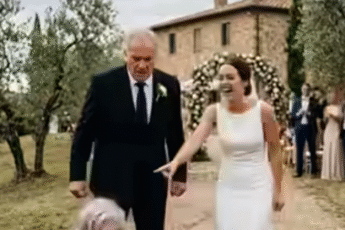
The ceremony was at three o’clock in the gardens of Julian’s family estate. Two hundred guests, an eight-piece orchestra, flowers flown in from Ecuador. It was everything I’d dreamed of and nothing I’d wanted.
Julian stood at the altar, looking like every dream I’d ever had. We exchanged vows, exchanged rings. He lifted my veil. “You may now kiss the bride.” He kissed me, and the guests applauded. I tasted salt. I didn’t know if it was from his tears or mine.
We moved to the garden reception. Cocktail hour. Golden light. Julian and I stood near the fountain, accepting congratulations. His hand was on the small of my back, warm and possessive.
“Excuse me for a moment,” he said, kissing my temple. “I need to speak with my father.”
He stepped away. I was immediately surrounded by his business associates, but I watched Julian out of the corner of my eye. He was talking with his father when Veronica appeared. She touched Julian’s elbow, drawing him aside toward a cluster of rose bushes. I couldn’t hear what she was saying, but I saw her pull a folded piece of paper from her purse and hand it to him.
He opened it, read it, and I watched his face change. It was like watching ice form over water. Everything in him went cold and hard. His jaw clenched. He looked up, his eyes finding mine across the garden, and there was nothing in them I recognized.
He started walking toward me. The crowd parted instinctively. My heart was pounding.
“Julian?” my voice came out small.
He stopped in front of me, close enough that I could smell the champagne on his breath. “Is it true?” His voice was low, dangerous.
“Is what true? I don’t—”
And then his hand moved. Fast. Brutal. The crack of his palm against my cheek echoed across the garden like a gunshot. Pain exploded through my face. I stumbled sideways, my veil slipping. The entire reception went silent.
I touched my burning cheek, tasted blood, and looked up at him. My husband of less than an hour.
“How could you?” His voice broke. “How could you do this to me?”
I didn’t know what he was talking about. Veronica stood behind him, her hand over her mouth, her eyes wide with something that looked almost like satisfaction. And then I understood. Whatever was on that paper, it was a lie. She’d been orchestrating this from the beginning.
The rage that swept through me was cleaner than anything I’d ever felt. It burned away the pain, the confusion, the hurt. It left only clarity.
I straightened, lifted my chin, and looked my husband dead in the eyes. “Ask me what you think I did,” I said, my voice steady as stone. “Say it out loud. In front of everyone.”
Julian’s face twisted. “You know what you did. The money. The offshore accounts. You’ve been stealing from my company for the past year. Veronica showed me the evidence. Bank statements, wire transfers, all traced back to you. You’ve embezzled nearly half a million dollars.”
The accusation was so absurd, so obviously fabricated, that I almost laughed. “Show me,” I said. “Let everyone see this ‘evidence’.”
Julian hesitated, then pulled the crumpled paper from his pocket. It was a printout of bank statements, account numbers, transaction records. My name was highlighted. The forgery was good, professional.
“These are fake,” I said calmly.
“Don’t lie to me anymore,” he seethed. “My lawyer verified everything. The account exists. Your signature is on the transfer authorizations.”
“Then your lawyer is incompetent or in on it.” I turned to face the crowd. “I have never stolen a single dollar from my husband. I have never opened an offshore account. This is a fabrication.” I turned back to Julian. “And I can prove it.”
I walked to the nearest table, pulled out my phone, and opened a folder I’d been building for months—just in case. “Because I’m an accountant, and I’ve spent the last six months reviewing every single financial document in Julian’s company, preparing to merge our finances. I know every account, every transaction.” I held up my phone. “These are the real financial records. And you know what I found? Interesting patterns. Payments to shell companies. Invoices for work that was never done.”
Julian’s face had gone pale. “What are you talking about?”
“I’m talking about real embezzlement. Someone has been stealing from your company for years. And I know who.” I looked directly at Veronica. “It’s you.”
Veronica laughed. “That’s insane. Why would I steal from my own family?”
“Because your father cut you off two years ago, after you blew through your trust fund gambling,” I said, pulling up a spreadsheet. “Because you have debts that would bury you. Because you knew exactly how to access the company accounts without getting caught—until I started looking. Until I noticed that every shell company you created traces back to a single law firm: your secret boyfriend’s law firm.”
Her face went white. “You’re lying.”
“Am I? Want me to show everyone how you’ve stolen over three million dollars in the past five years?” The crowd gasped. Julian staggered backward. “That’s impossible,” he whispered. “Veronica would never…”
“She would,” I said. “And she’s been terrified I’d discover it. That’s why she’s been poisoning you against me. That’s why she fabricated this evidence tonight. She was hoping you’d divorce me immediately, before I could finish my audit and expose her.”
Veronica’s face went smooth and cold as glass. “You stupid little thing,” she said softly. “You think you’ve won?”
“I think the truth is going to come out.”
“The truth?” she laughed, a sound like breaking glass. “The truth is that Julian never loved you. I made sure of that. Deep down, he never trusted you.” She turned to her brother. “Tell her. Tell her about the private investigator you hired to dig into her past.”
Julian’s face confirmed it. He’d actually hired someone to investigate me. Something inside me finally, irrevocably broke.
“You didn’t trust me,” I said, the words coming out hollow. “Not ever.”
“I wanted to. I tried.”
“You hit me. In front of two hundred people. You believed her over me.”
Shame finally crossed his features, but it was too late. I took a deep breath. “I want you to know something,” I said, my voice carrying across the silent garden. “I’m pregnant. Eight weeks. I didn’t tell you because I overheard you and Veronica discussing how I was just using you for your money.” I pulled the small wrapped package from my purse, the onesie I’d been carrying for months, and threw it at his feet. “Congratulations. You’re going to be a father with a woman you don’t trust, who you physically assaulted on what was supposed to be the happiest day of our lives.”
The gasps from the crowd were audible now. Julian’s face had gone gray. “You’re… you’re pregnant?”
“I was going to tell you tonight,” I said, my voice cold. “But now, I’m going to walk away. I’m going to divorce you before the ink on our marriage certificate is dry. And I’m going to make sure everyone knows exactly what kind of man you are.” I turned to the crowd. “Thank you all for coming. I’m sorry you had to witness this, but I’m glad you did, because now you’ll all know the truth about the Clark family.”
I started walking. Behind me, I heard Julian call my name, but I didn’t turn around. I just kept walking out of the garden, my wedding dress dragging through the grass, my head held high. Behind me, chaos erupted. I didn’t care. I was done. Finished. Free.
The story went viral. By morning, I was famous: The Slapped Bride. The news picked it up. Social media exploded. Julian tried to call, to email, to show up at my apartment. I blocked him, deleted the messages, and called the police.
His lawyer sent divorce papers. I signed them gladly and hired my own lawyer—a shark who smelled blood in the water. We went after everything. And we went after Veronica.
The audit I’d started proved it all. The police got involved. Federal investigators. It was bigger than anyone realized—over five million dollars stolen. She and her boyfriend were arrested. Julian’s company nearly collapsed. His father had a stress-induced heart attack. The family name was destroyed. I felt nothing watching it burn.
I moved to San Diego, where no one knew my face. I had the baby, a girl. I named her Grace, after my mother.
Julian tried to establish visitation. My lawyer fought him. The video of the slap was shown in family court. The judge’s expression was carved from ice. He was granted supervised visitation only, pending anger management courses, and was ordered to pay substantial child support.
I built a new life. I started my own accounting firm specializing in forensic audits, helping women escape relationships built on economic control. Grace grew. She learned to smile, to laugh, to crawl. She filled the apartment with noise and love.
Years passed. Veronica was sentenced to fifteen years in federal prison. She passed away from lung cancer two years into her sentence. Before she did, she set up a two-million-dollar trust fund for Grace. The attached note read: So she’ll never have to marry for security. So she can be what I never was. Free.
Julian eventually remarried, a quiet woman, a therapist who understood his damage. They had a son.
When Grace was thirteen, I showed her the video. She watched the moment her father struck me, the moment I stood tall, the moment I walked away.
“Were you scared?” she asked.
“Terrified. But I did it anyway.”
“Why?”
I took her hand. “Because staying would have taught you the wrong lesson. It would have taught you that love means accepting cruelty, that marriage means silence. I wanted you to grow up knowing that you’re worth more than that. That we’re both worth more.”
She leaned her head on my shoulder. “I’m glad you walked away.”
“Me too, baby. Me too.”
People still recognize me sometimes. The Slapped Bride is a cautionary tale, a revenge fantasy, a symbol. I know what it really was: the end of one story and the beginning of another. The first story was about a girl who thought love could save her. The second is about a woman who knows better, who understands that you can’t love someone into wholeness, and that walking away is sometimes the bravest thing you can do. My husband struck me in the middle of our wedding. And what I did next—standing tall, speaking truth, walking away, rebuilding, thriving—didn’t just ruin him. It saved me. And in the end, that was always the more important story.