My wife confessed her darkest secret in Japanese, not knowing I was fluent. I’d been married to Aiki for three years when she finally got pregnant. We were so excited that she broke ten years of no contact with her mother.
“Konnichiwa,” her mom exclaimed when they arrived.
“Hey,” I responded, smiling benignly.
The thing is, I spoke fluent Japanese. But I’d always been too embarrassed by my past obsession with anime and manga, so I pretended I didn’t understand. Her white American dad, Robert, was already setting up a crib he’d brought over. I went to help him, and that’s when I heard it. From the kitchen, Aiki and her mom were speaking in rapid Japanese.
“Matt no?” her mother asked. “What will you do when he finds out it’s Matt’s baby?”
My hand froze on the screwdriver.
Aiki laughed. “Kare wa baka dakara. He doesn’t know. He’s an idiot.”
“You okay there?” Robert noticed I’d stopped working.
I let my voice crack. “Just… emotional, you know? Thinking about becoming a dad.” I made sure to project my voice toward the kitchen. “I’ve dreamed about this my whole life.”
From the kitchen, they exploded into Japanese laughter.
“Kawaisou! Poor thing!”
“Yume wo miteru. He’s dreaming.”
I smirked to myself. I’d seen dozens of these stories online, and I knew the only way out was to let her dig her own grave. The more emotional I appeared, the more ammunition they’d give me to destroy them.
Over the next few days, I played my part perfectly. I “accidentally” left my laptop open to baby name websites. I made sure they saw me reading parenting books at the kitchen table. My performance was flawless.
That weekend, we were watching an anime on the couch, and a character made an irresistible pun in Japanese. I couldn’t help it. I laughed out loud, a split second before the subtitle even appeared on the screen.
Aiki’s head snapped toward me. “Why did you laugh?” Her voice was sharp, suspicious.
I kept my eyes on the screen, feigning innocence. “Oh, the physical comedy is funny. The way he fell.”
“Sore wa…” her mother muttered from the armchair. “That was strange.”
“Un…” Aiki agreed quietly. “Yeah.”
A few nights later at dinner, I decided to twist the knife a little. Robert was carving a roast while the women set the table.
“You know,” I said casually, reaching for the potatoes, “I was thinking about downloading Duolingo for Japanese. It would be nice to understand what you and your mom talk about.”
Aiki’s fork clattered onto her plate. “No!” She cleared her throat, forcing a smile. “I mean… it’s so hard. You’ll never learn it. Why waste your time?”
The real game began when I got my promotion.
“Honey!” I burst through the door one evening, knowing her mom was visiting. “My boss pulled me aside today. He said with the baby coming…” I paused dramatically. “I’m getting a fifteen-thousand-dollar bonus!”
Aiki hugged me, her joy seeming genuine. “Oh, baby, that’s wonderful!”
But the second I went to check on dinner, I heard the rapid-fire Japanese.
“Juu-go-man doru! Fifteen thousand!”
“Motto hikidaseru. We can extract more.”
That night, I pushed further. “I’ve been thinking… maybe I should get a second job. I want our baby to have everything.”
Aiki’s eyes lit up. “Really?”
“I could do Uber after work,” I mused. “Maybe sell my gaming collection. Whatever it takes.”
She quit her job the next afternoon. She didn’t just quit; she sent a bridge-burning email calling her boss a sexist, her coworkers incompetent, and the company a toxic hellhole. She showed it to me proudly, like she’d done something brave.
“Are you sure that was wise?” I asked carefully.
“Who cares?” she chirped. “I have you.”
But here’s what she didn’t know. I’d already found Matt. My private investigator had tracked him down, and he was very interested to know about the baby he thought he’d paid five thousand dollars to avoid.
The family gathering was my masterpiece. I suggested hosting Aiki’s extended family for a pregnancy celebration, knowing the wine would loosen their lips.
“Tell them about Matt,” her mother urged in Japanese after her third glass. “They’ll think it’s funny.”
I busied myself with food, my phone recording from my pocket as Aiki giggled with her cousins about how she was taking me for a ride. Some laughed. Others looked horrified. Her aunt tried to shush her, but Aiki was on a roll.
“Mata nishin shitara, mata onaji koto suru. If I get pregnant again, I’ll do the same thing.”
That’s when I made my move. I walked in with a tray of appetizers, smiling blankly. “What are you all laughing about? I wish I could understand.”
The guilty silence was deafening. Several cousins couldn’t meet my eyes.
“Just girl talk,” Aiki slurred, even though we’d agreed she wouldn’t drink.
“About babies?” I asked innocently. “I love baby talk. Even if I can’t understand the language, I can feel the joy.”
That evening, I scheduled a “work trip” for the following week, making sure Aiki knew I’d be gone for three days. What she didn’t know was that I’d be in town, working with my lawyer and the PI. Or that the new “security system” I’d surprised her with had audio recording capabilities in every room.
As I kissed her goodbye, she was already on the phone with her mother, planning a visit from Jason—a new boyfriend she had lined up.
The next morning, I sat in my car outside a coffee shop, phone connected to my laptop, transferring the audio files. My hands shook as I listened again to Aiki’s voice saying she’d do it all over again. This wasn’t just evidence; it was proof of who she was. Someone who saw me as a resource to exploit, not a person to respect.
I met with my lawyer, Maria Whitaker, that afternoon. Her office was in a strip mall, unglamorous and efficient, just like her. She was maybe fifty, with short gray hair and an air of no-nonsense competence.
I played her selected clips of the Japanese conversations, pausing to provide my translation. She took notes in quick, efficient handwriting. When I got to the part where Aiki’s aunt tried to shush her, Maria looked up. “Did any other family members seem uncomfortable?”
“A few of the cousins wouldn’t meet my eyes afterward,” I told her. She made a note with a star next to it.
Maria explained that while the recordings might not be admissible in court, they were incredibly valuable for building a full picture and identifying potential witnesses. “We’ll use these as a roadmap,” she said, “to find legal evidence—texts, financial records, witness statements—rather than relying solely on surveillance.”
I understood, though part of me wanted to just play the recordings in court and watch Aiki’s face as everyone heard the truth.
That evening, I maintained my act with Aiki. She was scrolling through baby furniture websites, asking my opinion on cribs that all looked the same to me. Every word she said felt like it was happening in a different reality. The disconnect made my head hurt, but I kept my face neutral.
The next day, I met with Wallace Greco, a family law attorney Maria recommended. He reviewed my documentation methodically. He warned me, too, that the recordings could even work against me if a judge viewed them as vindictive.
He outlined a plan: legal separation, followed by a paternity challenge immediately after the baby was born. “The most important thing,” he stressed, “is that you do not sign any birth certificate or acknowledgement of paternity at the hospital.”
I asked about protecting my finances. He advised opening a separate bank account immediately. “As her spouse, before any filing, you have the legal right to transfer half of your joint savings into your own account. Do it now, before she can drain them.”
I opened the new account that afternoon and transferred exactly half of our savings—just over eleven thousand dollars. It was a grimly satisfying, concrete step. I also started a spreadsheet, logging every dollar she spent, building a clear picture of her financial dependence.
That evening, I was in the kitchen when I heard Aiki on the phone, speaking in rapid Japanese to her mother. I moved closer to the doorway, pretending to check the pantry, and caught her saying something about moving money into her mother’s account, “just in case.” My stomach dropped. She was already thinking about hiding assets.
I waited until past midnight, then opened my laptop in the home office. I logged into our router’s admin panel. The connection logs showed weeks of activity. And there it was: video calls happening between 11:00 p.m. and midnight, always after I’d gone to bed. The destination IP address was consistent. I took screenshots and emailed them to Maria, asking her to trace it.
Her response came the next afternoon. The IP belonged to an apartment complex on the west side. She’d already pulled the resident directory. Jason Martinez, age twenty-eight, unit 3B. Sales job, no criminal record, single. The absurdity of it—Aiki pregnant with Matt’s baby, married to me, and setting up her next relationship with Jason—would have been funny if it wasn’t destroying my life.
I started seeing a therapist, D’vorah, who specialized in betrayal trauma. In our first session, she asked me what I hoped to achieve with all this evidence gathering. I told her I wanted to expose Aiki in front of her entire family.
D’vorah nodded slowly. “And will that serve your healing, or just your anger?”
The question hit me harder than I expected. I didn’t have a good answer.
Over the next week, I started quietly removing my personal history from the house. I rented a storage unit and moved my parents’ photo albums, my grandparents’ furniture—small, irreplaceable things. I photographed everything, creating a digital inventory. Aiki noticed the missing wedding photo of my parents from the living room shelf.
“Where’d it go?” she asked casually.
“Took it to get the frame repaired,” I lied smoothly. “The corner was loose.” She accepted it without question.
That Saturday, I observed Maria’s meeting with Matt from a distance at a coffee shop. He was a tall guy in his early thirties who looked increasingly nervous as Maria spoke. I could see his whole posture change when she must have mentioned Aiki’s name. He leaned forward, running his hands through his hair, his leg bouncing under the table. He admitted everything: the affair, the five-thousand-dollar payment. He’d assumed Aiki would either terminate the pregnancy or pass the baby off as mine. He seemed genuinely shocked to learn the truth.
Two days before my fake work trip, I installed the security system while Aiki was at a doctor’s appointment. I mounted small cameras in the living room, kitchen, and hallway, each with hidden audio. When she got home, I showed her the new system with what I hoped looked like excited pride. “With the baby coming,” I said, “I want to make sure our home is secure, especially when I have to travel for work.”
She smiled and hugged me, saying it made her feel safer. She had no idea she’d just approved her own surveillance.
The morning of my fake departure, I kissed her goodbye. The kind of kiss that’s more habit than feeling. She told me to drive safely. I drove to a hotel on the other side of town, checked in, and set up my laptop to monitor the camera feeds.
Within three hours, I watched her call her mother. They spoke in rapid Japanese. Aiki said Jason was coming over tomorrow night, that everything was set up perfectly. Her mother expressed some caution, saying something felt off about my recent behavior. But Aiki laughed it off. She said I was too stupid to figure anything out, probably just stressed about becoming a father.
At seven o’clock the next evening, the doorbell camera showed Jason arriving with takeout and a bottle of wine. I watched Aiki open the door, and he kissed her right there in the doorway. Not a quick peck, but a real, lingering kiss. His hand went to her pregnant belly and rested there like he had every right to touch it.
They settled on the couch, their body language comfortable and familiar. They were playing house in my actual house. I had to close the laptop. The intimate domesticity of it was worse than I’d imagined.
Three nights before Aiki’s due date, I woke to her shaking my shoulder. Her face was tight with pain. “The contractions have started.”
I moved with focused energy, packing her hospital bag, timing the contractions, helping her breathe. At the hospital, I stayed by her side, a perfect, supportive husband. The medical staff moved around us with practiced efficiency. Around hour eight, Robert and Aiki’s mother arrived. The four of us settled into a vigil that must have looked completely normal.
The baby was born at 6:47 p.m., a healthy boy. The room filled with tears and congratulations. Robert was crying and taking photos. Aiki’s mother was cooing in Japanese. I stood slightly apart, watching this moment that should have been the happiest of my life but felt more like attending a funeral.
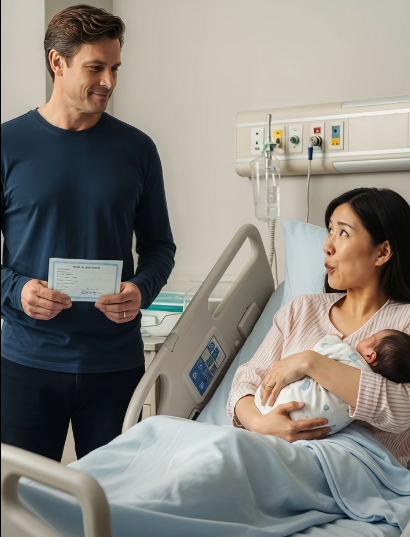
Thirty minutes later, a nurse came in with a clipboard. She smiled at me and started explaining the birth certificate paperwork, pointing to the lines where I would need to sign to be listed as the legal father.
I looked at the form, then at the nurse, and said quietly, “I’d like to arrange for paternity testing before I sign anything.”
The words dropped into the room like stones into still water. Aiki’s head snapped toward me, her exhausted face suddenly alert. Her mother started speaking rapidly in Japanese, asking what was happening, what I’d just said.
I turned to face her and responded in fluent Japanese, “I would like to establish paternity before accepting legal responsibility for the child.”
I watched the color drain from her face as she realized I’d understood every word for months. The room went completely silent. Aiki stared at me, her expression cycling through shock, then fear, then a cold calculation as her mind raced. Her mother gripped the bed rail like she might fall over. Robert looked between us with growing confusion.
The nurse, a true professional, recovered quickly and explained that the hospital could collect DNA samples. They offered expedited processing, results in twenty-four to forty-eight hours.
“I want the fastest option available,” I said. “I’ll pay whatever it costs.”
While the nurse handled the paperwork and collected the samples, I asked Robert to step into the hallway. I told him as gently as I could that there were questions about the baby’s paternity, that I had evidence of an affair, and that the biological father was likely a man named Matt. His face crumpled. He leaned against the wall like his legs wouldn’t hold him up anymore.
The results arrived by email two days later. The conclusion was in bold at the bottom: Based on the genetic analysis, the probability of paternity is 0.00%.
I forwarded the email to Wallace with a one-word message: File.
Two hours later, he confirmed the papers were filed and a process server was on the way to Aiki’s mother’s house.
Three days later, I met Aiki at a coffee shop. I sat across from her in a corner booth and, in a calm, measured voice, I told her everything. I told her I knew about Matt, Jason, the money, and the mockery. I told her I spoke fluent Japanese.
She tried to deny it, then minimize it, then blame her mother. Finally, she broke down, crying and apologizing, asking if we could work things out.
I listened until she had nothing left to say. Then I told her that the trust was completely destroyed. I explained that the legal process was moving forward and that she needed to contact Matt about his responsibilities as the biological father. I stood up, left money for both our coffees, and walked out.
Two months later, I was living in a modest apartment across town. The divorce was moving slowly through the courts. I was in therapy, working through the grief and the anger. Robert and I met for coffee every couple of weeks, two men processing betrayal together.
I wasn’t fine yet. But I was free. Free from the lies, the gaslighting, the mockery. I was building a life where I didn’t have to pretend, or hide, or play dumb. And that freedom was worth every bit of pain it took to get here.