The sound of my phone shattering against concrete still echoes in my nightmares. But what came before that moment, the silent accumulation of a thousand tiny cruelties, was infinitely worse.
My name is Rachel Morrison, and I am a single mother to the most beautiful six-year-old girl in the world. Her name is Emma, and she has these big, hazel eyes that sparkle with a light that can make the darkest days feel bright. She loves butterflies, strawberry ice cream with rainbow sprinkles, and drawing pictures of our little family—just the two of us, holding hands under a smiling sun.
Emma’s father, Daniel, died in a construction accident when she was only two. His death didn’t just break my heart; it pulverized it, leaving a void I never knew possible. We’d been high school sweethearts, married young, and he was my entire world. After he passed, I threw myself into being the best mother I could be. Emma became my reason to wake up, my motivation to keep going when grief threatened to swallow me whole.
My family never really understood my pain. My older sister, Jennifer, had always been the golden child. She married Bradley, a corporate lawyer who made six figures, and they lived in a McMansion in the suburbs. Their daughter, my niece, Olivia, was nine years old and had been spoiled rotten since the day she was born. My parents, Richard and Carol Thompson, worshiped the ground Jennifer walked on. In their eyes, everything she did was perfect.
Meanwhile, I was the disappointment. I’d married a construction worker instead of a professional. I lived in a modest two-bedroom apartment instead of a sprawling house. I worked as a pediatric nurse, a job I loved that paid the bills but didn’t impress anyone at family gatherings. My parents never said it outright, but I felt their judgment in every sideways glance, every backhanded compliment.
Still, they were family. Emma deserved to know her grandparents, her aunt, her cousin. So, despite the subtle digs and the obvious favoritism, I made an effort. I showed up to birthday parties, holiday dinners, and the occasional Sunday barbecue at my parents’ house.
That particular Sunday in late June started out deceptively normal. The sun was a warm hand on our shoulders, the sky a brilliant, cloudless blue. A gentle breeze rustled the leaves of the old oak tree in my parents’ backyard. They had invited us over for a cookout, and Emma had been excited all week. She’d even picked out a special outfit: her favorite purple dress with white flowers.
We arrived around noon, and the familiar scent of cut grass and sizzling burgers hung in the air. My father was manning the grill, beer in hand, while my mother fussed over the picnic table, arranging dishes just so. Jennifer was lounging in a deck chair, scrolling through her phone, while Bradley talked business with my father. And there was Olivia, riding her new, gleaming pink bicycle in circles around the large yard, showing off for anyone who would watch.
Emma ran straight to her cousin, her face alight with pure joy. “Olivia, your bike is so pretty!”
Olivia barely glanced at her, her expression one of bored superiority. “It’s a limited edition. My dad bought it for me because I got straight A’s this semester.”
I caught the smug look Jennifer shot in my direction over the top of her sunglasses. Her daughter was perfect, you see. Always had been, always would be. Emma was only in first grade, so report cards weren’t really a thing yet, but I knew the comparison was intentional.
The afternoon dragged on. I helped my mother in the kitchen, trying to tune out her running commentary. “You look so tired, Rachel… You really should make more of an effort with your appearance… It’s such a shame Emma doesn’t have a father figure in her life.” Each word was a tiny knife, a death by a thousand cuts.
Emma played quietly in the yard, trying desperately to get Olivia’s attention, but my niece was more interested in performing for the adults. She’d ride as fast as she could, then slam on the brakes, leaving skid marks in the grass. My father applauded each time as if she were competing in the Olympics.
Around 3:00, I went outside to check on Emma. She was sitting alone under the oak tree, drawing pictures in the dirt with a stick. My heart ached seeing her so isolated. Before I could say anything, Olivia came zooming past on her bike, nearly clipping Emma’s leg.
“Olivia, slow down!” I called out. “You almost hit Emma.”
My niece circled back around, an ugly scowl on her face. “She should move. This is my grandparents’ yard, and I can ride wherever I want.”
Jennifer looked up from her phone just long enough to say, “Rachel, don’t police my daughter. She’s fine.”
I bit my tongue until it throbbed. Starting a fight wouldn’t help anyone, especially not Emma. I went over to my daughter and sat down beside her. “Having fun, sweetheart?”
She shrugged, her little face trying so hard to be brave. “I guess Olivia doesn’t really want to play with me.”
“That’s okay,” I said, pulling her into a hug that felt more for me than for her. “How about after we eat, you and I go get ice cream? Just the two of us?”
Her face lit up. “Really? Can I get strawberry with rainbow sprinkles?”
“Absolutely.” We sat there for a while, talking about the butterflies fluttering around my mother’s flower garden. Emma loved pointing out the different colors, making up names for each one. The Sparkle Wing. The Sunset Dancer. The Yellow Princess. Her imagination was boundless, and these quiet moments with her were my entire world.
Dinner was called, and we gathered around the picnic table. The conversation flowed around me: Jennifer talking about Bradley’s latest promotion, my parents discussing their upcoming cruise, Olivia bragging about her role in a community theater production. Emma ate quietly beside me, occasionally tugging on my sleeve to show me a ladybug on her napkin or a cloud that looked like a bunny. I engaged with her fully, treasuring her wonder. She was such a sweet, gentle soul.
After dinner, the adults lingered while the kids were excused. Emma asked if she could look at the flowers up close, and I nodded, watching as she carefully approached the garden. She was so gentle with the plants, barely touching the petals, just observing their beauty.
Olivia, meanwhile, had returned to her bike. She was riding in increasingly erratic patterns, clearly showing off, but also growing more reckless. I saw her aim straight for Emma several times, swerving away at the last second with a little laugh. Each near miss made my heart jump into my throat, but Emma was too focused on the flowers to notice the danger.
My mother was telling a story when I heard the sickening thud.
I looked up just in time to see Emma crumpled on the ground, Olivia’s bike wheel inches from her small body. My daughter’s scream pierced the air—a sound of pure, unadulterated agony that will haunt me for the rest of my life.
I was up and running before my brain could fully process what had happened. Emma was on the ground, blood streaming from a gash on her forehead. Her left arm was bent at an unnatural angle, and she was sobbing, calling for me.
But I wasn’t the first one to reach her. My parents got there a split second before me, and for a foolish moment, I thought, Thank God, they’re going to help her.
Instead, they ran straight past my bleeding, crying daughter and rushed to Olivia.
“Are you hurt?” my mother cried, her hands frantically checking Olivia over. “Oh my god, sweetheart, are you okay?”
Olivia wasn’t crying. She wasn’t even scratched. She was standing next to her bike with a calculating look on her face, and I knew in that instant—she’d done it on purpose. My father was examining the bike, making sure it wasn’t damaged, while Emma continued to scream in pain behind them.
I dropped to my knees beside my daughter, my hands shaking as I tried to assess her injuries. The head wound was bleeding profusely, and her arm was definitely broken. She was going into shock, her little body trembling violently. “It’s okay, baby. Mommy’s here,” I said, my voice cracking. “You’re going to be okay.”
I pulled out my phone to call for an ambulance, but before I could dial, I heard my mother’s sharp voice. “This is your fault, Emma!” she shrieked. She actually left Olivia’s side to come and glare down at my injured daughter. “Are you blind? Can’t you see her?”
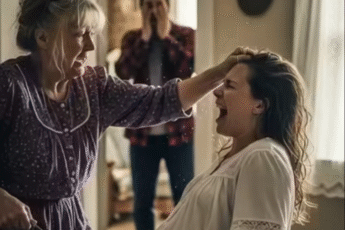
Then my mother did something I will never forgive. She slapped Emma across the face. My six-year-old daughter, who was already bleeding and crying with a broken arm, was struck by her own grandmother.
Emma’s sobs intensified into terrified wails, and I felt something fundamental break inside me. I stood up, putting myself between my mother and my child. “What is wrong with you?” I shouted, my voice raw with disbelief. “She’s hurt! Olivia hit her on purpose!”
Jennifer materialized beside our mother, her face twisted with rage. “How dare you accuse Olivia? Your brat got in the way!”
“She was standing still by the flowers!” I screamed back. “Olivia aimed right for her! I saw it!”
My father stepped forward, his face red with anger. “You’re being hysterical, Rachel. Accidents happen. Stop trying to blame Olivia for your daughter’s clumsiness.”
I couldn’t believe what I was hearing. Emma was on the ground, bleeding and broken, and they were defending the child who didn’t have a scratch on her. My hands were shaking as I tried again to dial for help. The amount of blood was terrifying me.
That’s when my father grabbed my phone right out of my hand.
“What are you doing?” I demanded, reaching for it.
He held it above his head, and then he did something that still doesn’t feel real. He threw my phone down onto the concrete patio as hard as he could. It exploded into pieces of glass and plastic.
“Let her be,” my father said, his voice cold and hard. “She just ruined my precious granddaughter’s ride.”
The world stopped. Those words hung in the air, poisonous and vile. Let her be. About Emma. About his own granddaughter.
Jennifer actually laughed. A short, sharp sound of amusement. “Finally, someone setting priorities right.”
I stared at these people—my family, my blood—and I saw them clearly for the first time. They weren’t just playing favorites. They genuinely did not care if Emma lived or passed away. She was less than nothing to them.
Bradley, who had been silent until now, wouldn’t even look at me. He just walked over to check on Olivia, who was milking the attention for all it was worth, pretending to sniffle. My mother put her arm around Olivia. “Let’s get you inside, sweetheart. You must be so shaken up.”
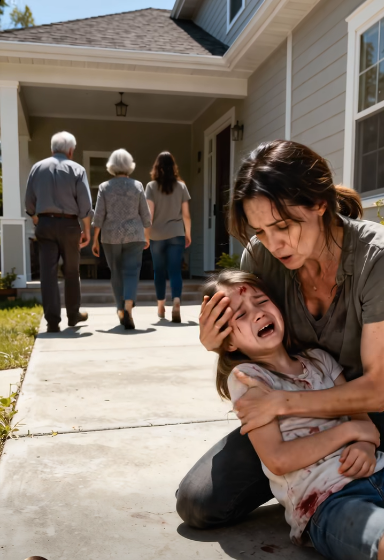
They all started walking away. All of them. Jennifer, Bradley, my parents, clustered around Olivia like she was the victim, heading toward the house. Emma was still on the ground, bleeding into the grass, and they were leaving us there.
“Please,” I called out, my voice breaking. “Please, someone help me get her to the hospital.”
My father didn’t even turn around. “Figure it out yourself. You always do.”
They went inside and closed the door.
I was alone in the backyard with my severely injured daughter. No phone, no car keys—they were in my purse inside the house. Emma’s crying had gotten weaker, which scared me more than the screaming had. I pulled off my cardigan and pressed it against the head wound, then carefully lifted her into my arms. She whimpered in pain, and I felt hot tears streaming down my own face.
“Stay with me, Emma,” I whispered. “Stay with Mommy. We’re going to get help.”
I carried her around to the front of the house. My car was blocked in by Jennifer’s SUV and my father’s truck. I couldn’t get to my keys anyway. The next-door neighbors, an elderly couple named Mr. and Mrs. Patterson, were outside watering their garden.
“Help!” I screamed, my voice raw. “Please, someone help us!”
Mrs. Patterson looked up, saw Emma covered in blood, and immediately dropped her hose. “Oh my heavens! Walter, call for help!”
They rushed over, Mr. Patterson already on his phone. Mrs. Patterson brought towels to help stop the bleeding while we waited. They kept asking what happened, and I couldn’t form coherent sentences. All I could do was hold Emma and pray.
The ambulance arrived within ten minutes, though it felt like a lifetime. The paramedics took over, carefully stabilizing Emma before loading her onto a stretcher. Mrs. Patterson insisted on driving me to the hospital so I could stay with my daughter. As we pulled away, I saw my family through the front window. They were all sitting in the living room, fawning over Olivia. They didn’t even look outside as the ambulance drove away with their other granddaughter inside.
At the hospital, Emma was rushed into surgery. The head wound required seventeen stitches. Her arm was broken in two places and needed pins. She’d suffered a severe concussion and had to be monitored for brain swelling. The doctor told me that if I’d waited even thirty minutes longer to get her help, the consequences could have been catastrophic.
They kept her for three days. I never left her side, sleeping in a chair next to her bed, holding her hand, singing to her when she woke up scared and confused. My family never called, never showed up, never even texted to ask if Emma was alive.
But Mrs. Patterson, this woman who barely knew us, visited every single day. She brought fresh clothes for me, coloring books for Emma, and enough homemade soup to feed us for a week. She was more of a grandmother to us in those three days than my own mother had been in years.
On the fourth day, we went home. Emma’s arm was in a bright pink cast covered in stickers. The silence from my family was deafening. A week after the incident, I finally received a text from Jennifer: Mom’s birthday dinner is next Saturday at 6:00. Don’t be late. That was it. No “How’s Emma?” Just an expectation that I would show up like nothing had happened. I didn’t respond.
Two days later, my mother called. I let it go to voicemail. “Rachel, I don’t know why you’re being so difficult,” her message began. “You need to let this go. Family is important.”
The irony was a physical pain. Emma’s recovery was slow. The physical wounds were healing, but the emotional scars ran deep. She had nightmares every night. She was terrified of bikes. She asked me repeatedly why Grandma had hit her, why no one had helped her, and I had no answers that made sense.
After six weeks, the cast came off. I started taking her to a child psychologist, Dr. Sarah Chen, who specialized in trauma. Dr. Chen was wonderful with Emma, but during one of our sessions, she asked to speak with me privately.
“Rachel,” she said gently but firmly, “What you’ve described—the deliberate injury, the refusal to help, the physical contact by your mother—this isn’t just family drama. This is abuse and neglect. You would be well within your rights to file charges. You need to protect Emma from further contact with these people.”
I knew she was right. That night, after Emma was asleep, I sat down and wrote everything out. I documented the text from Jennifer, the voicemail from my mother. Then I contacted a lawyer. Her name was Patricia Wynn, and she came highly recommended by Mrs. Patterson.
Patricia listened to my story, her expression growing increasingly grim. “Rachel,” she said when I finished, “this is one of the clearest cases of willful neglect and endangerment I’ve seen. Your father’s statement, combined with your mother’s actions and their collective refusal to render aid… this is criminal.”
“I don’t want revenge,” I said quietly. “I just want to protect Emma.”
“Sometimes, protecting your child and seeking justice are the same thing,” Patricia replied. “Do you want these people anywhere near your daughter ever again?”
“No. Absolutely not.”
“Then we need to establish legal boundaries. We’ll start with a restraining order.”
Patricia moved fast. We went before a judge who, after reviewing Emma’s medical records, granted the restraining order immediately. It prohibited my parents, Jennifer, Bradley, and Olivia from coming within five hundred feet of Emma or me.
The police opened an investigation. Within two weeks, the arrests began. My father was arrested at his office. My mother was served papers at home. Suddenly, it was real for them. There were consequences.
My phone, which had been silent for weeks, exploded.
From Jennifer: How could you do this to your own family?
From my mother: You vindictive, ungrateful child! After everything we’ve done for you!
From my father: This is ridiculous! I’m going to lose my job over this!
I blocked all of them. But they didn’t stop. Jennifer showed up at my apartment, screaming from the parking lot until she was arrested for violating the order. My mother sent relatives—flying monkeys—who called to tell me I was destroying the family over an “accident.” I blocked them, too.
Through it all, I focused on Emma. She was getting stronger. The nightmares were becoming less frequent. Mrs. Patterson had become her surrogate grandmother, the kind she deserved.
Six months after the incident, the criminal case went to court. The wheels of justice turned slowly, but they did turn. My father was charged with child endangerment and destruction of property. My mother faced charges for her actions against Emma. Jennifer was charged for violating the restraining order. Bradley even faced potential disbarment proceedings for failing to render aid.
Their high-powered attorney suggested a plea deal: they would plead guilty to reduced charges, pay restitution for Emma’s medical bills, complete anger management and parenting classes, and maintain zero contact. They’d serve probation instead of jail time.
“It’s your call,” Patricia told me.
I thought about Emma, about putting her through more trauma. “I just want it over,” I said. “I want them out of our lives.” They took the deal.
The plea hearing was scheduled for a Friday morning. I didn’t have to attend, but I wanted to. I needed to look them in the eye and show them I wasn’t broken.
I sat in the gallery with Patricia, watching as my family was led in. My father looked like he’d aged a decade. My mother was crying. Jennifer looked furious.
Before the judge could close the proceedings, my father asked to speak. He turned to me, tears in his eyes. “Rachel, I’m so sorry. I don’t know what I was thinking. Emma is my granddaughter, and I failed her. I failed you. Please, give us a chance to make this right.”
My mother was nodding frantically. “We’ll do anything! We love Emma! We’re begging you!” Even Jennifer spoke, her voice breaking. “I’m sorry, Rachel. I should have helped.”
They looked pathetic. These people who had held so much power over me for so long, on their knees, begging for mercy.
I stood up. Patricia tried to stop me, but I shook my head. I had things to say.
“You want mercy?” My voice was steady, cold. “Emma cried for mercy while she bled on your lawn. She begged for help while you all walked away. She is six years old, and you told her to be left alone because she inconvenienced your favorite grandchild.”
My mother sobbed harder. “We didn’t mean—”
“You absolutely meant it,” I cut her off. “You meant every word, every action. Do you know what Emma asked me last week? She asked if Grandma disliked her because she wasn’t good enough. My six-year-old daughter thinks she deserved to be hit and abandoned because she isn’t as good as Olivia.”
Jennifer was crying now, too. “Rachel, please—”
“You don’t get to say my name,” I said quietly. “You don’t get to cry and play the victim. You stood there and laughed. You said someone was finally setting priorities right. Well, I’m setting mine. My priority is Emma. My priority is protecting her from people who would hurt her.”
I turned to the judge. “Your honor, I want the restraining order made permanent. No future contact, no letters, nothing. They’re not family. Family doesn’t do what they did.”
The judge looked at my parents with clear distaste. “So ordered. The restraining order is made permanent. If any of you attempt to contact Ms. Morrison or her daughter, you will face immediate consequences.”
As I left the courtroom, I heard my mother wailing. I didn’t look back.
I drove home to our little apartment where Mrs. Patterson was helping Emma make paper butterflies. When Emma saw me, her face lit up. “Mommy, look! This one’s the Rainbow Queen!”
I scooped her into my arms and held her tight. She was my rainbow after the storm.
That night, for the first time in months, I felt something approaching peace. My family was gone, but we were free. Free from judgment, from favoritism, from people who would hurt us.
Months later, Emma and I were at the park. She was on the swings, laughing, completely healed. My phone buzzed with an email from Patricia. The court-ordered restitution had been paid in full. Every penny of Emma’s medical bills was covered. It wouldn’t fix what happened, but it was accountability.
I looked back at Emma, who was showing a new friend how to find four-leaf clovers. She was resilient. They hadn’t broken her spirit. They hadn’t dimmed her light. That was my victory.
We went for ice cream after the park, just like I’d promised her all those months ago. She got strawberry with rainbow sprinkles.
“Mommy,” Emma said thoughtfully, “Mrs. Patterson said she’s teaching me how to make my own ice cream next week.”
“That sounds amazing. What flavor are you going to make?”
“Butterfly flavor,” she declared confidently. “It’ll be all different colors mixed together, like butterfly wings.”
I laughed, a sound that was genuine and free. “That sounds perfect, baby girl.”
She smiled at me, that beautiful smile that made everything worthwhile. “I love you, Mommy.”
“I love you, too, Emma. More than all the butterflies in the world.”
We walked home hand in hand. Our little apartment had never looked more beautiful. Inside, we were safe. We were loved. We were enough. Just the two of us.
They had wanted mercy. They got justice instead. And Emma and I? We got freedom.