I rose early, before the first hint of dawn, and slipped from beneath the light blanket. I carefully tucked it around my sleeping husband, Ian, then leaned down to press a soft kiss to his unshaven cheek. In the kitchen, I started the coffee, my favorite ritual. I loved summer dawns. In the quiet twilight, I would step onto our small balcony, watch the city sleep below, and smile as I sipped the hot, dark brew. The air was still clean, unspoiled by the day’s exhaust fumes, and I would thank fate for my quiet, perfect life.
Ian loved me, I loved him, and soon, our first child would arrive. We were so excited. I was certain it would be a boy; he was convinced we’d have a daughter. We’d spend hours in bed, dreaming aloud. I wanted a son who would be an athlete—strong, healthy, and handsome. Ian pictured a daughter who would become a brilliant doctor, like his late mother.
“You know, when I was a kid, I wanted to be an archaeologist,” he’d chuckle, stroking my hair. “I was obsessed with dinosaurs. I even came up with a name for a new one I’d discover: the Ian-o-saurus.”
“Is that why you became a heavy equipment operator?” I’d laugh. “An excavator is a lot more efficient than a shovel.”
Remembering those sweet, silly conversations, I finished my coffee and went back inside to make breakfast. The smell of bacon and eggs soon filled our small apartment, and Ian appeared almost immediately, slumping onto a barstool with a frown.
“Did you wake up on the wrong side of the bed again?” I asked, not turning from the stove. “You’ve been so moody lately.” I placed a plate in front of him and sat opposite. He poked at the eggs with his fork, his gaze distant.
“Ava,” he began quietly, his eyes fixed on the window. “This is hard to say, but I can’t lie anymore. I’ve been hiding this for too long, and it’s eating me alive.”
A chill spread through me, a stark contrast to the humid kitchen air. “Hiding what, Ian? What have you been lying about?”
“A few months ago,” he said, his voice a low, steady murmur that felt like hammer blows on an anvil, “I realized I love someone else.”
The world seemed to narrow to the space between us, the air growing thick and hard to breathe.
“It just happened. I’m sorry. But you can’t blame a person for who they love, can you? First it was you, now it’s her.”
“Her?” I whispered, squeezing my eyes shut against the tears I knew would come. “Who is she?”
“She’s new at work. A supervisor. I think I mentioned her. We just… connected. She even broke off her engagement for me. And I promised her I’d be free, too.” He reached for my hand. I pulled it away. Not immediately, but I pulled it away.
“What about us?” I managed to choke out, the unshed tears a heavy weight on my chest. “What about our baby? Did you forget? We’re having a child, Ian.”
“It doesn’t matter if it’s a boy or a girl,” he interrupted, his voice hardening. “I remember everything. But you need to understand, I can’t torture myself like this. Or you. It wouldn’t be fair.”
“Fair?” I spat, the word dripping with a bitterness I didn’t know I possessed. “What about your mother? What about our friends who celebrated at our wedding? What will you tell our child when they grow up? Do you think they’ll ever forgive you for this?”
He was silent for a long time, rubbing his neck. The quiet was so absolute it felt like it might burst my eardrums. My summer morning had, in an instant, turned into a bleak, endless night.
“Look, things happen in life,” he finally said, trying to put his arm around me. I flinched away, jumping to my feet. I swung my hand and slapped him, the sharp crack echoing in the small kitchen.
“I will never be in your position,” I cried. “I am not you.”
I ran to the entryway, pulling on a jacket, shoving my feet into sandals. “Where are you going?” he called after me.
I didn’t answer. My hand was on the doorknob, and a desperate, foolish part of me prayed he would come, hold me, and whisper that it was all a terrible joke. I would have forgiven him. I would have forgotten instantly. But Ian was silent.
“I’m leaving,” I said loudly. “Goodbye.”
I waited another heartbeat.
“Your choice,” he finally replied.
I stepped over the threshold and closed the door on my life.
I spent the day at my friend Leah’s house. She was a whirlwind of chaos, juggling a perpetually grumpy husband and two wild children amidst a never-ending home renovation. I didn’t tell her what had happened. Her own life was a storm, and my hurricane felt like an intrusion. Leah, perceptive as always, noticed my haunted expression.
“What’s wrong, Ava? You look like you’ve seen a ghost.”
“Just tired,” I lied, sipping my long-cold tea. “Pregnancy, you know.”
“Oh, tell me about it,” she sighed. “But you’re lucky. Ian is a rock. Not like my lazy oaf.”
Lucky. The word was a punch to the gut. I quickly said my goodbyes and left, leaving her staring after me in confusion.
As dusk settled, I found myself on a massive concrete overpass that spanned a web of dark, silent train tracks. The city lights were just beginning to glitter in the distance. Leaning against the cool metal of the guardrail, I felt utterly alone, a comet drifting in the cold, empty space between stars, destined to burn out.
The thought, once it formed, was terrifying in its clarity. No one needs me. My parents were gone. My husband loved another. There wasn’t a single soul in this city who would even notice if I disappeared.
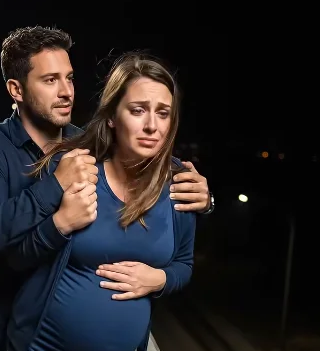
I took a deep breath, my hands gripping the rail. I swung a leg over, then the other, and stood on the narrow, terrifying ledge. The wind whipped my hair around my face. I placed a hand on my belly. “Forgive me,” I whispered to my unborn child, the words stolen by the wind. “There’s no other way.”
I closed my eyes, leaned forward, and was about to let go when a powerful grip seized my shoulders, pinning me against the railing. I cried out, twisting my head. A stranger, his eyes wide with alarm, was yelling something I couldn’t hear over the roaring in my ears.
“Who are you?” I asked, my tongue thick and numb.
“Looks like I’m your guardian angel,” the man panted, his grip unyielding as he pulled me back over the rail and onto the solid ground of the walkway. He sat me on the asphalt, then collapsed beside me, wiping sweat from his forehead. A bicycle leaning nearby crashed to the ground, the loud clatter snapping me back to reality.
“Were you really going to do it?” he asked, his voice gentle. “What about the baby?”
“How did you know?” I whispered, shame and confusion warring within me.
“I’m observant,” he said with a sad smile. “I saw you from a distance, holding your belly.” He paused. “Boyfriend trouble?”
“Husband,” I managed to say.
“Ah, husband,” he sighed, nodding with a profound, knowing sorrow. “That’s different. But still, it’s no reason to end a life. Especially not two.”
“What would you know about it?” I snapped.
The man’s smile never wavered, but it was now filled with such immense sadness that my own heart ached in response. “Unfortunately, I know a lot,” he said softly. “A little over a year ago, my wife died. She was pregnant, too. A car accident. One minute she was here, the next… gone.” He looked out over the tracks. “You think I didn’t want to do exactly what you were just about to do?”
“I’m so sorry,” I whispered, the words utterly inadequate. “What stopped you?”
“I don’t know,” he shrugged. “Something. Someone.” He looked at me. “Look, you can get through anything. You never forget, but you get through it.” A sudden gust of cold wind swept across the overpass, and the first heavy drops of rain began to fall. “Come on. There’s a good place nearby. Let’s get you out of this rain.”
He introduced himself as Elias. The “good place” was a small, quiet restaurant called The Dahlia Bistro. It was warm and inviting, a sanctuary from the storm outside. I had no money, so I ordered only a coffee, not wanting to impose. Elias, however, enthusiastically ordered for us both.
“Lisa, my dear,” he said to the waitress, “bring us ice cream, waffles, crepes, and two coffees. And please, be quick.”
“Right away, Mr. Hayes,” she replied with a familiar smile.
“They know you here,” I observed, a small laugh escaping me for the first time that day.
“You could say that,” he nodded, pulling off his cycling gloves. “To be more precise, I own the place. It was my wife, Dahlia’s, dream. She used to run everything. I just drove trucks. After she passed… I couldn’t bring myself to sell it. It’s all I have left of her.”
He spoke of her with a love so deep and enduring it was palpable. When the desserts arrived, he urged me to eat. “My mom always said sweets are the best medicine for sorrow.”
For the first time in what felt like a lifetime, I ate. And as I ate, Elias talked. He was no longer just a stranger, but a man with a kind, open face, a deep, rumbling laugh, and eyes that held both immense pain and a surprising amount of light. The awkward, burly cyclist had transformed into someone who felt… familiar. Safe.
When I prepared to leave, I found a crumpled twenty-dollar bill in my pocket—my last—and put it on the table. Elias followed me out into the pouring rain.
“Where are you going?” he asked.
I just shrugged. I had no idea. Going back to the apartment was impossible, and I couldn’t burden my few friends so late at night.
“I thought so,” Elias sighed, pulling out his phone. He disappeared back into the bistro and returned a moment later, pressing a set of keys into my hand. “These are for my late grandfather’s apartment. It’s empty, but it’s dry and safe. I called a taxi for you. The address is on this paper, along with my number. Call if you need anything.”
“Aren’t you afraid?” I asked, stunned by his trust. “I could be a thief.”
He laughed, a genuine, warm sound. “There’s nothing left to steal. And in the morning, I’ll come by to make sure you haven’t run off with the old furniture. Now go. Get some rest.”
A week later, I went back to the apartment to get my things. Ian, freshly shaven and looking refreshed, was ironing a suit. My presence barely seemed to register.
“Need any money?” he asked, his voice flat, after I’d packed my bag.
“I’ll manage,” I said coldly.
“Doing what?” he scoffed. “When was the last time you even worked?”
I didn’t answer. I just walked out the door, leaving him to his new life.
A year and a half passed in a blur of healing and rebirth. I had my daughter, whom I named Lily, after my own late mother. Elias and I fell in love, a slow, quiet love built on shared grief and a mutual desire to find light in the darkness. We married. He renamed the bistro Ava’s Place as a wedding gift. I started working there, not as a manager, but as a waitress. I wanted to stay connected to the work, to the people. I understood what it felt like to be on your feet all day, serving others with a smile, no matter what storms were raging inside.
One rainy Saturday evening, a worn-out sedan pulled up outside. A man and a woman rushed inside, shaking off the rain. The man looked up at the neon sign and smirked. “Ava’s Place,” he muttered to his companion. “Just like my ex’s name.”
They sat at a table by the window. I approached with my notepad, my heart a steady, calm drum in my chest. “Welcome to Ava’s. What can I get for you?”
He looked up. Ian. His jaw dropped, his face paling. The woman beside him, his new wife, looked annoyed.
“Hello, Ian,” I said with a small, polite smile, writing down their order.
“You… you work here?” he stammered, his face a mask of disbelief and condescending pity. “As a waitress? Life treating you well in the service industry?”
“Life is complicated,” I replied, my smile never wavering. “As you well know.”
“Who is that?” his wife whispered loudly as I walked away.
“My ex,” Ian mumbled, his bravado gone. “I never thought I’d see her here.”
Just then, the front door burst open and Elias rushed in, his face beaming, his eyes shining with a joy so pure it lit up the entire room.
“Ava!” he boomed, ignoring everyone else. “You won’t believe it! It happened! Lily just called me Dad! She looked right at me and said ‘Dad’!”
He swept me into a massive hug, lifting me off the floor and spinning me around. He kissed me deeply, right there in the middle of the restaurant.
“Isn’t that a miracle?” he asked, turning to the stunned room. He spotted Ian and his wife. “Friends!” he declared, shaking their hands vigorously. “Welcome! To celebrate this wonderful night, your dinner is on the house! Everything is on the house tonight, a celebration for my beautiful, beloved wife!”
He hugged me again, his love a warm, protective shield. I glanced over his shoulder at Ian. He was choking on a piece of potato, his face turning a blotchy red. He slammed a fist on his chest, then turned to stare out the window at the drizzling rain, a man utterly defeated.
“So that’s your ex,” his wife whispered, a new, sharp edge to her voice. “Some waitress.”
“I’m going for a smoke,” Ian gasped, stumbling up from the table and fleeing out the door into the night.
I watched him go, and I felt nothing. No anger, no desire for revenge. Just a quiet, profound sense of peace. My angel, the one I had met on a dark overpass, held me close. My life hadn’t ended that night. It had just begun.