The air inside The Gilded Fork always smelled of old money and fresh desperation, a cloying mixture of truffle oil, searing wagyu, and the unspoken anxiety of people trying too hard to matter. For three years, this restaurant had been the stage for my husband’s performances. He was the star, the benevolent provider, the man in the bespoke Italian suit. I was the prop.
Tonight, the performance felt heavier than usual. Perhaps it was the humidity of the city rain battering against the stained glass, or perhaps it was the thirty-four weeks of pregnancy swelling my ankles and pressing against my lower back.
“Table for two. Vancroft-Miller. The best you have,” Marcus barked at the maître d’, his voice a decibel too loud for the hushed atmosphere. He didn’t look at me. He never looked at me when an audience was present. He walked three steps ahead, his polished oxfords clicking rhythmically on the marble floor.
I waddled behind him. I hate that word—waddled—but it was the only accurate description. My maternity dress, a navy silk number that used to make me feel elegant, now felt like a sausage casing. I instinctively placed a hand on my belly, feeling the rhythmic hiccups of my unborn son.
When we reached the corner table—the one secluded by velvet ropes and moody lighting—Marcus didn’t pull out my chair. He sat down, adjusted his cufflinks, and snatched the leather-bound menu from my hand before I could even open it.
“You don’t need to look, Elena,” he said, flashing a teeth-whitened smile at the hovering waiter. “My wife is feeling… heavy today. She’ll have the garden salad. Dressing on the side. No croutons. And water. Tap is fine for her.”
I felt the heat rise in my cheeks, not from embarrassment, but from a low, simmering hunger. “Marcus,” I whispered, leaning in. “I’m actually craving protein. The doctor said the baby needs iron. I was looking at the Lobster Thermidor…”
He laughed. It wasn’t a joyful sound; it was a sharp, patronizing bark that made the couple at the next table glance over.
“The doctor said watch your weight, Elena,” he cut me off, his voice dropping to a hiss that was somehow louder than a shout. “Look at you. You’re waddling already. Do you want to be huge forever? Do you want me to lose interest completely?” He reached across the table and patted my hand, his grip unnecessarily tight. “Trust me, I’m doing you a favor. I’m the only one looking out for you.”
He turned back to the waiter, his charm toggling back on like a light switch. “I, however, will have the Ribeye, rare. And a bottle of your ’98 Cabernet. The expensive one.”
I looked down at the empty white tablecloth. For years, I had told myself this was love. That his control was care. That his financial stranglehold on our checking accounts was just “good business sense” because I was “too emotional” with money. I came from the Vancroft family—a lineage of steel magnates and silent power—but Marcus had spent our entire marriage convincing me that my family’s legacy was a fluke and that I was incompetent. He had built a golden cage, and I had walked right into it, handing him the key.
But tonight, as the waiter scurried away and Marcus began checking his reflection in the back of a spoon, something felt different. My baby kicked. It wasn’t a gentle flutter. It was a hard, sharp jab against my ribs. It felt like a protest. It felt like a wake-up call.
This is the last meal I will ever let you order for me, I thought, the realization ringing in my ears louder than the crystal glassware.
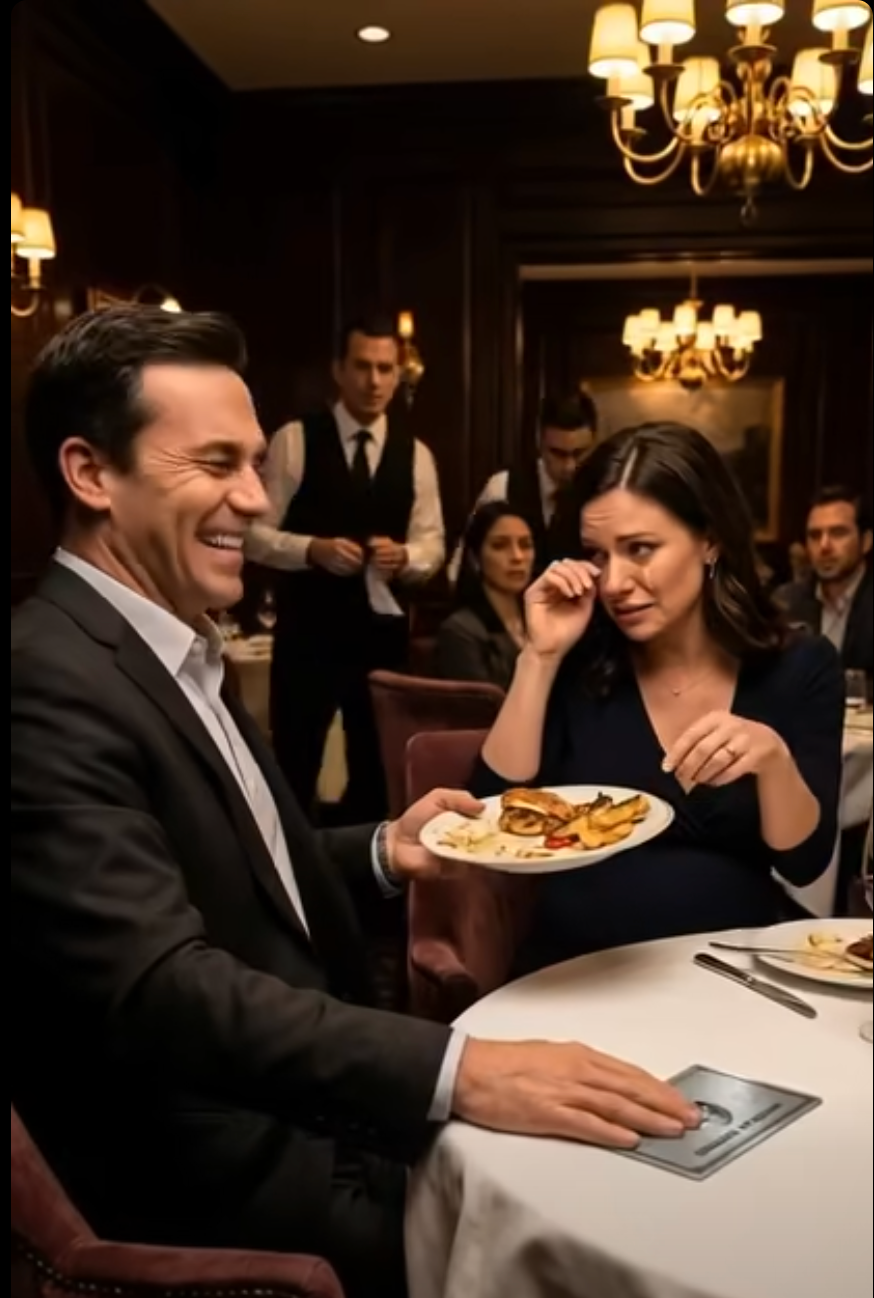
The waiter returned, balancing a tray. The smell of rosemary butter and searing meat hit me like a physical blow, making my mouth water uncontrollably. He placed the sizzling steak in front of Marcus. Then, with an apologetic wince, he placed a small, white bowl in front of me. It wasn’t salad. It was the complimentary bread basket scraps—the dry ends that usually get thrown away.
The silence at the table was deafening. I stared at the bowl. Three crusts. Dry, flaky, and insulting.
Marcus sliced into his steak, a river of red jus and melted butter running onto the ceramic plate. He chewed theatrically, moaning with pleasure, before noticing I hadn’t moved.
“YOU DON’T NEED THE LOBSTER; YOU’RE JUST GOING TO GET FATTER. HERE, EAT THE BREAD CRUSTS,” he sneered, pushing the bowl closer to my face.
The volume of his voice stopped conversations at three nearby tables. The waiter froze, holding the wine bottle mid-pour.
“Eat up,” Marcus muttered, seeing the tears welling in my eyes. “And stop crying. You’re making a scene. You’re lucky I take you out at all. God, you’re pathetic when you’re hormonal.”
My tears fell, heavy and hot, dropping onto the dry bread. I watched the droplet absorb into the stale crust. Discarded. Unwanted. Dry. Just like he made me feel.
But as that tear vanished, the sorrow vanished with it.
It was a physical sensation. My spine, which had been curved in submission for three years, suddenly straightened. The pain in my back disappeared, replaced by a rod of cold steel. My breathing slowed. The room seemed to sharpen in focus. I looked at Marcus—really looked at him—and I didn’t see a husband. I saw a small, insecure man wearing a costume of wealth he barely understood.
I picked up the linen napkin and wiped my face. One firm stroke. The tears were gone.
“You’re right, Marcus,” I said. My voice was different. It wasn’t the whisper of a wife; it was the tone of a Vancroft. “I shouldn’t make a scene over bread.”
I reached into my clutch. Marcus rolled his eyes, taking a swig of wine. “Don’t look for tissues. Just use the napkin.”
I didn’t pull out a tissue. My fingers brushed past the joint debit card he monitored like a hawk. I reached into the hidden zippered lining at the back of the bag, a compartment I hadn’t opened since our wedding day.
I pulled out a card. It wasn’t plastic. It was anodized titanium, black as a moonless night, heavy and cold. The Centurion Card. The “Black Card.” The kind you don’t apply for; you are invited to. The kind linked to the Vancroft Family Trust—a trust Marcus thought I had lost access to when I married him.
He was too busy chewing a chunk of fat to notice. But the waiter noticed. His eyes widened, his pupils dilating in sheer terror as he recognized the mythic object in my hand.
I raised two fingers. Not to my husband, but to the floor staff.
“Manager,” I said. The word cut through the restaurant’s clatter like a guillotine blade. “Now.”
Marcus finally looked up, a piece of steak hanging from his fork. “Elena, what the hell are you doing? Put that away before you embarrass me.” He didn’t see the card yet. He only saw my defiance. But the Manager, a man named Mr. Henderson who prided himself on knowing every net worth in the room, was already sprinting toward our table, sweat beading on his forehead.
Mr. Henderson arrived, straightening his tie, his eyes locked on the black titanium slab resting on the tablecloth next to the bread crusts.
“Is there a problem, Madame?” he asked, his voice trembling slightly.
“Yes,” I said, my voice steady, low, and terrifyingly calm. “I dislike the ownership of this establishment. I find the atmosphere… tolerant of trash.”
Marcus dropped his fork. It clattered loudly. “Elena! Stop bothering the man. Apologize immediately. She’s pregnant,” he said to Henderson, offering a conspiratorial, ‘men-of-the-world’ wink. “Hormones. She gets hysterical.”
I ignored Marcus entirely. I didn’t even blink. I kept my eyes fixed on Henderson. “I want to buy the restaurant. Tonight. Right now. Name your price, plus twenty percent for the inconvenience of the paperwork.”
Marcus let out a short, hacking laugh. “Buy the restaurant? With what? Your allowance? Henderson, bring her some butter for her crusts so she shuts up.”
Henderson didn’t move. He looked from Marcus, a man who tipped ten percent and complained about wine corkage, to me, Elena Vancroft, whose grandfather had built the steel skeletons of half the skyscrapers in this city.
“Madame,” Henderson stammered, “I… I would have to call the owner, Mr. Valenti.”
“Call him,” I commanded. “Tell him Elena Vancroft is making the offer. Tell him I want the deed transferred before dessert is served.”
At the mention of my maiden name—a name synonymous with industrial empires—Henderson paled. He nodded once, sharp and military. “Right away, Ms. Vancroft.”
He scurried away.
Marcus stared at me, his face twisting into a mask of confusion and irritation. He took another sip of wine, his arrogance fighting a losing battle against the reality unfolding before him. “Vancroft? You haven’t used that name in years. And what game is this? You don’t have that kind of money, Elena. Your daddy cut you off. You told me that.”
I picked up my water glass, watching the condensation slide down the side. “I told you I wanted to live a simple life with you, Marcus. I told you I didn’t want my money to define us. I never said I didn’t have it.”
He scoffed, cutting another piece of steak. “You’re delusional. When the bill comes for this little ‘joke,’ don’t expect me to pay it.”
I watched him eat. He was so sure of his power. He thought the world operated on his rules—that the loudest voice won, that the man holding the wallet held the leash. He had no idea that for three years, I hadn’t been submissive; I had been sleeping. And the beast was awake.
Cliffhanger:
The Manager returned after three minutes. He looked like he had seen a ghost. He held a tablet and a portable card reader. He bowed slightly to me. “Mr. Valenti accepts. He said… he said it’s an honor.” I tapped the Black Card on the reader. Beep. Transaction Approved. Marcus finished his last bite, wiped his mouth, and sneered. “Finally done playing pretend? Good. Let’s go.” I didn’t move. “I’m not going anywhere,” I said. “But you are.”
“Actually,” I said, the temperature in my voice dropping to absolute zero, forcing Marcus to finally look me in the eyes. “I didn’t just ‘want’ to buy it, Marcus. I have bought it. The transaction cleared two minutes ago.”
Marcus stared at me. He looked at the Manager, waiting for the punchline. “Henderson, tell my wife to stop this nonsense.”
Henderson took a step back, aligning himself with me. “I take my orders from the owner, sir. And Ms. Vancroft is the owner.”
The color drained from Marcus’s face. It started at his hairline and washed down to his neck, leaving him a pale, gaping fish. “You… you bought… this place? Now?”
“Yes. And my first act as owner is to curate the clientele.” I gestured to the empty bowl of bread crusts. “I find that we have a pest problem.”
I signaled to the shadows near the entrance. Two burly security guards, men who usually handled paparazzi, stepped into the light.
“Ban this man,” I said, my voice ringing clear across the silent dining room. “From the premises. Forever. If he returns, charge him with trespassing.”
Marcus stood up, his chair scraping violently against the floor. “This is a joke! Elena, stop this! I’m your husband! You can’t do this!”
“Get him out,” I said, picking up the wine list with a calm I didn’t know I possessed. “And Henderson? Bring me the Lobster Thermidor. The whole one. And a vintage sparkling water.”
The guards moved in. One grabbed Marcus by the elbow of his expensive suit. Marcus swatted him away. “Don’t touch me! Do you know who I am?”
“Yes,” I said, not looking up from the menu. “You’re the man who just ate his last meal on my dime.”
The guards seized him. Marcus began to struggle, his dignity disintegrating with every second. The other diners—the socialites, the bankers, the people he tried so hard to impress—were all watching. Some were whispering. One woman was openly smiling.
As Marcus was dragged toward the heavy oak doors, kicking and screaming, he managed to grab the doorframe. He looked back at me, his eyes wide with a frantic, desperate realization. “Elena! Who’s going to take care of you? You need me! You’re pregnant and useless without me!” I locked eyes with him one last time, raising my glass of water in a mock toast. “I never needed you, Marcus. I just felt sorry for you.” The security guards shoved him out into the pouring rain and slammed the door.
The silence that followed the slamming door was heavy, but it wasn’t awkward. It was the silence of a storm passing.
I sat alone at the best table in the house.
The waiter, the one who had served the crusts, approached the table. He was trembling. “Madame Owner… I… about the crusts. He ordered me to. He said…”
“I know,” I said softly. “It wasn’t your fault. You were doing your job. But things are going to be different now.”
“Yes, Madame.”
“Bring the lobster,” I repeated. “And bring a round of champagne for the kitchen staff. On me.”
He nodded, relieved, and practically ran to the kitchen.
Ten minutes later, a massive, steaming Lobster Thermidor was placed before me. It smelled of cream, brandy, and victory. I picked up my fork. I didn’t rush. I took a bite of the sweet, rich meat. It was the best thing I had ever tasted. It wasn’t just food; it was nourishment. It was self-care. It was the taste of a life reclaiming its own borders.
Outside, through the rain-streaked window, I could see a figure standing on the sidewalk. Marcus. He was frantically tapping on his phone.
I knew exactly what was happening. He was trying to call an Uber. He was trying to book a hotel. But the credit card linked to the joint account—the account I had funded with my “allowance” transfers, the account I had just frozen via my private banking app three minutes ago—was dead.
He was staring at his screen: Account Suspended by Primary Account Holder.
He froze. I saw his shoulders slump. The rain soaked his bespoke suit, ruining the wool. He looked up at the window, into the warm, golden glow of the restaurant. He saw me eating the lobster.
He wasn’t the provider. He never was. He was the beneficiary of my silence. And now, the silence was over.
I finished my meal, savoring every bite. Then, I pulled out my phone and dialed a number I had memorized but never called.
“Hello, Arthur?” I said to the family attorney who had served my father for forty years. “It’s Elena. Yes, I’m back. Prepare the divorce papers. Use the ‘Infidelity and Mental Cruelty’ clause. And Arthur? Change the locks on the penthouse tonight. Security will meet you there. He can sleep at his mother’s house.”
“Understood, Ms. Vancroft,” Arthur said, his voice warm with relief. “Welcome home.” I hung up. I placed my hand on my belly. The baby moved again, but this time, it felt like a settle, a calm roll. “Don’t worry, little one,” I whispered. “Daddy isn’t coming home. But we’re going to be just fine.”
Six Months Later
The Gilded Fork was gone. The sign above the door now read simply: Elena’s.
The heavy velvet curtains were gone, replaced by airy linen. The oppressive silence was replaced by the hum of genuine conversation and clinking glasses. The menu was simpler, focusing on honest, high-quality ingredients. No pretension. Just excellence.
I sat at the head table, the sunlight streaming in through the clean windows. On my lap sat Leo, four months old, with eyes as bright as polished steel and a laugh that sounded like bells.
I was sharing a massive seafood platter with three of my oldest friends—women Marcus had isolated me from, women who had rushed back to my side the moment the papers were served.
“The sourdough is incredible, El,” my friend Sarah said, tearing off a chunk of the warm, fresh bread. “You hired a new baker?”
“I did,” I smiled, bouncing Leo on my knee. “Best in the city.”
I happened to glance out the window. Across the street, a man was walking. He was thinner. His suit was ill-fitting, likely off the rack. He looked tired. It was Marcus.
He paused, looking across the street at the restaurant. He saw the full tables. He saw the laughter. He saw me—glowing, healthy, holding his son whom he had never met. He saw the abundance he had tried to starve out of me.
For a moment, our eyes met across the traffic. There was no anger in me anymore. Just a profound, distant pity. He looked away first, unable to bear the brightness of the life he had thrown away for the sake of his ego. He put his head down and walked on, disappearing into the gray crowd.
I looked down at Leo. He was reaching for the bread basket. I picked up a piece of the soft, warm inside of the loaf—the heart of the bread.
“Here you go, my love,” I whispered, pressing the soft bread into his tiny hand. “Only the best for you. We don’t eat scraps. We own the bakery.”
Leo cooed, shoving the bread into his mouth. I laughed, looking out at the horizon beyond the street. The world was vast, and for the first time in years, I had an appetite for all of it. The story of my silence had ended, but my reign had just begun.
If you want more stories like this, or if you’d like to share your thoughts about what you would have done in my situation, I’d love to hear from you. Your perspective helps these stories reach more people, so don’t be shy about commenting or sharing.