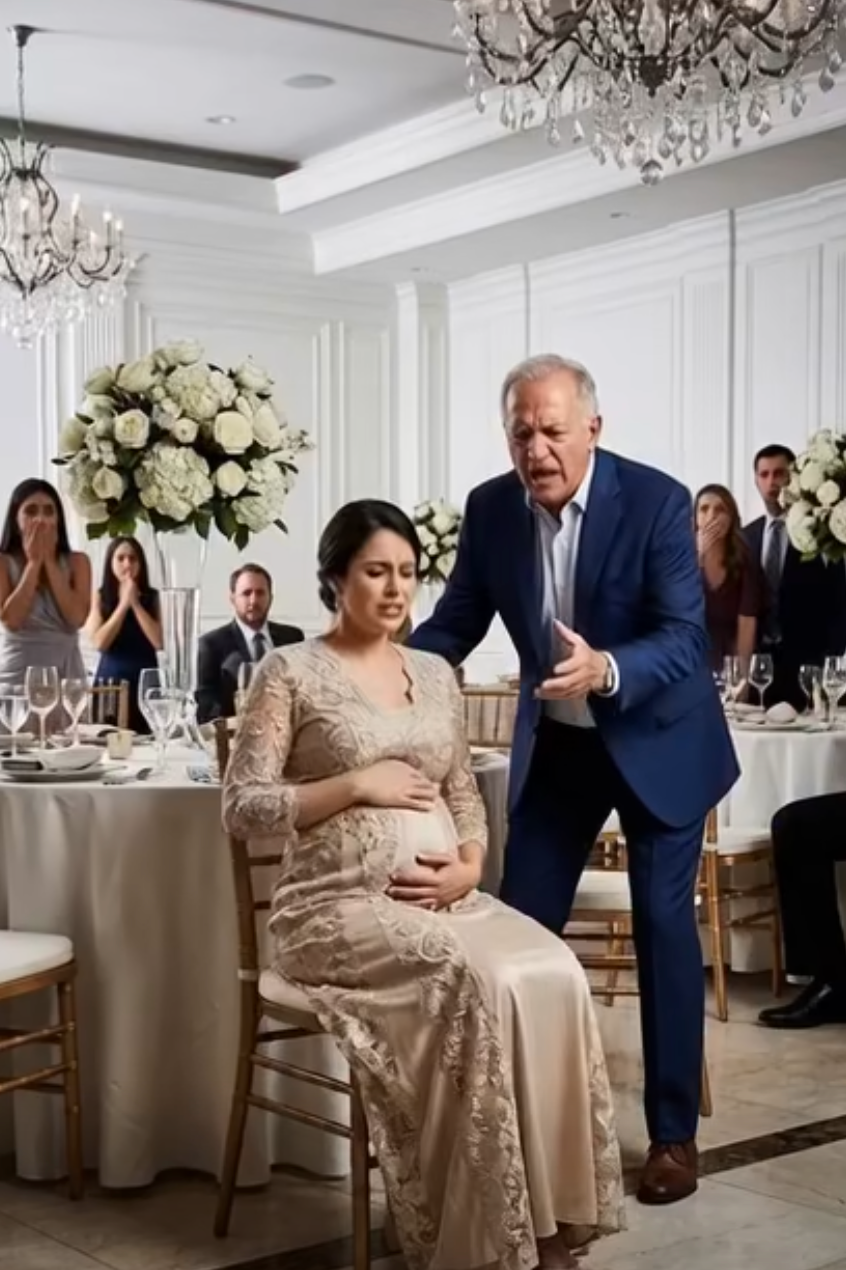
The moment my father kicked my chair, he didn’t just break a piece of furniture; he shattered the invisible chains of guilt that had bound me to them for thirty years. It wasn’t a stumble. It wasn’t an accident born of clumsy feet or crowded banquet halls. It was a precise, calculated detonation of my dignity, executed in the middle of a high-society wedding reception, designed to remind me of my place. Or rather, my lack of one.
My name is Emily, and for three decades, I was the scapegoat in a tragedy disguised as a family. This is the chronicle of my emancipation. It is a journey that moves from the polished marble floor of the Oakwood Country Club to the sterile, terrifying quiet of a hospital room, and finally, to the liberating silence of a life without abusers.
The air in the Oakwood Country Club ballroom smelled of expensive lilies and old money. It was a scent that usually triggered a reflex in me to straighten my spine and make myself smaller, a conditioned response to entering any room my parents occupied. But tonight, making myself small was a physical impossibility.
I was eight months pregnant, my body a swollen, aching vessel that felt less like my own and more like public property. I shifted my weight in the banquet chair, trying to hide a grimace as a Braxton Hicks contraction tightened across my belly like a steel band. My ankles throbbed in time with the bass of the jazz band, a dull, rhythmic ache that traveled up my shins.
I watched my cousin cut her wedding cake across the room. She was laughing, feeding a piece to her new husband, while her parents watched with misty, adoring eyes. I felt a pang of envy so sharp it nearly winded me. I wasn’t jealous of the wedding; I was jealous of the safety. I was jealous of the visible, undeniable evidence that she was loved simply for existing.
“I checked my watch,” I whispered to myself, the internal monologue running a frantic commentary. Daniel had been gone five minutes. He had just stepped away to the restroom, squeezing my hand and promising to bring back sparkling water. Without him, my shield was down. I was exposed.
“I just need to make it through dinner without an incident,” I thought, rubbing the side of my stomach. “Just eat the chicken, smile at the aunts, and go home.”
But in the Carter family, silence wasn’t peace; it was just reloading.
The double doors at the entrance of the ballroom swung open, and the atmosphere in the room seemed to drop ten degrees. My mother, Deborah, entered not like a guest, but like a critic attending a play she had already decided to loathe. She wore a dress of severe navy silk, her eyes scanning the room not for friends, but for flaws. My father, Mark, trailed behind her, a looming shadow in a tuxedo that cost more than my first car. He moved with the heavy, arrogant gait of a man who believed the ground should be grateful to catch his step.
And then, there was Rachel.
My younger sister floated in, clutching her stomach. She was barely twelve weeks pregnant, hardly showing a bump, yet she held herself as if she were carrying the messiah. She was the Golden Child, the sun around which my parents’ dark planet orbited. She looked radiant, fragile, and utterly utterly terrifying.
My heart hammered against my ribs. I looked for Daniel, but the crowd was too thick. I was alone. I saw Deborah’s gaze sweep the room, bypassing the bride, the groom, and the joyous guests, until it locked onto me. The polite, social smile she wore dropped instantly, replaced by a look of cold calculation. She didn’t wave. She didn’t smile. She marched.
And I realized with a sinking, nauseating dread: They weren’t looking for a seat. They were looking for a target.
They arrived at my table like a storm front. There were no greetings. No “Hello, Emily,” or “How is the baby?” There was only the immediate imposition of their will.
“Get up,” Deborah said. Her voice was a hiss, a whisper far more dangerous than a shout. It was the voice she used when she wanted to destroy your self-esteem without alerting the neighbors. “Rachel is delicate. She needs the support of a chair with arms. The ones at our table are armless.”
I blinked, looking at the empty chairs surrounding us. “Mom, there are open seats right there. With arms.”
“Those are too far from the head table,” Deborah snapped, her eyes narrowing. “Rachel needs to be close to the family. She’s feeling faint. Get up. You’ve always been sturdy. You can take the side chair.”
I looked at the side chair. It was a flimsy, folding wooden thing brought out for the overflow guests.
“Mom,” I said, my voice trembling but firm, “I’m fully dilated effectively. My back is spasming. I can’t sit on a folding chair. I need the support.”
Deborah rolled her eyes, a gesture of supreme dismissal. “Don’t be dramatic. You’re making a scene. Rachel is fragile.”
My father, Mark, stepped forward. He didn’t speak to me; he spoke at me. “You heard your mother, Emily. Move.”
It was the tone of voice that had governed my childhood. The tone that meant compliance or consequence. But then, I felt a flutter in my stomach. My son. A fierce, primal heat rose in my chest. For thirty years, I had moved. I had apologized. I had made myself invisible to accommodate Rachel’s spotlight.
But not today. Not with my son inside me.
“No,” I said. The word hung in the air, heavy and foreign. I gripped the armrests of my chair. “I am not moving.”
Mark’s face turned a shade of purple usually reserved for traffic jams. The veins in his neck bulged against his collar. To be defied—publicly, by the scapegoat—was a glich in his reality. He didn’t grab my arm. He didn’t shout. He went for the foundation.
“You selfish little—”
He drew his leg back. It happened in slow motion. I saw the shine of his patent leather shoe. I saw the malice in his eyes—not a loss of control, but a deliberate decision to punish. He kicked the rear leg of my banquet chair with the force of a mule.
CRACK.
The sound of the wood snapping was louder than the jazz band. The world tilted violently to the left. Gravity, once a constant, abandoned me. I didn’t scream immediately. I gasped as the chair collapsed, twisting my body as I plummeted.
My side hit the marble floor with a sickening thud. The impact vibrated through my teeth, jarring my spine.
Then came the liquid.
Warm, gushing, undeniable. It soaked through my dress, pooling rapidly on the cold white stone. The pain wasn’t immediate; it was a delay, a silent intake of breath before the scream.
Rachel didn’t rush to help. She jumped back to avoid getting her shoes wet, covering her mouth with her hands. Her eyes were wide, not with worry, but with the thrill of the drama, the excitement of the spectacle.
I lay in the puddle of amniotic fluid and blood, gasping through the first real, agonizing contraction of active, trauma-induced labor. I looked up, my vision blurring. I expected to see regret on my father’s face. I expected shock.
Instead, I saw Mark dusting off his pant leg. He looked down at me with a sneer, a look of utter disgust, and he said the words that will haunt me until my dying day.
“Look what you made me do.”
The ballroom exploded into chaos, but for me, the world had narrowed to the rhythm of agony tearing through my abdomen.
“Emily!”
The voice was a roar. Daniel. He charged through the crowd, his face a mask of pure terror. He didn’t ask questions. He shoved Mark aside with a force that sent my father stumbling back into a waiter.
“She caused a scene, Daniel!” Mark sputtered, trying to puff his chest out, attempting to regain control of the narrative before the audience could form an opinion. “Get her under control. She threw herself—”
Daniel didn’t even look at him. He fell to his knees in the fluid, ruining his suit, his hands trembling as he touched my face. “Emily? Can you hear me? The baby?”
“Something’s wrong,” I choked out, clutching his lapel. “It hurts too much. It’s not… it’s not right.”
The next hour was a blur of sirens and fluorescent lights. The ambulance ride was a nightmare of jolts and medical jargon. “Fetal heart rate is dropping,” the paramedic yelled into his radio. “Possible placental abruption. We need an OR prepped now.”
At St. Jude’s Hospital, the urgency was palpable. I was being stripped of my ruined dress, hooked up to monitors that beeped with frantic irregularity. Daniel was holding my hand so hard I thought he might break it, but I needed the pain to stay grounded.
“We have to put you under, Emily,” the doctor said, his eyes serious above his mask. “We need to get him out. Now.”
Just as the anesthesiologist moved toward me, my phone, which Daniel had placed on the bedside table, buzzed. It was a text message. Through the haze of pain, I glanced at the screen.
Rachel: Mom is really upset you ruined the reception. Everyone is talking. You need to apologize when you wake up. Dad says he’s willing to forgive you if you pay for the dry cleaning and the chair.
The audacity of it breathless. The sheer, delusional magnitude of their narcissism. They weren’t worried about whether I lived or died. They weren’t worried about their grandchild. They were worried about the dry cleaning.
That text message was the fuel I needed. It burned through the fear. It burned through the conditioning.
I handed the phone to the nurse standing by my head. My voice was raspy, broken, but the command was absolute.
“If those people come here,” I gasped between the waves of contraction, “call security. They are not family. They are the reason I’m here.”
The nurse looked at the text, then at me. Her expression hardened. “Understood, honey. You just focus on the baby.”
As the anesthesia mask descended over my face, darkness began to creep in at the edges of my vision. But before I went under, I heard a commotion in the hallway.
“I am her father!” Mark’s voice, booming and entitled, echoed from the lobby. “I have a right to see her! She’s hysterical!”
“Sir, you need to step back,” a security guard’s voice replied, firm and unyielding.
I looked at Daniel, then at the empty crib where our baby should be. The darkness took me, leaving me with one final, terrifying thought: If my son dies, I will kill them.
I woke up to the sound of a rhythmic whoosh-whoosh—the sound of a healthy heartbeat on a monitor.
I blinked my eyes open. Daniel was sitting in the chair next to the bed, still wearing his blood-stained shirt. He looked like he had aged ten years in ten hours. But in his arms, wrapped in a standard-issue hospital blanket, was a tiny bundle.
“He made it,” Daniel whispered, his voice cracking. “He’s in the NICU for observation because of the stress, but he’s okay. You’re okay.”
I let out a sob that racked my entire body. The relief was physically painful. But the peace was short-lived.
A knock at the door. A police officer, a woman with kind eyes and a badge that read Detective Miller, stepped inside. She held a notebook.
“Mrs. Carter? I’m sorry to disturb you,” she said softly. “We have a report of an assault at the Oakwood Country Club. However, your father is currently in the lobby. He is claiming it was an unfortunate accident. He says the chair was faulty and you… tipped over.”
The gaslighting. Even here. Even now. They were trying to rewrite reality. If it was my word against theirs, I knew how this would go. Mark was a pillar of the community. I was just the clumsy daughter.
“He didn’t trip,” I whispered. “He kicked it.”
“He says he stumbled,” Detective Miller said gently. “Without witnesses willing to speak up against him…”
My heart sank. The guests were his friends. They wouldn’t cross him.
“I have something,” Daniel interrupted. He pulled out his phone. “Emily’s cousin, Sarah. She was filming the cake cutting from across the room. She just sent me this.”
He turned the phone toward the detective and me.
I watched the screen. The video was high definition. In the background of the cake cutting, clear as day, was our table. You could see the argument. You could see Mark’s face turn red. You could see Deborah sneering.
And then, you saw it.
It wasn’t a stumble. It was a wind-up. Mark looked at the chair leg, drew his foot back, and struck with vicious precision. You could see the shock on my face as I fell. You could see Rachel jump back and laugh—actually laugh—before covering her mouth.
The silence in the hospital room was deafening.
Detective Miller watched it twice. Her jaw tightened. She looked at me, and the pity in her eyes was replaced by professional resolve.
“That,” she said, tapping the screen, “is not an accident. That is Aggravated Assault and reckless endangerment of a minor.”
She looked me in the eye. “Mrs. Carter, if we arrest him, he will likely lose his standing. Your family… this will destroy their reputation. Are you sure you want to proceed?”
I looked at the video again. I saw the man who was supposed to protect me, trying to hurt me to please his wife and favorite daughter. I looked at Daniel, holding our son—the son Mark had almost killed because he wanted a chair.
“No,” I said, my voice raspy but steady, harder than it had ever been in my life. “He didn’t trip. He aimed. He tried to hurt me. I want to press charges.”
“All of them,” Daniel added. “And I want a restraining order against the mother and the sister, too.”
Detective Miller nodded and stepped out of the room.
Ten minutes later, Daniel opened the door slightly so we could hear. Down in the lobby, the shouting began.
“You can’t do this! Do you know who I am?!” Mark was screaming. “I am Mark Carter! That girl is a liar!”
“Turn around and place your hands behind your back,” the officer’s voice cut through his bluster.
Then came Deborah’s wail—not a cry of sorrow, but a shriek of indignation. “This is humiliating! Emily, you ungrateful brat! Tell them to stop!”
Rachel tried to sneak past the commotion, heading toward the elevators, likely coming to guilt-trip me into dropping the charges. “Think of the family!” she would say.
Daniel walked to the door of my room, stepped into the hall, and stood like a sentinel. I couldn’t see Rachel, but I heard Daniel’s voice, cold and lethal.
“You wanted a seat, Rachel? You can sit in the waiting room. Forever. You are never seeing this baby.”
He slammed the door.
“It’s done,” Daniel said, sitting back down on the bed and taking my hand. “They’re in custody.”
But then, my phone lit up again. It was a notification from social media. The video hadn’t just been sent to the police; Sarah had posted it.
It already had 50,000 views. And the caption read: The moment my uncle tried to kill his grandchild. The secret is out.
The fallout was nuclear.
In the age of the internet, there is no hiding place for monsters in tuxedos. The video went viral within hours. By the next morning, Mark Carter wasn’t just the man who kicked a chair; he was the face of domestic abuse on every local news feed.
A lawyer representing my parents called three days later. He sounded tired, a man who knew he was defending the indefensible.
“Your father is prepared to offer a substantial settlement,” the lawyer said. “He is willing to transfer the deed to the lake house into your name and pay a lump sum of two hundred thousand dollars. In exchange, you drop the criminal charges and sign a Non-Disclosure Agreement.”
I was nursing Leo in the rocking chair of our living room. My C-section incision still burned, a constant reminder of the violence. I looked down at his tiny, fragile head—the head that almost hit the marble floor.
“Tell him,” I said, feeling a strange, intoxicating lightness in my chest, “that he can’t buy this. Tell him I don’t want his money. I want a record. I want a judge to tell him he’s a criminal.”
“Mrs. Carter, lengthy trials are expensive and emotional—”
“And tell my mother,” I interrupted, “that if she comes near my son, I will release the voicemails she left me in high school. The ones where she told me I was unlovable. I think the internet would love those, too.”
I hung up.
The weeks followed in a blur of legal victories. The Oakwood Country Club banned my parents for life—a social death sentence for Deborah. Mark was fired from his firm; the partners didn’t want the PR nightmare.
And Rachel? She tried to play the victim. She posted a tearful video claiming she was “traumatized” by the event. But the internet is a cruel judge. Commenters dissected the footage, pointing out her laugh, her jump back to avoid the fluid. She was branded an accomplice. Her socialite friends dropped her. The Golden Child had lost her shine.
I struggled with the physical recovery. I struggled with the newborn exhaustion. But for the first time in my life, the “heavy” energy was gone. I wasn’t walking on eggshells. I was walking on my own floor, in my own home, and the silence wasn’t reloading; it was just peace.
Six months later, the court date was set. I received a package in the mail with no return address. Inside, wrapped in tissue paper, was a single, crushed crystal glass from the wedding—likely swept up from the floor that night.
There was a note in Deborah’s handwriting, jagged and angry:
You broke us. Watch your back.
One year later.
The house was loud. Not the polite, stifled noise of the country club, but the chaotic, joyous noise of life. It was Leo’s first birthday.
The living room was full of friends, Daniel’s loving parents, and Sarah, the cousin who had filmed the video. There was cake smashed into the carpet. There was jazz playing, but this time, it didn’t make my ankles throb.
I sat in a sturdy oak armchair—a symbolic gift from Daniel. I watched my son stumble across the room on wobbly legs. He tripped over a toy truck and fell.
My heart jumped, a reflex from the past. But Leo didn’t look terrified. He didn’t look to see if he was in trouble for falling. He looked at me, his eyes bright, and he laughed. He grabbed the chair leg, pulled himself up, and kept going.
I took a deep breath, inhaling the scent of vanilla frosting and safety.
My mother told me I broke the family that night. She was wrong. The family was broken long before I hit the floor. I just finally let the pieces shatter so I didn’t cut myself holding them together anymore.
I looked at the empty seat at the head of the dining table where a patriarch would usually sit. I didn’t feel a loss. I felt space. Space to breathe. Space to grow.
As I stood up to bring out the candles, the doorbell rang.
The chatter died down. Through the frosted glass of the front door, I saw a silhouette. The stiff posture, the aggressive tilt of the head. It looked terrifyingly like my mother.
The room went silent. Daniel started to move toward the door, his jaw set.
I put a hand on his arm to stop him. “No,” I said. “I got this.”
I didn’t feel fear. I felt the calm of a woman who knows her own strength. I walked to the door. I didn’t ask who it was. I didn’t peek. I reached out, locked the deadbolt with a loud, definitive click, and turned off the porch light, leaving the ghost in the dark.
I turned my back on the door and walked back to the party. Back to the warmth. Back to the family I chose.
I wasn’t opening the door. Not today. Not ever.
If you want more stories like this, or if you’d like to share your thoughts about what you would have done in my situation, I’d love to hear from you. Your perspective helps these stories reach more people, so don’t be shy about commenting or sharing.