The Inheritance of Bruises
Chapter 1: The First Strike
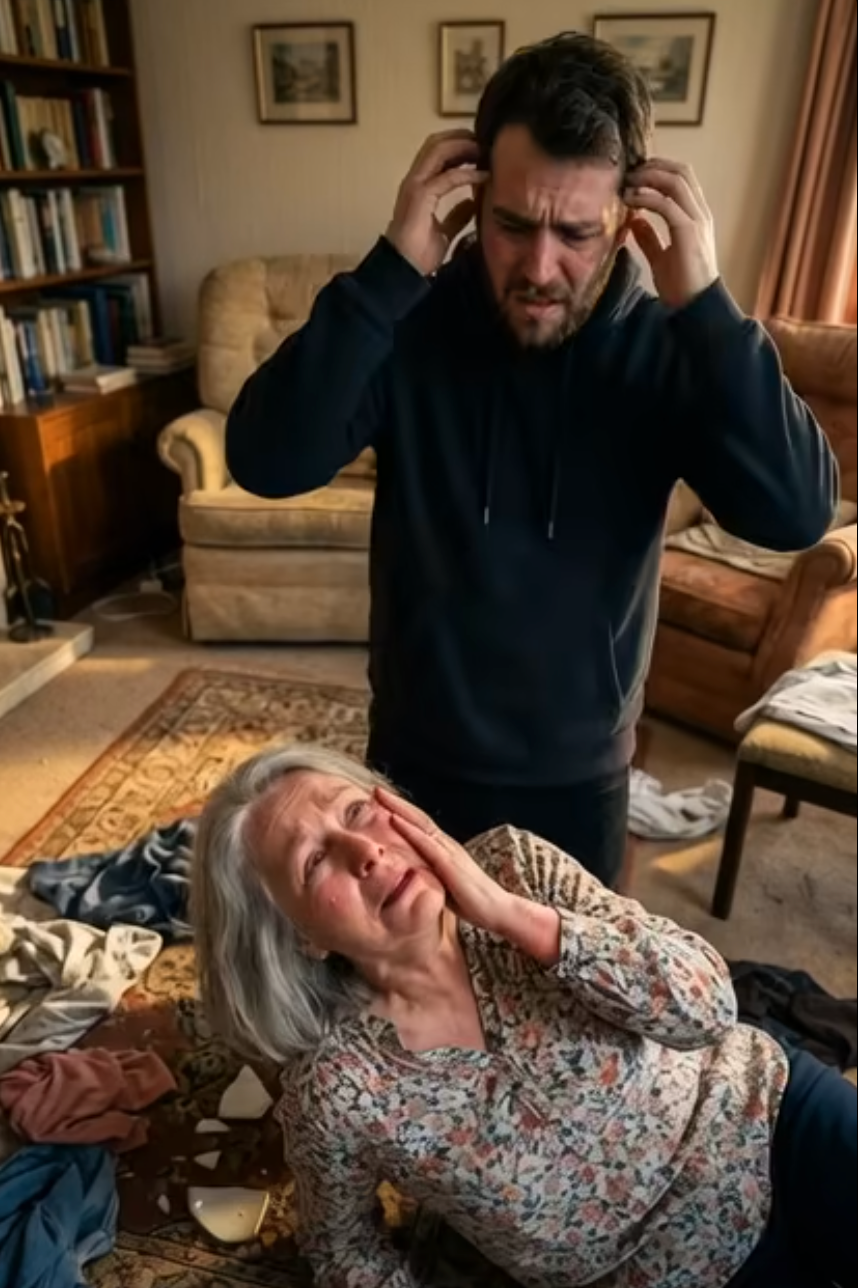
The first time my son hit me, it wasn’t in a dark alley or a smoky bar. It wasn’t a crime of passion fueled by alcohol or a stranger’s provocation. It happened in my own living room, under the soft glow of the lamp his father had bought for our anniversary, surrounded by the framed photos of his own childhood.
It was a Saturday in Cedar Ridge, Texas. The heat outside was oppressive, a physical weight that pressed against the windows, but inside, the air conditioning hummed its steady, artificial cool. I had just finished folding a basket of laundry—Robert’s old shirts that I couldn’t bear to pack away, mixed with my own linens—when the front door slammed open.
Ryan stormed in. His boots, heavy and caked with the red dust of a construction site, stomped hard enough to make the china rattle in the cabinet. His face was a map of fury, flushed a dangerous crimson, his eyes wild in a way I hadn’t seen since he was seventeen and punching holes in the drywall over a breakup.
“You hid the deed, didn’t you?” he shouted, crossing the room in three long strides to get right in my face.
I blinked, my hands still clutching a warm towel. “Ryan? What are you talking about?”
“The house, Mom!” he yelled, jabbing a thick, calloused finger toward the ceiling. “Dad’s deed! I checked the safe. It’s not there. Emily told me you’re ‘handling’ everything. You signed it over to her, didn’t you? You’re cutting me out.”
A familiar ache bloomed in my chest—the specific, heavy grief that came whenever my children fought over money. Robert had barely been gone six months, and already the vultures were circling, picking at the bones of the life we had built.
“Your father’s estate is with the lawyer,” I said slowly, trying to keep my voice level. “Nothing has been finalized. No one is cutting you out, Ryan.”
“Liar.” His lip curled, revealing teeth in a snarl that looked terrifyingly like a wolf’s. “You always loved her more. Daddy’s girl gets the house, the car, the clean money. And I get what? The leftover tools in the garage? The debt?”
“That is not true,” I said, my voice hardening. “And you know it.”
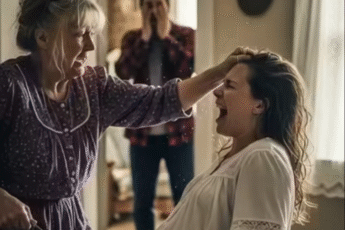
My words were gasoline on a bonfire. He reached out and grabbed my upper arm. His grip was shocking—hard, bruising, devoid of any recognition that he was touching his mother.
“Where is it, Mom?”
“Let go,” I said, trying to pull back, panic fluttering in my throat like a trapped bird. “Ryan, you’re hurting me.”
“Tell me where the deed is!” he roared.
I didn’t even see it coming. One second I was looking into my son’s eyes—eyes that used to look at me with adoration when he scraped his knee—and the next, there was a flash of white light.
His fist connected with my cheekbone. The sound was sickening—a wet, hollow thud that echoed in my skull. My head snapped to the side with violent force. I stumbled backward, my feet tangling in the rug, and crashed onto the coffee table.
A stack of mail went flying. A vase shattered.
For a moment, the world tilted on its axis. I tasted copper in my mouth. Blood.
I looked up from the floor, dazed. Ryan stood over me, his chest heaving. His eyes were wide now, the pupils blown, as if he had just woken up from a trance and realized what his hands had done.
“Mom,” he whispered, his voice trembling. “I… I didn’t…”
The next thing I remember clearly is the red uniform of the paramedic kneeling beside me, the static of a radio, and the cold plastic of an oxygen mask pressing against my swelling face.
Chapter 2: The Silent Witness
Weeks passed. The purple bruise on my cheek faded to a sickly yellow, then vanished, but the bruise on my soul only deepened.
I lay in a hospital room, admitted for recurring dizzy spells that the doctors worried were signs of a concussion or something worse. The room was sterile and cold, smelling of antiseptic and stale coffee.
The door opened with a soft click. Daniel Carter, my late husband’s attorney and a family friend for thirty years, walked in. He held a thick manila folder in one hand and a small, black external hard drive in the other. His face was grave.
“We need to talk, Margaret,” he said quietly, pulling a chair close to the bed. “And I think it’s time Ryan learns the truth.”
He walked over to the wall-mounted TV and plugged the drive into the USB port. The screen flickered from a generic nature loop to a blue menu.
“When your son sees this,” Daniel said, patting the folder that rested on his knee, “his entire world is going to shift.”
The video started.
It was a high-angle shot of my living room. The fish-eye lens distorted the edges slightly, but the picture was crystal clear. There was the brown leather couch. The cross-stitched “Home Sweet Home” pillow. The photos of Robert.
I had almost forgotten. Robert had installed the cameras two years ago after a string of break-ins in the neighborhood. “Just in case,” he had said. “I want to know you’re safe when I’m gone.”
He had been right.
On the screen, I saw myself folding laundry. It was surreal, watching a ghost of myself unaware of the violence about to descend. Then, Ryan entered the frame. Even on the screen, his energy was jagged, terrifying.
“Pause,” Daniel said to the nurse who stood by the door, a silent witness I had requested.
He turned to me. “Do you want him here for this? Or do we handle it with the judge first?”
As if summoned by the tension in the room, the door burst open.
Ryan stood there. He looked ragged. Dark circles bruised his eyes, and he smelled faintly of stale cigarette smoke. He had been avoiding me since “the incident,” communicating only through terse texts or the family group chat when Emily forced him to respond.
“Your lawyer called me,” he said, his voice rough. He wouldn’t look at me. “Said I needed to come. Something about Dad’s will.”
Daniel didn’t flinch. “Good. You need to see this, Ryan.”
Ryan frowned at the TV screen. “What is this?”
“It’s your father’s legacy,” Daniel said. “And evidence.”
He hit play.
The sound from the TV speakers was tinny but undeniable. Ryan’s voice boomed: “You hid the deed, didn’t you?”
We watched in silence. We watched his fists clench. We watched his body language shift from agitated to aggressive. We watched me shrink back, my hand fluttering to my throat in fear.
Then came the grab. The jerk of my arm. My voice, small and frightened: “You’re hurting me.”
And then, the punch.
There were no sound effects. No dramatic music. Just the brutal reality of a son striking his mother.
Ryan’s face in the hospital room went ghostly pale. “Turn it off,” he muttered, looking away.
“No,” Daniel said, his voice like iron. “Watch it.”
On screen, I fell. The camera captured his shock, his retreat, the neighbor rushing in. It captured the ruin of a family in high definition.
When the video ended, the silence in the room was heavier than the air before a tornado.
Ryan swallowed hard. “Mom,” he whispered. “I… I didn’t think it looked like that.”
“That’s the thing about cameras,” Daniel replied, unplugging the drive. “They don’t care how you ‘thought’ it looked. They don’t care about your excuses. They just show what happened.”
He set the remote down and opened the folder with deliberate, agonizing slowness.
“Now,” Daniel said, “about the deed you were so sure your mother ‘hid.’ This is Robert’s will. The final version, signed and notarized six months before he died.”
Ryan’s head snapped up. Hope and dread warred in his eyes. “You have it?”
“I’ve had it the whole time,” Daniel said. “Per Robert’s instructions, I was to keep it confidential until the estate was settled peacefully—or until there was any sign of coercion or violence against Margaret.”
He slid a copy of the document onto my bed tray. He handed another to Ryan.
My son stared at his father’s signature. His eyes scanned the legal jargon, skipping to the distribution of assets.
“This can’t be right,” he whispered. “It says… the house goes to Mom. Not to me. Not to Emily.”
“The house,” Daniel corrected, “belongs solely to your mother for the rest of her life. Upon her passing, it is to be sold, and the proceeds split equally. But here—”
Daniel leaned forward and tapped a paragraph highlighted in neon yellow.
“Here is the part you need to read, Ryan. Out loud.”
Ryan hesitated. His hands shook as he held the paper. He began to read, his voice cracking.
“‘If either child engages in physical or emotional abuse, coercion, or violence toward their mother in connection with this inheritance, that child’s share shall be immediately and irrevocably revoked. Their portion shall be donated to the Cedar Ridge Shelter for Domestic Violence at my attorney’s discretion.’”
He looked up, stunned. “Dad wrote that?”
Daniel met his gaze. “Robert knew how money poisons people. He saw it with his own brothers. He wanted to protect your mother. And Ryan… that punch? It didn’t just bruise her face. It triggered this clause.”
Ryan’s mouth opened, then closed. He slumped into the chair, as if his strings had been cut.
“So I lose everything?” he whispered.
Daniel folded his hands. “You lost the most important thing the day you raised your hand to her. The will just formalized it.”
Chapter 3: The Weight of Consequences
For a long time, the only sound was the rhythmic beeping of the heart monitor. Ryan stared at the floor, his hands gripping his hair, looking less like a furious man and more like a lost boy.
“You knew?” he asked finally, his voice hoarse. “About the clause?”
I shook my head on the pillow. “I knew he had a will. I didn’t know he wrote that. I didn’t want to think about the house, Ryan. I was just trying to figure out how to breathe without him.”
Ryan pressed his palms into his eyes. “I was so angry. I thought you were choosing Emily. She always lands on her feet. Good job. Nice car. I’m drowning, Mom. The truck payments, the credit cards… I saw that house as a lifeline.”
“So you hit the one person who would have thrown you a rope,” I said softly.
He flinched as if I had struck him.
“I’m not saying that to hurt you,” I continued. “I’m just… I’m tired of pretending. You didn’t just lose an inheritance, Ryan. You broke the foundation.”
He looked at me then. Really looked at me. He saw the fading yellow bruise. He saw the fear that hadn’t quite left my eyes.
“I’m sorry,” he whispered. Tears leaked out. “I know that doesn’t fix it. I just… I don’t know when I became this person.”
“Step one,” Daniel said, standing up and buttoning his jacket, “is owning it. Step two is accepting the consequences. And step three is deciding if you’re going to stay that person, or become someone your father would recognize.”
Ryan nodded slowly. “So that’s it? I’m cut out? No appeal?”
“Legally, yes,” Daniel said. “Emotionally? That’s between you and your mother. But the will is ironclad. Robert was very specific.”
Daniel left the room, the door clicking shut behind him. The nurse dimmed the lights and stepped out, leaving us in the semi-darkness.
Ryan didn’t leave. He stayed in the chair. He poured me a glass of water. He adjusted the blanket. Small, useless gestures of penance.
“Mom?” he asked after an hour. “If Dad were here… what do you think he’d say?”
I closed my eyes. I pictured Robert—his rough hands, his stubborn jaw, the way he loved his children with a ferocity that scared me sometimes.
“I think he’d be heartbroken,” I said honestly. “But I also think he’d say, ‘This isn’t the end of the story unless you let it be.’”
Ryan swallowed hard. “Do you think… do you think you can ever forgive me?”
I looked at the ceiling tiles, counting the dots. Forgiveness is a heavy word. People throw it around like it’s cheap, like it’s a given because of blood. But blood doesn’t stop a fist.
“I don’t know yet,” I said. The truth hung between us. “Forgiveness isn’t a switch, Ryan. It’s a road. And right now, I’m not ready to walk it. But I know this: I won’t let fear live in my house anymore. If you want to be in my life, it has to be as a man who respects me, not a son who sees me as an obstacle to a paycheck.”
He nodded, tears tracking through the stubble on his cheeks. “Then I guess I’ve got work to do.”
Chapter 4: The Line in the Sand
When he finally left, the room felt empty in a new way. Not lonely, but clear.
I lay there, thinking about the camera. About Robert’s foresight. About the way love sometimes means building walls to keep the people you love from destroying themselves—and you.
Losing the money was the best thing that could have happened to Ryan. It stripped away the motive. Now, if he came back, it would be for me. Or he wouldn’t come back at all.
And I had to be okay with either outcome.
That’s what I keep circling back to. We tell women—mothers especially—that their love must be unconditional. That they must be endless wells of forgiveness. But a well can be poisoned.
If you were in my shoes, lying in that hospital bed, watching your child realize they had gambled their family for a house and lost… would you let them back in?
Do you believe that blood is enough to earn a second chance? Or are there moments when protecting your own peace, your own safety, matters more than keeping the family picture intact?
I’m honestly asking. Where do you draw the line between forgiveness and self-respect? Because I drew mine in the sand that day, and I’m still waiting to see if the tide washes it away.
Like and share this story if you believe that sometimes, “tough love” is the only love that saves.