If you have never stood inside a house that costs twenty million dollars, let me tell you what it smells like. It does not smell like home. It smells of ozone, lemon polish, and a terrifying, sterile silence that screams “do not touch.” The Van Doran estate on the edge of Lake Tahoe was a fortress of glass and steel, a monument to the ego of a family that believed they owned the very air we breathed.
It was Christmas Eve, but the air inside the estate held no warmth. Outside, the lake was a sheet of gunmetal gray, churning under a winter storm warning. Inside, the temperature was controlled to a precise seventy degrees, yet I had never felt colder in my life.
I stood in the shadow of the hallway, watching my daughter, Lena.
She was twenty-four, but in that house, she looked like a child again. She was arranging hors d’oeuvres on a silver platter, her hands trembling so violently that the prosciutto roses threatened to topple. She had lost weight. Her collarbones were sharp ridges against her pale skin, and her eyes, once bright with the fire of youth, were dull and darting, constantly scanning the room for threats.
“Lena! Come here!”
The voice belonged to Garrett Van Doran, the patriarch. It was a voice like grinding stones, deep and devoid of patience. He sat in a leather armchair by the fire, a cigar clamped between his teeth, holding court. Beside him was his son, my son-in-law, Preston. Preston was a carbon copy of his father, only hollower. He possessed the arrogance but lacked the intellect, a dangerous combination that resulted in pure, unadulterated cruelty.
I watched Lena flinch. The air seemed to leave the room.
I stepped forward, my voice low. “You don’t have to go if you don’t want to, honey.”
Lena turned to me. Her smile was a mask of terror, tight and fragile. “I can’t make them angry, Mom. Not on Christmas. Please. Just… stay back.”
She picked up the tray and walked into the lion’s den. I followed, keeping to the periphery, a ghost in their grand design.
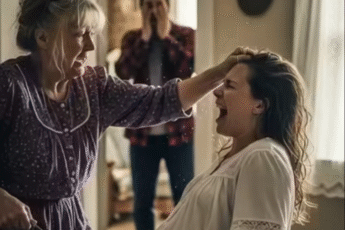
“Took you long enough,” Preston sneered, not bothering to look at her as he snatched a glass of whiskey from the side table. “God, you move like a snail. Is it the medication? Or are you just slow today?”
“I’m sorry, Preston,” Lena whispered. “I wanted it to be perfect.”
“Perfect,” Garrett rumbled, blowing a cloud of acrid smoke toward the ceiling. “We didn’t buy you for your culinary skills, girl. We brought you in to breed an heir. And so far, you’re failing at that, too.”
The men laughed. It was a loud, exclusionary sound, a barking noise that signaled their unity and our isolation. They used their wealth not just as a shield, but as a bludgeon. To them, Lena and I were accessories—necessary for the image of a family man, but ultimately disposable. I was the widow of a schoolteacher; Lena was the scholarship girl Preston had “rescued.” They never let us forget the disparity. We were the dirt beneath their Italian leather shoes.
“Let’s go outside,” Preston said suddenly, standing up. He swayed slightly. He was three scotches deep. “I want to see the waves.”
“It’s freezing, Preston,” Lena said softly.
“I didn’t ask for a weather report,” he snapped. “I said, let’s go.”
He grabbed her wrist. Not affectionately. He grabbed it hard enough to turn the skin white.
My stomach dropped. There was a static in the air, a prickly sensation on the back of my neck that signaled danger. I had spent the last two years watching the light fade from my daughter’s eyes, watching the psychological erosion of her spirit. But this felt different. This felt physical.
As they moved toward the sliding glass doors, I saw it. Preston glanced back at his father. He winked.
It wasn’t a playful wink. It was conspiratorial. It was the signal of a predator who had decided that the game was over and it was time for the kill.
I grabbed my coat and followed them out into the biting wind. The cold hit me like a physical blow, freezing the breath in my lungs. But as I stepped onto the icy wood of the pier, the cold was the least of my worries.
Something is going to happen, I thought, the dread coalescing into a scream in my throat. They aren’t just looking at the water.
The wind on the pier was deafening, drowning out the sound of the party music drifting from the house. The lake was a churning abyss, black and violent. The railing was slick with ice.
Preston walked close to the edge, dragging Lena with him. She was shivering, her thin cocktail dress offering no protection against the sub-zero wind chill.
“Look at that,” Preston shouted over the wind, gesturing to the black water. “That’s raw power, Lena. Something you wouldn’t understand.”
“Preston, please, I’m cold,” Lena pleaded, pulling back. “Can we go inside?”
“You’re always complaining!” Preston yelled. He spun around, his face twisted in a mask of drunken irritation. “You’re such a drag, Lena. Just a wet blanket.”
Garrett stood a few feet back, leaning against a wooden piling, watching with a bored expression. He took a sip of his drink. He was the audience for this play.
“Just loosen up!” Preston shouted.
And then, he moved.
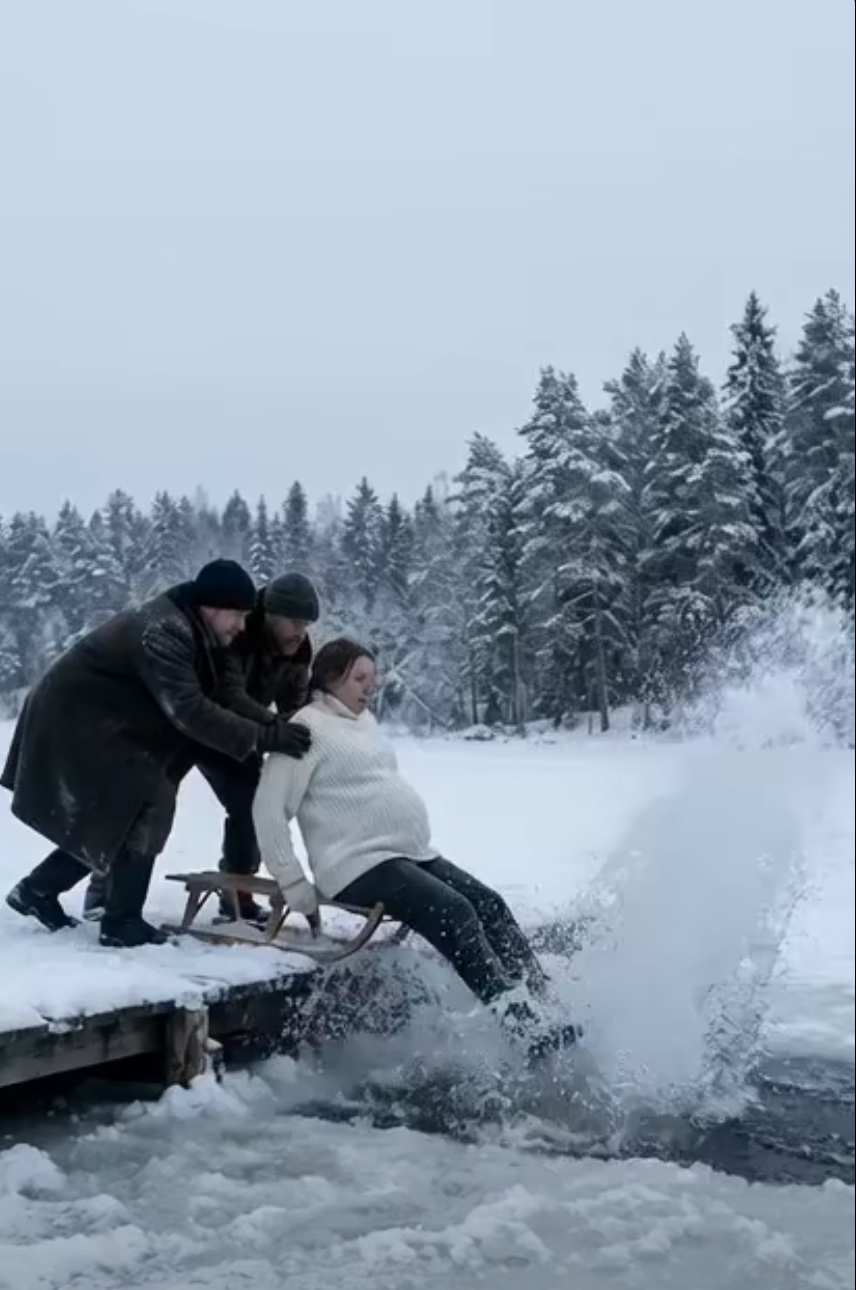
It wasn’t an accident. I will testify to that until the day I die. It wasn’t a stumble. Preston planted his feet, looked her dead in the eye, and shoved.
“No!” I screamed, but the wind tore the sound away.
Lena’s arms flailed, grasping at empty air. Her heels slipped on the icy wood. There was a terrifying moment of suspension, where time seemed to stop, and I saw the sheer betrayal on my daughter’s face.
Then came the splash.
It wasn’t like in the movies. It wasn’t a loud, dramatic crash. It was a sickening, wet thwack as her body hit the freezing water, followed instantly by silence. The darkness swallowed her whole.
“Lena!” I shrieked, sprinting down the slippery dock.
I expected Preston to dive. I expected Garrett to yell for help.
Instead, Preston stood there, looking down at the ripples, wiping a speck of water from his lapel. He let out a short, incredulous laugh. “Whoops.”
Garrett didn’t even move. He just watched, swirling the ice in his glass.
“Help her!” I screamed at them, skidding to the edge. “She can’t swim in this! It’s freezing!”
“She needs to cool off,” Preston slurred, smirking at his father. “Teaches her a lesson about nagging.”
The water was black. I couldn’t see her. The shock of Lake Tahoe in December causes immediate hypothermia. It paralyses the muscles.
I didn’t think. I kicked off my shoes and prepared to jump, knowing I probably wouldn’t make it out either. But before I could leap, a blur of motion shot past me.
It was one of the catering staff—a young man, barely twenty. He didn’t hesitate. He vaulted over the railing and dove into the blackness.
The seconds that followed lasted an eternity. I was on my knees, sobbing, clawing at the wood. Preston and Garrett were lighting cigars, shielding the flame from the wind, completely unbothered.
Then, a gasp. The boy surfaced, dragging a limp bundle of blue silk.
He hauled her onto the lower deck. Lena was blue. Her lips were gray. She wasn’t breathing.
As the boy began frantic chest compressions, the only sound was the wet thud of his hands on her ribcage and my own guttural wailing.
“Come on, Lena, breathe!” I begged.
Preston looked down at his wet Gucci loafers with annoyance. “God, she’s so dramatic,” he scoffed. “She’s probably holding her breath. Get up, Lena, stop making a scene.”
Garrett exhaled a plume of smoke, looking at the young waiter with disdain. “If she can’t handle a dip, she can’t handle this family.”
A cough. A retching sound. Water spewed from Lena’s mouth. She was alive, but barely. Her eyes rolled back in her head, and she seized, her body racking with tremors.
Sirens wailed in the distance—the caterer must have called.
As the paramedics rushed down the pier, pushing past the annoyed billionaires, Garrett leaned in close to me. His eyes were hard, soulless chips of flint. His voice dropped to a menacing whisper that chilled me more than the lake ever could.
“Accidents happen, Eleanor. Don’t ruin your daughter’s marriage by making a scene. No one will believe you over us. We own this town.”
The hospital was a different kind of cold. It was the cold of antiseptic and fluorescent lights.
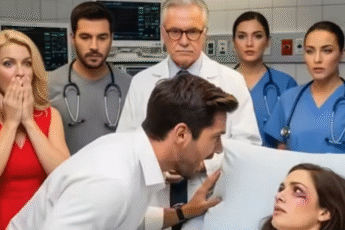
I stood in the hallway, looking through the glass. Lena was hooked up to monitors, a tangle of tubes and wires keeping her warm, keeping her heart beating. The doctor said she was stable, but the hypothermia had been severe.
Outside in the waiting room, I could hear Preston on the phone. He wasn’t crying. He wasn’t praying. He was spinning the story.
“Yeah, total freak accident,” he was saying, his voice smooth, practiced. “She had too much to drink, slipped on the ice. I tried to grab her, but… yeah. Tragically clumsy. We’re devastated.”
He laughed then. A short, stifled chuckle at something the person on the other end said.
The local police had already come and gone. They took statements. They nodded sympathetically at Garrett Van Doran. They patted Preston on the shoulder. They looked at me with pity when I tried to say he pushed her, scribbling “hysterical mother” into their notebooks. Garrett was right. They owned the town.
I turned my back on the window. My hands, which had been shaking for hours, suddenly went still.
There is a specific kind of clarity that comes when you realize you have nothing left to lose. They had tried to kill my child. And they were laughing about it.
I reached into my purse and pulled out my old, cracked iPhone. I scrolled past the contacts of neighbors, the bakery, the hair salon. I stopped at a number I hadn’t dialed in six years.
Lucas.
My brother. The black sheep. The one the family didn’t talk about because we didn’t understand what he did. We knew he worked for a private firm in D.C. We knew he traveled to places that weren’t on tourist maps. We knew that when he walked into a room, the temperature changed.
I pressed call.
It rang once.
“El?” His voice was gravel. Alert. He picked up on the first ring, as if he had been waiting for this call for a decade.
“Lucas,” I said. My voice sounded dead, hollowed out by the trauma. “They almost killed her. And they laughed.”
There was a silence on the other end so profound I thought the line had died. Then, the sound of a heavy metal door closing. The background noise of a busy office cut out instantly.
“Who?” Lucas asked. One word. No pleasantries.
“The Van Dorans. Garrett and Preston. They pushed her into Tahoe. The police… the police are shaking their hands.”
“Is she alive?”
“Barely.”
“What do you want me to do, El?”
I looked through the glass at my daughter. My beautiful, broken girl, who had spent three years trying to please monsters. I looked at the bruises on her wrist that predated the fall.
“I want them gone, Lucas,” I whispered. “I want them stripped. I want them to feel what it’s like to drown.”
“Understood,” he said. “Give me twenty minutes. Do not leave the hospital.”
“Lucas?”
“Yeah?”
“Burn it all down.”
“Consider it ash.”
The line clicked dead.
Back at the estate, I imagined Garrett was pouring another scotch. I imagined Preston was posting a ‘prayer’ request on Instagram to garner sympathy.
Garrett’s phone buzzed in his pocket. A notification. A strange, encrypted file uploaded to the Van Doran private server. He swiped it away, annoyed, distracted by a toast Preston was making to “resilience” and “new beginnings.”
He had no idea his life had ended five minutes ago.
It didn’t take days. It took hours.
Lucas didn’t work with lawyers. He worked with data. He worked with the kind of people who could find the digital skeleton in anyone’s closet, and the Van Dorans had a graveyard.
I sat in the hospital waiting room, sipping tepid coffee, watching the clock. Preston had left “to get a change of clothes” (which meant to go home and sleep), while Garrett had returned to the estate to “manage the press.” They thought the storm had passed.
They were wrong. The storm had just made landfall.
The first sign was the noise. Not in the hospital, but on the television mounted in the corner. The local news channel was interrupted by a breaking report.
“…Federal agents are currently raiding the Van Doran estate in what sources are calling the largest fraud investigation in Nevada history…”
I stood up, walking slowly toward the screen.
The camera showed the driveway of the estate. It wasn’t the local sheriff’s deputies this time. It was the FBI. Black SUVs swarmed the manicured lawn. Agents in windbreakers were carrying out boxes—endless boxes of files.
Then, the footage cut to something else. A video. grainy, black and white, but unmistakable.
It was footage from a security camera. Not the Van Dorans’ cameras—those had undoubtedly been wiped. This was from the neighboring property, a high-angle shot that looked down onto the pier.
The world watched in real-time as the figure of Preston Van Doran clearly, undeniably, shoved his wife into the water. They watched him laugh. They watched Garrett turn his back.
The anchor’s voice was shaking. “This footage, leaked anonymously to every major news outlet and the District Attorney’s office ten minutes ago, contradicts the official statement given by the family…”
The doors to the hospital waiting room burst open.
It wasn’t Preston coming back to play the grieving husband. It was two officers, accompanied by a suit-wearing detective I didn’t recognize. But behind them, handcuffed and looking smaller than I had ever seen him, was Preston.
He was disheveled. He was weeping.
“You can’t do this! Do you know who I am?” Preston screamed, his voice cracking. “My father will have your badges!”
“Your father is currently being indicted for racketeering, money laundering, and conspiracy to commit murder, Mr. Van Doran,” the detective said, his voice like iron. He held up a tablet. “And we know exactly who you are. You’re the man trending at number one on Twitter for attempted manslaughter.”
Preston’s eyes scanned the room wildly until they landed on me.
I stood there, wrapped in a hospital blanket, holding my Styrofoam cup. I didn’t look away.
“Mom!” Preston shrieked. “Mom, tell them! Tell them it was a joke! Help me!”
He lunged toward me, but the officers yanked him back.
I took a sip of my tea. I looked him up and down, seeing him for what he truly was: a terrified child who had broken his toy and was shocked that he had to pay for it.
I slowly, deliberately, tilted my head. I offered him zero comfort. Zero recognition.
“Mom!” he wailed as they dragged him toward the exit.
I turned my back on him and walked toward Lena’s room. The heavy oak doors of the ward swung shut with a final, echoing thud, cutting off his screams.
The fallout was nuclear.
Because Lucas hadn’t just exposed the push. He had exposed everything. The shell companies. The bribes to local zoning boards. The tax evasion. The offshore accounts were frozen within an hour of my call. The “untouchable” dynasty was liquidating assets just to pay for legal teams that were rapidly quitting.
Because of Lucas’s findings—proof of flight plans and hidden passports—bail was denied. Preston and Garrett were sitting in county jail, wearing orange jumpsuits that clashed horribly with their complexions.
Two days later, Lena woke up.
The doctors said she was lucky. I knew luck had nothing to do with it. She was a survivor.
I was sitting by her bed when her eyes fluttered open. She looked around, panic instantly gripping her features. She tried to sit up, the heart monitor spiking.
“Where are they?” she rasped, her voice damaged from the tube. “Did I… did I ruin Christmas? Is Preston mad?”
It broke my heart to hear her first thoughts were of his anger.
I stroked her hair, smoothing it back from her forehead. “Shh, baby. It’s okay. You didn’t ruin anything.”
“I have to go back,” she whispered, tears leaking from her eyes. “He’ll be so angry if I’m not there.”
“You are never going back there, Lena,” I said firmly.
I picked up the remote and turned on the small TV in the room. It was on mute, but the headlines were screaming in bold font: VAN DORAN EMPIRE COLLAPSES. DOMESTIC ABUSE SCANDAL EXPOSES DECADES OF FRAUD.
Lena watched the screen. She saw the mugshot of Preston—unshaven, terrified. She saw the footage of the estate being seized by the government.
She looked at me, her eyes wide, processing the impossible.
“You did this?” she asked.
“I didn’t do anything, sweetheart,” I lied softly. “I just made sure the truth came out. They did this to themselves. Their arrogance was the match. I just lit it.”
For a long time, she just stared at the ceiling. Then, she took a deep breath. It was a ragged, painful breath, but it was the first one I had seen her take in years that wasn’t constricted by fear.
“I want a divorce,” she said. Her voice was weak, raspy, but undeniable.
“Already in the works,” a deep voice said from the doorway.
We looked up. Lucas stood there. He was wearing a nondescript grey suit, looking like an accountant, an insurance salesman, a nobody. But his eyes were sharp.
He didn’t come in. He just nodded at me, then at Lena.
“The lawyers will be here in an hour,” Lucas said. “They won’t get a dime, Lena. You get it all. Restitution.”
“Thank you,” Lena whispered.
Lucas didn’t smile. He just tipped his chin and vanished into the hallway as silently as he had arrived.
Six months later, I sat on the porch of the small cottage Lena and I had rented on the coast. The mailman dropped off a stack of letters.
One was from the Nevada State Penitentiary.
It was from Garrett. I opened it. It wasn’t an apology. It was a rambling, desperate scrawl begging for money, claiming he had hidden assets that only I could access if I just helped him. He was trying to manipulate me, even from a cage.
I didn’t read past the first line. I took a lighter from my pocket—I didn’t smoke, but I kept it for moments like this—and held the flame to the corner of the envelope.
I watched the handwriting curl and blacken, turning to ash in the wind.
One Year Later
The snow was falling gently outside, dusting the pines with powdered sugar. But this wasn’t Tahoe. This was a small, A-frame cabin in Montana, tucked away in the mountains where no one knew our names.
Inside, the fire was roaring. The smell was not ozone and polish; it was cinnamon, roasting turkey, and woodsmoke.
“Checkmate!”
I turned to see Lena sitting on the rug, laughing. It was a real laugh—a deep, belly laugh that made her eyes crinkle. She was playing chess with Lucas.
Lucas was actually smiling. It was a rare sight, like seeing a snow leopard, but he was smiling.
“You let me win,” Lena accused him.
“I never let anyone win,” Lucas replied dryly, resetting the board. “You’re just getting ruthless.”
“Good,” I said, walking over with a tray of hot cocoa. “Ruthless is good.”
Lena looked healthy. She had gained weight. Her hair was shiny. She was studying to be a paralegal, wanting to help women who were trapped in golden cages.
There was no static in the air. No tension. No fear of a door slamming or a voice raising.
I looked out the window at the falling snow. I thought of the icy lake, the black water, and the silence of the men who had stood on the pier, drinks in hand, watching my daughter sink.
They had thought they were gods. They thought their money made them immortal. They thought we were weak because we were quiet.
“They forgot,” I whispered to the glass, my reflection staring back at me, stronger and older. “They forgot that even gods can drown.”
“Mom?” Lena called out. “Are you okay?”
I turned back to the warmth of the room, to the family that had been forged in fire and ice.
“I’m better than okay,” I said.
My phone buzzed on the coffee table. A news alert. BREAKING: Preston Van Doran testifies against father in plea deal attempt. Garrett Van Doran faces life without parole.
I didn’t even pick it up. I smiled, a genuine, peaceful smile.
“Who’s ready for dessert?” I asked, turning off the phone and tossing it onto the sofa, leaving the chaos of the past permanently behind us.
If you want more stories like this, or if you’d like to share your thoughts about what you would have done in my situation, I’d love to hear from you. Your perspective helps these stories reach more people, so don’t be shy about commenting or sharing.