The Canvas of Lies: My Mother-in-Law’s Darkest Secret
The harsh fluorescent hospital lights stabbed straight through my eyelids as consciousness clawed its way back, dragging me out of the deepest, most bone-heavy sleep I had ever known. It was the kind of exhaustion that settles into your marrow, the price paid for twenty-three hours of labor. Just four hours earlier, at 3:47 a.m., I had brought my daughter into the world
Lily Rose. The name was a prayer I whispered in my mind, an anchor in the fog. The nurses had taken her to the nursery so I could rest, promising she was healthy, perfect, everything a mother could dream of. I had trusted them. I had trusted that the world was safe.
But it was voices that pulled me back from the dark.
Not the gentle murmur of nurses, but sharp, agitated shouts layered over one another, buzzing with a tension that made my heart hammer against my ribs before I could even open my eyes. Confusion settled in first, thick and disorienting, followed immediately by a cold, sliding dread.
I forced my eyes open, blinking against the glare.
My hospital room was full. Too full.
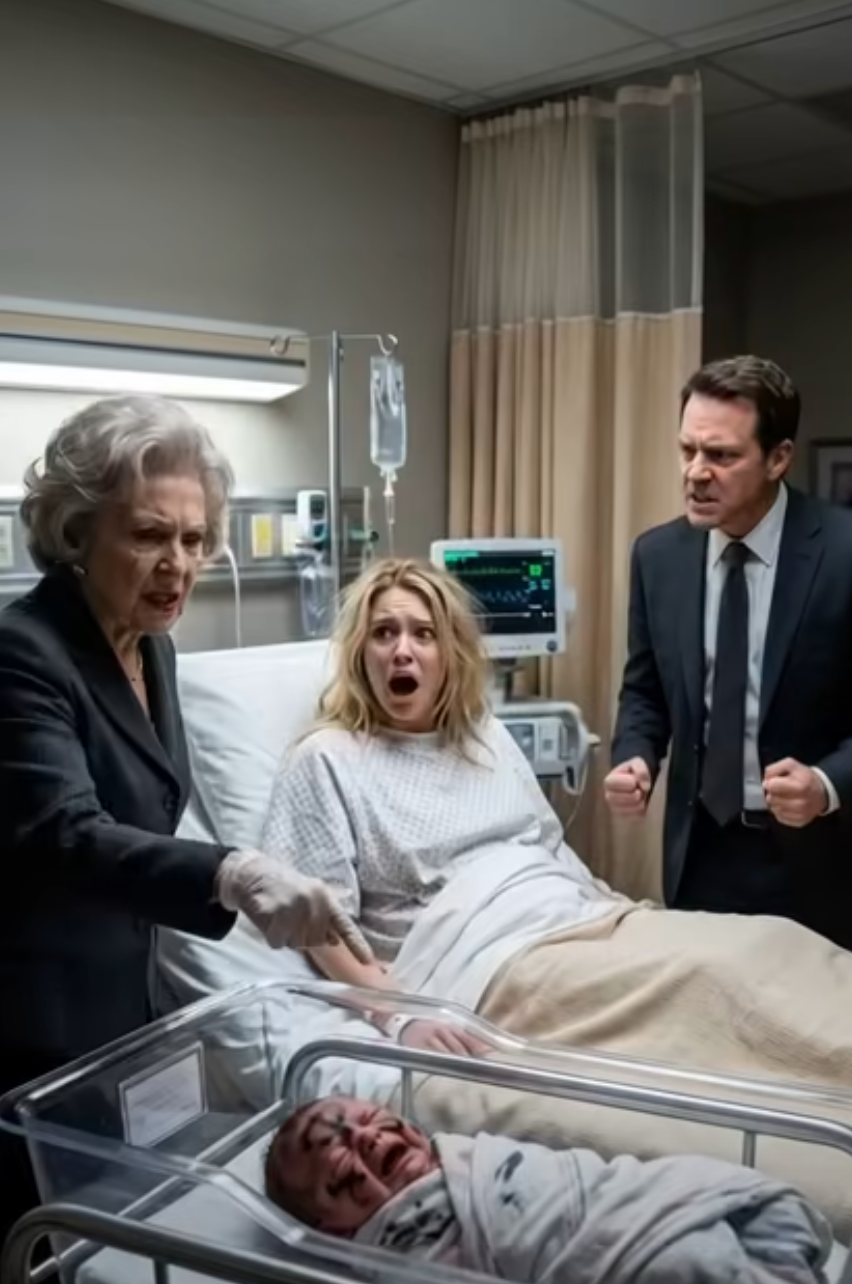
People stood clustered around my bed, their faces frozen in expressions I couldn’t immediately process—a cocktail of shock, disgust, and a dark, heavy judgment. At the foot of my bed stood my husband, Marcus. His posture was rigid, his hands clenched into fists so tight his knuckles were bleached white. His face was twisted into a sneer of pure revulsion, an expression so foreign on the man I loved that it felt like a physical blow.
Then my eyes shifted.
Patricia.
My mother-in-law stood near the bassinet, holding my baby girl in her arms. For a split second, relief flooded me—my baby was here. But then my gaze dropped, and my world shattered into a million jagged shards.
Lily’s skin was black.
Not the soft, pinkish tone she had been born with. A thick, uneven, glistening black substance was smeared across her tiny arms, her legs, her stomach, and her delicate face. It was paint. I could smell it now—acrid and chemical, cutting through the antiseptic air of the room. It was still wet in places, streaking down her skin, pooling in the crook of her elbow.
“Everyone come look!” Patricia shrieked, her voice sharp and triumphant, vibrating with a manic energy. She lifted Lily higher, holding her out not like a grandchild, but like a piece of damning evidence. “This baby doesn’t look like my son.“
Her words sliced through the room. I looked around wildly. Marcus’s father, Richard, looked pale and sick. His sister, Jennifer, had her hands over her mouth. And my own parents… my parents were staring at the baby, and then at me, with identical looks of horror.
“Marcus…” I croaked, my voice a broken rasp. I tried to sit up, pain flaring in my abdomen. “What is—”
“Shut up,” he snapped.
The silence that followed was deafening. Marcus stepped closer, looming over the bed. “Don’t say another word. You’re a disgusting woman,” he hissed, his voice trembling with a fury that terrified me. “After all these years… to do this to me?”
My mind scrambled for traction. Someone had painted my baby. While I slept, defenseless, someone had violated the sanctity of this room and desecrated my child. The truth tried to claw its way up my throat, but before I could scream, my mother moved.
She stepped forward, her face a mask of cold fury.
Smack.
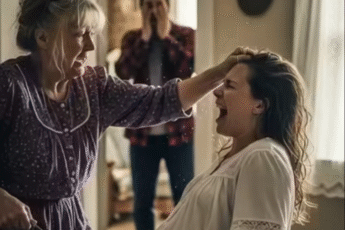
The sound of her hand connecting with my face cracked through the room like a gunshot. My head snapped to the side, stars bursting behind my eyelids. The sting on my cheek was nothing compared to the crater opening in my chest.
“You’re dead to me,” my mother whispered, her voice low and venomous. “You’ve shamed us all. You’re not welcome in our lives.”
I stared at her, stunned into silence. This was the woman who had held my hand through every fever, every heartbreak. Now, she looked at me as if I were a monster.
And then, I saw it.
Patricia smiled.
It wasn’t a polite smile. It was a predator’s grin, wide and satisfied, radiating a chilling triumph. As my family turned their backs on me—my parents, my husband, my in-laws—filing out of the room like a funeral procession, Patricia lingered for just a second.
She leaned in close, bringing the chemical stench of the paint with her. She lowered her voice to a whisper that was meant only for me.
“Good luck with that ugly thing,” she hissed, her breath warm against my ear. “Finally, I’ve got my son back.”
She dropped Lily into the bassinet with a carelessness that made me gasp, then straightened her designer jacket and walked out, her heels clicking a rhythm of victory on the linoleum.
The door clicked shut.
Silence rushed back in, suffocating and heavy. I was alone. Abandoned by everyone I loved. And in the bassinet, my daughter began to wail—a high, thin sound of distress that pierced my heart. I reached for her, my hands shaking violently, staring at the black paint drying on her skin, and I realized with a terrifying clarity: I was at war.
The next three hours were a blur of controlled chaos. I pressed the nurse call button seventeen times in under a minute. When a young nurse named Sarah rushed in, the color drained from her face so fast I thought she might faint.
“Oh my god,” she breathed, staring at the bassinet. “Code Pink. We need security!”
The hospital went into lockdown. Dr. Chen, the attending pediatrician, worked with a team of nurses to gently remove the substance from Lily’s skin. It was a non-toxic craft paint, thank God, but it was stubborn. They had to use special, gentle solvents. My daughter screamed through the entire process, her tiny body thrashing against the nurses’ hands. Every cry felt like a knife twisting between my ribs.
“Who did this?” Dr. Chen asked, her voice tight with controlled rage as she wiped a streak of black from Lily’s ear.
“My mother-in-law,” I whispered, the words tasting like ash. “Patricia Thornton.”
The police arrived within the hour. Officer Jake Morrison took my statement while I sat in my hospital gown, still bleeding, still aching, watching strangers try to undo the damage done to my child.
“We will investigate, ma’am,” Morrison said, his pen scratching against his notepad. “This is assault on a minor. If the paint is toxic, it could be worse.”
“Do you have somewhere safe to go upon discharge?” he asked, looking up.
I opened my mouth to say home, and then realized I didn’t have one anymore. Marcus had the keys. My parents had disowned me.
“I… I’ll figure it out,” I stammered, fighting back tears.
“We’ll help you,” Nurse Sarah said softly, squeezing my shoulder.
But as I sat there, watching the last of the gray water swirl down the drain of the specialized baby bath, my mind began to clear. The shock was receding, replaced by a cold, hard knot of fury.
Patricia had made a mistake.
While she was smiling that victorious smile, I had seen something. In her haste to frame me, in her arrogance, she hadn’t been careful enough. On her right thumb, deep in the cuticle, there had been a smudge. A smudge of black paint.
She thought she had won. She thought she had destroyed me. But she had forgotten one thing: a mother protecting her child is the most dangerous creature on earth.
The hospital kept us for an extra forty-eight days for observation, citing “chemical exposure risk.” I knew it was partly to give me time to find a place to live. During those days, the isolation was crushing. My phone was silent, save for a few hateful texts from Marcus’s friends who had heard the “news.”
But I didn’t spend those days crying. I spent them planning.
I called my best friend, Rachel. She was a paralegal with a nursing degree—a lethal combination of skills. She arrived within an hour, bringing a suitcase of clothes, food, and a rage that matched my own.
“I will burn her house down,” Rachel said flatly, looking at Lily’s red, irritated skin.
“No,” I said, my voice steady. “We’re going to be smarter than that. I need you to help me find something.”
“What are we looking for?”
“Motive,” I said. “Patricia has always hated me, but this? This was nuclear. She was terrified. She acted like a cornered animal lashing out. Why? Why was she so afraid of this baby?”
We turned my hospital room into a war room. Rachel used her legal connections to pull public records. I used my patient rights to demand every scrap of medical data generated during my stay.
And then, late on the second night, while Lily slept in the bassinet, I found it.
I was reviewing the blood work. Standard procedures.
My blood type: A Positive.
Lily’s blood type: AB Positive.
I stared at the paper. Then I pulled up the copy of Marcus’s medical records I had on my phone from when I handled his insurance paperwork two years ago.
Marcus’s blood type: O Positive.
My heart stopped. I grabbed a napkin and drew a Punnett square, my hand shaking.
Genetics 101. A parent with Type A blood and a parent with Type O blood cannot produce a child with Type AB blood. It is genetically impossible. For a child to be AB, one parent must provide the A marker, and the other must provide the B marker.
If Marcus was O, he couldn’t be the father.
Patricia’s accusation… was it true? Had I made a mistake? No. I knew I had been faithful. I knew it in my bones. There had never been anyone else.
“Rachel,” I whispered. “Look at this.”
Rachel studied the papers, her brow furrowing. “Okay, so Marcus isn’t the dad? But you said…”
“I didn’t cheat,” I insisted. “There is no other explanation… unless…”
“Unless Marcus isn’t Type O,” Rachel finished.
“But his records say he is. Look.” I showed her the insurance form.
“Records can be wrong,” Rachel said slowly. “Or they can be changed.”
The next morning, Rachel went to the Hall of Records downtown. She dug up Marcus’s original birth certificate—the long-form version filed by the hospital thirty-two years ago, not the amended one the state issues later.
She came back to the hospital pale and breathless. She handed me a photocopy.
Name: Marcus Edward Thornton.
Blood Type at Birth: B Positive.
“He’s B,” I breathed. “If he’s B, and I’m A… we can make an AB baby. He is the father.”
“But why do all his adult records say O?” Rachel asked.
“Because someone changed them,” I said, the realization hitting me like a physical blow. “Patricia changed them. But why?”
We kept digging. We looked at Richard Thornton’s medical history. He was a prominent businessman; his health scares made the local papers. Five years ago, he had surgery. The article mentioned he had a rare blood subtype: B-Weak.
I looked at Rachel. “If Richard is B, and Patricia is A (which I knew from her constant complaining about her health), they could have a B child. So why hide it?”
Then Rachel found the smoking gun. Buried in the archives of a different hospital system—the one the Thorntons had abruptly left when Marcus was eight months old.
A note in an old file: “Parents refused genetic compatibility screening following transfusion complications. Suspected incompatibility with paternal markers. Patient discharged against medical advice.”
The hospital had suspected Richard wasn’t the father. Patricia had panicked, pulled Marcus out, and spent the next thirty years altering records, changing doctors, and ensuring Marcus’s paperwork said “O Positive”—the universal donor type, safe, generic, untraceable.
Patricia hadn’t painted Lily because she thought I cheated. She painted Lily because a new baby meant new blood tests. She was terrified that if anyone looked too closely at the genetics of the grandchild, they would realize the father—Marcus—was a lie.
She wasn’t exposing my affair. She was covering up her own.
Rachel helped me move into a small, shabby apartment on the east side of town. It smelled of dust and old cooking oil, but it was mine. I pinned the medical records to the wall like a detective’s murder board.
I contacted Susan Chen, a divorce lawyer with a reputation for being a shark. When I showed her what I had found, she sat back in her chair and let out a long, low whistle.
“You realize this is fraud? Identity theft? Medical tampering?” Susan said.
“Can we use it?”
“Oh, we’re going to do more than use it,” Susan smiled, and it was terrifying. “We’re going to detonate it.”
The police investigation into the assault on Lily was moving forward. Detective Lisa Martinez had found the paint supplies in Patricia’s trash—she was arrogant enough not to hide them well. Patricia had been arrested and bailed out by Richard within hours. The narrative in the press was that she was a “distraught grandmother trying to prove infidelity.” The public was split.
I needed to end this.
I called Detective Martinez. “I have evidence regarding the motive,” I told her. “I want a meeting. With everyone. Marcus, Patricia, Richard, my parents. At the station.”
“This isn’t a soap opera, ma’am,” Martinez said.
“No, it’s a crime scene,” I replied. “And I have the proof of why she did it. If you want a confession, get them in a room.”
The conference room at the precinct was cold and sterile. The air was thick enough to choke on.
Marcus sat between his parents, looking haggard. He wouldn’t meet my eyes. Patricia sat with her back straight, wearing a Chanel suit like armor, looking at me with pure disdain. My parents sat in the corner, looking unsure.
I stood at the head of the table, Lily sleeping in her carrier beside me. I placed my hand on the folder.
“Thank you all for coming,” I said. My voice didn’t shake.
“Let’s get this over with,” Richard grunted. “My wife is under a lot of stress.”
“She should be,” I said. I opened the folder and slid a paper toward Marcus. “Marcus, look at this. It’s Lily’s blood type. AB Positive.”
Marcus glanced at it, bored. “So?”
“I’m A Positive,” I said. “You, according to every doctor you’ve seen since you were three, are O Positive.”
“Exactly,” Patricia snapped. “Biologically impossible. Proof that you’re a whore.”
“Actually,” I said, turning to her, “it’s proof that someone is lying. But it’s not me.”
I slid the second paper toward Marcus. The birth certificate. “This is your original birth record, Marcus. You were born B Positive.”
Marcus frowned, picking up the paper. “Mom? This says B. Why do my doctors say O?”
Patricia went pale. “It… it was a clerical error. The hospital made a mistake.”
“A mistake that persisted for thirty-two years?” I asked. “A mistake that required you to change pediatricians four times before Marcus turned five?”
I turned to Richard. “Richard, you’re B-Weak. Patricia is A. You could produce a B child. So why hide it? Why change his records to O?”
“I don’t know what you’re getting at,” Richard said, his voice tight.
“I think you do,” I said. “Or maybe you don’t. Maybe you’re the victim here too.”
I dropped the final document on the table. The genetic analysis I had Susan commission using the markers from the old hospital records Rachel found.
“When Marcus was a baby, the doctors wanted to run a DNA test because his blood wasn’t reacting the way it should if he was your son, Richard. Patricia refused. She threatened to sue. She pulled him out.”
I looked directly at Patricia. She was trembling now, her composure cracking like cheap porcelain.
“You changed his records to O Positive because O is generic. It hides things. If he stayed B Positive, and doctors looked closely at his genetic markers, they would see that they didn’t come from Richard.”
I took a deep breath.
“I had a lab run a probability model. Marcus isn’t Richard’s son. His biological father is likely David Hood—Richard’s old business partner. The timeline of your ‘work trips’ thirty-two years ago matches perfectly.”
The silence in the room was absolute. It was the sound of a nuclear bomb detonating before the shockwave hits.
Richard slowly turned to look at his wife. His face was a mask of horror. “Patricia? David?”
“It’s a lie!” Patricia screamed, standing up. “She’s lying! She painted her own baby! She’s trying to destroy us!”
“Sit down, Mrs. Thornton,” Detective Martinez barked.
“You assaulted my daughter,” I said, my voice rising over hers. “You painted Lily because you knew a new baby meant new blood tests. You knew if we realized Marcus’s blood type was wrong, we’d start digging. You sacrificed your granddaughter to hide your affair.”
“I did it for this family!” Patricia shrieked, and then clamped her hand over her mouth.
The confession hung in the air.
Marcus looked at his mother, his eyes wide, filled with the devastating realization that his entire life—his identity, his medical history, his father—was a fabrication.
“You…” Marcus whispered. “You let me destroy my marriage. You let me throw out my wife and child. To protect yourself?”
“I protected you from the truth!” Patricia sobbed. “Richard would have left me! We would have lost everything!”
Richard stood up. He didn’t scream. He didn’t shout. He simply removed his wedding ring, placed it on the metal table with a clink, and walked out of the room.
Jennifer followed him, shooting her mother a look of pure disgust.
My mother, who had slapped me, who had disowned me, let out a small, strangled sound. She rushed toward me. “Oh God. Samantha. I… I didn’t know.”
I stepped back, keeping the table between us. “I know you didn’t know, Mom. But you didn’t ask. You didn’t trust me. That’s something you’re going to have to live with.”
The Aftermath
The fall of the House of Thornton was swift and public.
Patricia pleaded guilty to assault on a minor, medical fraud, and identity theft. She took a plea deal to avoid a jury trial that would have aired every dirty secret she had left. She received two years of probation, 500 hours of community service, and a ten-year restraining order keeping her away from me and Lily.
But the real punishment wasn’t legal. Richard divorced her, leaving her with a fraction of the wealth she had clung to. The scandal made her a pariah in the social circles she worshipped. She ended up alone in a small condo, ignored by the town that used to fear her.
Marcus… Marcus tried.
He came to my apartment a week after the confrontation. He stood in the hallway, looking broken.
“I filed for divorce from you,” he said, his voice cracking. “I want to withdraw it. I want to come home. I want to be a father to Lily.”
I looked at him—really looked at him. I saw the man who had stood at the foot of my hospital bed and told me to shut up. The man who had looked at our daughter with disgust.
“You are her father,” I said. “And you will pay child support. You will have visitation when she’s older, supervised at first.”
“But us?” he asked, reaching for my hand. “Can we fix us?”
“No,” I said, pulling back. “Because when the world fell apart, you didn’t stand by me. You stood by the lie. You chose your mother over your wife. I can’t build a life on that foundation.”
I closed the door.
Eighteen months later.
I sat on the patio of a small house I’d bought with the divorce settlement. The autumn sun was warm on my face. Lily was toddling through the grass, chasing a golden retriever puppy. Her skin was flawless, glowing in the sunlight.
Rachel sat across from me, pouring two glasses of white wine.
“Do you ever regret it?” she asked. “Doing it so publicly? Destroying them like that?”
I watched Lily laugh as the puppy licked her face. I thought about the hospital room. The smell of paint thinner. The slap. The smile on Patricia’s face when she thought she had won.
“She wanted an audience for my humiliation,” I said, taking a sip of wine. “She wanted witnesses to my destruction. I just gave her what she wanted—witnesses. They just ended up witnessing the truth instead.”
Rachel clinked her glass against mine. “To the truth.”
“To the truth,” I smiled. “And to living well. It really is the best revenge.”
I watched my daughter run, free and happy, untainted by the darkness that had tried to claim her. We had walked through the fire, and we had come out the other side—not just survivors, but warriors. And we were finally, beautifully, free.
Like and share this post if you found this story inspiring!