Airports are not places of transition; they are theaters of deception. I have spent the better part of twenty years standing in the periphery of Terminal 3, watching the masquerade. To the uninitiated, this is just a chaotic sea of faces, a blend of tearful goodbyes and hurried hellos, all scented with the sterile tang of floor wax and the cloying sweetness of duty-free perfume. But to me, to a man who hunts the things that hide in the dark, an airport is a hunting ground. Here, anonymity is the best disguise. You can be anyone for a few hours. A business tycoon, a grieving lover, a tourist lost in translation. Or, you can be a monster wrapped in silk.
I stood near the priority lane, my back pressed against the cold concrete of a support pillar. In my hand was a cup of coffee that had gone cold an hour ago, a bitter sludge that I sipped purely for the caffeine jolt it offered my tired synapses. I wasn’t looking at the departure board. I wasn’t checking my watch. My eyes were fixed on the woman currently berating the check-in agent at Counter 4.
She was the epitome of the “Socialite.” She wore her wealth like armor. Her trench coat was Burberry, cinched tight at the waist to accentuate a figure that had likely cost as much as my yearly salary to maintain. Her sunglasses were oversized, designed to deflect gaze rather than sun, and her heels—red-bottomed Louboutins—clacked against the polished floor with the rhythm of a ticking clock. To the casual observer, she was just another rich, entitled traveler annoyed by the incompetence of the service industry.
But I wasn’t a casual observer. I was Detective Jack Thorne, and I had been tracking the Stork Ring for eight agonizing months.
“I said I’m in a hurry,” Isabella snapped, slamming a platinum credit card onto the counter. The sound echoed, sharp and metallic, cutting through the low hum of the terminal. “Priority boarding implies speed, does it not? Or is that a concept too difficult for you to grasp?”
The agent, a young woman with tired eyes, flinched but maintained her professional smile. “I apologize, Ms. Vance. The system is just verifying your luggage weight. It will only be a moment.”
“I don’t have a moment,” Isabella hissed. She adjusted her sunglasses, and for a split second, her hand trembled. It was a micro-movement, invisible to anyone not looking for it. But I saw it. I saw the way her knuckles bleached white as she gripped the handle of her designer carry-on. I saw the vein throbbing in the hollow of her neck, pulsing with a rhythm that was too fast, too erratic for simple impatience.
She wasn’t angry. She was terrified.
In my earpiece, the static crackled. “Subject is at the counter. Target appears agitated. Do we move?”
I tapped my earpiece once—a signal for hold. “Not yet,” I murmured, barely moving my lips. “Let her think she’s cleared the hurdle. The trap only works if the prey feels safe.”
I watched as she tapped her foot. It was a nervous tic. She wasn’t thinking about a vacation in the Maldives or a business meeting in Zurich. I knew exactly what was running through her mind. She was thinking about a timeline. She was thinking about a payout. And mostly, she was thinking about the threat that hung over her head like a guillotine blade: Just get through the gate, and the debt is cleared.
Isabella Vance wasn’t the mastermind; she was a mule. A very expensive, very beautiful mule used by people who understood that customs agents rarely look twice at a woman wearing ten thousand dollars’ worth of clothing.
The agent typed something into her computer and nodded. “You’re all set, Ms. Vance. Have a pleasant flight.”
Isabella snatched her boarding pass without a word of thanks. She grabbed the handle of her carry-on—a large, hard-shell suitcase with a floral print—and turned sharply toward the security checkpoint. She let out a breath, her shoulders sagging slightly. She thought she had made it. She thought the hard part was over.
I pushed myself off the pillar, tossing the cold coffee into a trash bin. My team was scattered throughout the terminal, disguised as janitors, travelers, and kiosk vendors. We were the invisible net tightening around her.
As Isabella walked briskly toward the security conveyor belts, stepping into the line for the X-ray machine, I moved closer. The air around her seemed to vibrate with tension. She hoisted the heavy bag onto the belt with a grunt, refusing help from the TSA agent. She was protective of that bag. Too protective.
And then, it happened. A glitch in the matrix. A variable that no amount of planning could have predicted.
As the bag began to move toward the rubber curtains of the X-ray machine, a sound cut through the air. It was faint at first, a low, metallic hum. Zzzzzzt. Zzzzzzt.
Isabella froze.
The bag on the belt began to dance. It shivered against the hard plastic tray, the wheels rattling against the metal rollers. The hum grew louder, rhythmic and undeniable. It wasn’t the vibration of a phone. It was mechanical, persistent, and loud enough that the businessman behind her took a step back.
I stopped ten feet away, my hand instinctively drifting toward the concealed holster under my jacket. The script had just been flipped.
Isabella stared at the bag, her face draining of all color. The arrogance vanished, replaced by a primal, naked fear. She reached out, her hands shaking violently, as if to snatch the bag back from the belt.
“Madam?” The security guard at the monitor looked up, frowning. He wasn’t looking at the screen; he was looking at the suitcase that was now vibrating so hard it was inching toward the edge of the belt.
“Madam, your carry-on is vibrating,” the guard said, his voice echoing in the sudden silence of the queue.
Isabella looked at him, then at me. Her eyes locked onto mine, and in that fraction of a second, she realized she was not looking at a fellow passenger. She was looking at the end of her life as she knew it.
“Madam, your carry-on is vibrating,” the guard repeated, this time louder. Those five words didn’t just stop a woman in her tracks; they were the first loose thread that would unravel a criminal empire.
The vibration wasn’t subtle anymore. It was a violent, buzzing rattle that made the bag hop slightly on the conveyor belt. It sounded like a heavy drill engaged against concrete, muffled by layers of fabric. The mundane atmosphere of the security checkpoint evaporated instantly, replaced by the sharp, electric scent of panic.
“It’s… it’s just my electric toothbrush!” Isabella stammered, her voice pitching up an octave. It was a terrible lie. Electric toothbrushes don’t sound like industrial machinery, and they certainly don’t make a fifty-pound suitcase dance. She lunged forward, her manicured fingers clawing at the handle. “I need to turn it off! Let me take it!”
The security guard, a man named Miller whom I had briefed earlier to look out for suspicious behavior but not to engage until my signal, instinctively stepped between her and the bag. His training kicked in. Vibration meant mechanism. Mechanism could mean a bomb.
“Don’t touch the bag, Ma’am!” Miller barked, his hand dropping to his radio. “Step back! I need you to step back now!”
“No! It’s personal items! You have no right!” Isabella shrieked. The veneer of the high-society lady shattered completely. She wasn’t Isabella Vance, heiress and philanthropist anymore. She was a cornered animal. Her eyes darted wildly around the terminal, seeking an exit, seeking a miracle.
The vibration grew louder, a relentless thrum-thrum-thrum that seemed to synchronize with the pounding of my own heart. This wasn’t part of the plan. We were supposed to let her pass security, track her to the gate, and see who she contacted. But chaos is the one element you can never fully control in an operation.
“Code Red at Checkpoint A,” I spoke clearly into my lapel mic, abandoning my cover. “Move in. Containment only. Do not let her leave the sterile area.”
Isabella heard me. She spun around, spotting the earpiece, the focus, the predatory stance. She realized the airport was full of eyes, and all of them were fixed on her.
Panic is a powerful drug. It overrides logic. It overrides reason. Instead of surrendering, Isabella Vance did the only thing her adrenaline-soaked brain could conceive. She ran.
“I won’t go back!” she screamed, a guttural sound that tore through the terminal. She didn’t grab the bag. She abandoned it. She shoved Officer Miller hard enough to knock him off balance and bolted toward the glass exit doors, sprinting in Louboutins that cost more than the guard’s car.
“Stop her!” I yelled, drawing my badge, though the weapon stayed holstered.
The terminal erupted into chaos. Travelers screamed and dropped to the floor, luggage was abandoned, and the carefully orchestrated flow of the airport disintegrated. Isabella was fast, fueled by the terror of what awaited her if she was caught—or worse, if she failed her delivery. But she was running on polished marble in stilettos.
She made it twenty yards. As she tried to bank a hard left toward the exit, her heel caught on a metallic transition strip. Her ankles buckled. She went down hard, sliding across the dirty tiles, her silk blouse tearing against the floor.
Before she could scramble up, two uniformed officers were on her. They didn’t treat her like a lady; they treated her like a fugitive. They tackled her, pinning her to the ground. The impact knocked the wind out of her, but not the fight. She thrashed and kicked, screaming obscenities that would make a sailor blush.
“Get off me! Do you know who I am? I’ll sue you! I’ll buy this whole damn airport and burn it down!”
I didn’t run to her. I walked. I walked with the heavy, measured steps of a man who knows the chase is over. I signaled for the officers to cuff her. The click of the handcuffs was audible even over the din of the crowd.
“Isabella Vance,” I said, looking down at her. Her makeup was smeared, her hair a bird’s nest of blonde tangles. “You’re under arrest.”
She spat at my shoe. “You have nothing! I ran because I was scared! That bag isn’t mine! I’ve never seen it before!”
The denial was pathetic. I turned my back on her, walking toward the conveyor belt where Officer Miller and the bomb squad lead were standing over the suitcase. The area had been cleared. A fifty-foot radius of empty floor surrounded the bag, which was still vibrating, though the rhythm was beginning to falter, sounding like a dying battery.
The terminal had fallen into a hush. Hundreds of people were watching from behind the yellow tape, phones raised, recording the spectacle.
“Bomb squad is two minutes out, Detective,” Miller said, sweat beading on his forehead. “Do we wait?”
I looked at the bag. The vibration was mechanical, yes. But there was something else. A sound underneath the mechanical whir. It was faint, muffled by the thick plastic shell and layers of insulation. But I had heard that sound before. It was a sound that haunts you.
“No,” I said, my voice cold. “We don’t wait. Open it.”
“Sir, protocol dictates—”
“I said open it!” I roared, stepping forward. “There’s no bomb in there, Miller.”
Miller swallowed hard, his hands trembling as he reached for the zipper. The metallic zzzzzip was deafening in the silence. He pulled the top flap back.
The vibration stopped immediately.
For a second, there was silence. Absolute, crushing silence. And then, a sound rose from the open suitcase that made every parent in the terminal freeze.
It wasn’t a ticking clock. It wasn’t an alarm.
It was a soft, muffled whimper.
Miller recoiled as if he had been burned, stumbling back against the metal rollers of the scanner. His face drained of color, turning a sickly shade of grey. “Oh god,” he whispered. “Oh my god.”
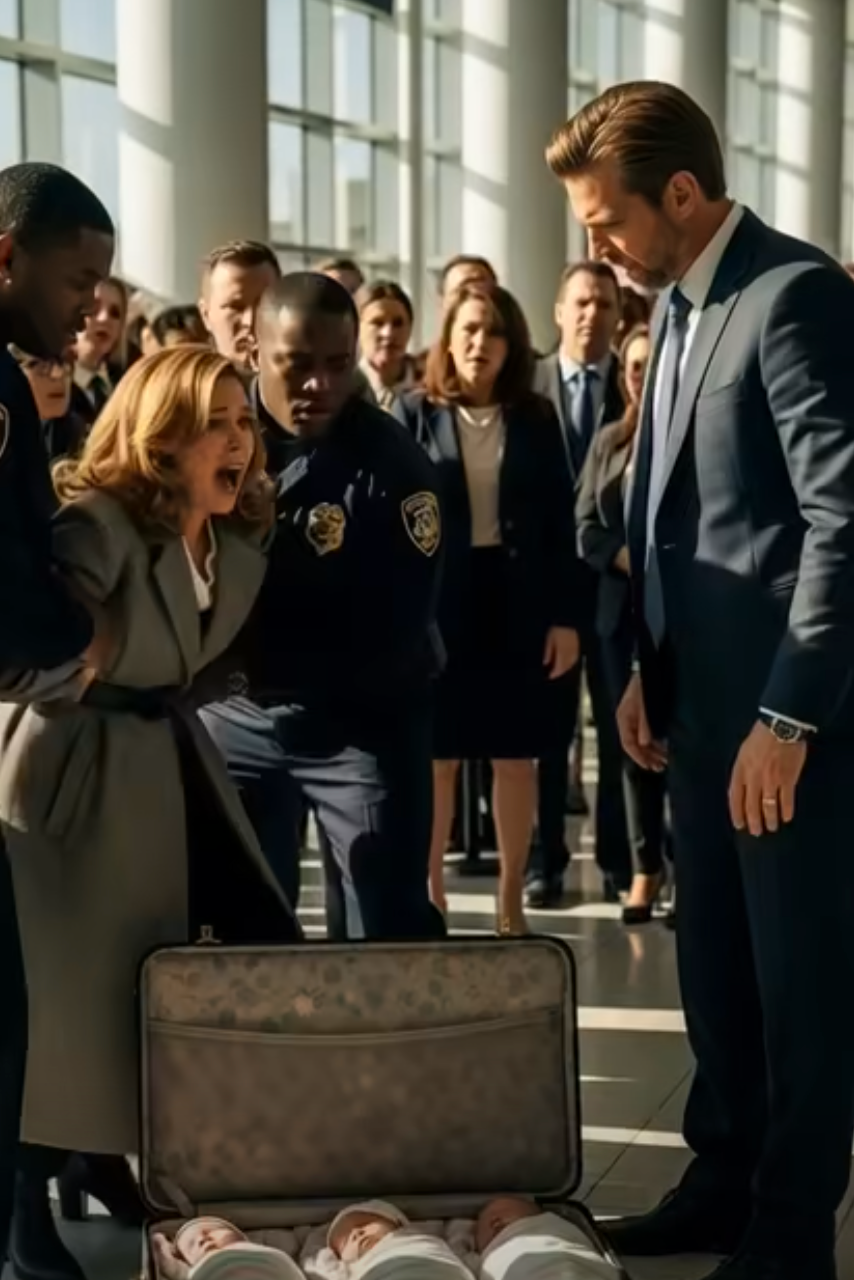
I stepped forward and looked inside. In my twenty years on the force, I have seen dead bodies. I have seen crime scenes that looked like slaughterhouses. But nothing, absolutely nothing, prepares you for the sight of evil packaged like dry cleaning.
The interior of the suitcase was lined with black velvet. Nestled inside, packed with grotesque precision between layers of bubble wrap and folded cashmere sweaters, were three infants.
They were tiny, likely no more than a few months old. They were positioned head-to-toe, like fragile vases in a shipping crate. Their mouths were taped shut with medical-grade adhesive. Their eyes were closed, their breathing shallow and rhythmic—chemically induced sleep. They didn’t move. They didn’t cry. They were sedated cargo.
Wedged between the middle child and the side of the case was a battery-operated bottle warmer. It had been switched on, likely by accident when the bag was shoved, and the vibration of its motor against the hard plastic shell was the “glitch” that had saved their lives.
A collective gasp rippled through the crowd as the image on the security monitors—which someone had forgotten to turn off—displayed the X-ray contents to the public. It was a skeletal, ghostly image of tiny bones curled in the fetal position.
The silence broke. A woman in the crowd screamed, a sound of pure, maternal horror. People began to shout. Some covered their mouths; others turned away, weeping. The reality of what was happening in their sterile, safe airport had just crashed down upon them.
I reached into the bag. My hands, usually steady, shook slightly. I peeled the tape gently from the mouth of the closest baby, a boy with dark fuzz for hair. I pressed two fingers to his neck.
Thump… thump… thump.
Slow. Too slow. But there.
“Paramedics!” I bellowed, my voice cracking. “Get the medics in here now! Code Blue! Pediatric emergency!”
Behind me, the sound of struggling resumed. Isabella Vance was still on the floor, pinned by the officers, but she had seen the monitors. She saw that the contents were revealed.
“I didn’t want them!” she screamed, her voice tearing at her throat. “I didn’t want them! I was just supposed to deliver the package! They forced me!”
The crowd turned on her. If looks could kill, Isabella would have been disintegrated on the spot. The “Greek Chorus” of the terminal shifted from fear to a palpable, dangerous rage.
“You monster!” someone shouted. “Let us at her!”
I stood up, turning slowly to face her. I felt a coldness settle over me, a detachment that was necessary for what I had to do next. I walked over to where she lay, her expensive blouse ruined, her face a mask of snot and tears. She looked up at me, seeking sympathy, seeking a deal.
“They said it was just documents!” she lied, sobbing. “Then they said it was drugs! I didn’t know it was… I didn’t know!”
“Liar,” I said quietly. The word cut through her hysterics. “You knew the weight. You knew the silence. You knew exactly why you had to bypass the regular scanners.”
I knelt beside her, bringing my face inches from hers. I wanted her to see the void in my eyes. “You don’t care about them, Isabella. You care that you got caught. That line—’I didn’t want them’—that’s going to play on loop at your trial. It’s going to be the epitaph on your tombstone.”
“Please,” she whimpered. “I have money. I can pay. Who do I need to pay?”
The sheer audacity, the ingrained belief that wealth could scrub away sin, almost made me laugh. Almost.
“You can’t buy your way out of this,” I said. “But you might be able to survive it.”
I stood up, looking over the heads of the officers at the chaotic scene. The paramedics had arrived. They were lifting the babies out with infinite tenderness, checking vitals, administering oxygen. The smallest one, the one whose warmer had vibrated, let out a weak cough. It was the most beautiful sound I had ever heard.
But the job wasn’t done. The mule was down, but the buyer was still waiting. And if Isabella didn’t show up, he would disappear into the wind, looking for another shipment, another mule.
I looked down at the sobbing socialite. “You’re right, Isabella,” I said, my voice carrying over the silent terminal, ensuring everyone heard. “You didn’t want them. But the man waiting for you in Arrivals does. And you’re going to help me destroy him.”
“I’m Detective Thorne, Human Trafficking Task Force,” I announced, flashing my badge to the airport security team who were looking at me for direction. “We’ve been tracking the ‘Stork’ ring for eight months. Isabella here was their golden goose—rich, frequent flyer, above suspicion. A perfect cover for moving ‘high-value goods’.”
I grabbed Isabella by the arm and hauled her to her feet. She couldn’t stand straight; her knees were water, her spirit broken. I dragged her away from the crowd, toward a service alcove, signaling my team to form a perimeter.
“Listen to me,” I hissed, pressing her against the wall. “That vibration? A faulty warmer. A stupid, mechanical mistake. It saved those kids, but it complicates my operation. The buyer is downstairs. He’s expecting a text. ‘Landed.’ If he doesn’t get it in the next two minutes, he vanishes. He assumes you’ve been burned, and he cuts ties. And you? You take the fall for all of it alone. Kidnapping. Trafficking. Child endangerment. You’ll die in prison, Isabella.”
Her eyes were wide, darting frantically. “He’ll kill me. If I talk, he’ll kill me.”
“If you don’t talk, you’re dead anyway,” I countered. “Look at your life, Isabella. It’s over. The galas, the champagne, the shopping trips? Gone. The only currency you have left is information. You want protection? You want a cell that isn’t in general pop? You give me the buyer.”
I pulled her phone out of her pocket. It was locked. I held it up to her face. “Unlock it.”
She hesitated. Her lip trembled. She was weighing the wrath of the cartel against the wrath of the judicial system.
“Unlock it!” I shouted, slamming my hand against the wall next to her head.
She flinched and the FaceID unlocked the device. I shoved it into her hand. Her fingers were shaking so badly she almost dropped it.
“Open your messages. The contact listed as ‘Concierge’.”
She looked up at me, stunned. “How did you…”
“I told you, I’ve been watching you for months. I know everything. I know about the gambling debts in Monaco. I know about the mortgage fraud. And I know ‘Concierge’ is the broker.”
I checked my watch. “Thirty seconds, Isabella. Send the text.”
She stared at the screen. Her thumb hovered over the keyboard. This was the moment. The pivot point between a criminal protecting her boss and a witness saving her own skin.
“I can’t,” she whispered. “He’s… he’s connected. You don’t understand.”
“I understand that there are three babies hooked up to oxygen tanks ten feet away because of you,” I snarled. “Type it. Lead me to the evidence.”
Isabella closed her eyes. A tear leaked out, cutting a track through her ruined foundation. She tapped the screen.
Landed.
She hit send.
The seconds dragged like hours. The little ‘delivered’ icon appeared. We waited. The terminal noise seemed to fade into a dull roar. All I could hear was Isabella’s jagged breathing.
Ping.
A reply.
I snatched the phone from her hand. The message was brief, coded, and chilling.
Bring the package to the black SUV, Curb 4. Driver is waiting. Don’t be late.
I looked at Isabella. She looked small, pathetic, trapped between the monsters she served and the law she scorned.
“Good girl,” I said, though the words tasted like ash. I keyed my radio. “All units, target is mobile. Black SUV, Curb 4. We have a green light. I repeat, green light for takedown.”
I smiled, a cold, humorless expression that I saw reflected in the glass of the alcove. “Game on,” I whispered, hauling Isabella back toward the concourse. “Time to meet your boss.”
The walk to Curb 4 was a blur of tactical movement. My team, the ghosts of the airport, materialized from the woodwork. Undercover agents in tactical vests threw on jackets labeled POLICE, weapons drawn but low.
We used Isabella as a shield, walking her out the automatic doors into the biting cold of the arrival curb. The exhaust fumes hit me, mingling with the smell of rain and asphalt.
“Walk to the car,” I ordered, my voice a whisper in her ear. “Smile. Act like you own the place.”
She tried. God help her, she tried. She straightened her spine, attempting to summon the arrogance that had been her defining trait an hour ago. But she was shaking.
The black SUV was idling in the no-parking zone, tinted windows opaque and menacing. As Isabella approached, flanked by me and another agent posing as her private security, the rear window rolled down just an inch.
“Put the bag in the trunk,” a voice growled from the dark interior.
“Do it,” I whispered.
Isabella motioned to the empty air, mimicking the signal for a porter. It was the signal.
“GO! GO! GO!”
The peaceful curb exploded into violence. Flashbangs detonated with blinding light and deafening cracks, stunning the driver. Agents swarmed the SUV, shattering the windows with batons.
“Police! Show me your hands! Hands!”
I didn’t watch the driver. I ripped the rear door open. The man inside was scrambling for a weapon under his seat. I grabbed him by the lapels of his expensive Italian suit and dragged him out onto the wet pavement.
It wasn’t a thug. It wasn’t a tattooed gangster. It was a man I recognized from the society pages. A high-profile adoption lawyer named Marcus Thorne (no relation, thank God), a man who claimed to find homes for the needy.
“Marcus Thorne,” I spat, pinning him with my knee. “You’re under arrest for human trafficking, kidnapping, and conspiracy.”
He looked up at me, blood trickling from a cut on his forehead. “Do you know who I represent?” he sneered. “This is a misunderstanding. I’m a humanitarian.”
“Tell it to the jury,” I said, cuffing him tight enough to bruise.
As the squad cars shrieked onto the curb, lights flashing red and blue against the grey sky, I looked back toward the terminal doors. Through the glass, I could see the scene inside.
It was a stark juxtaposition. Outside, violence, shouting, the chaotic dismantling of a criminal enterprise. Inside, a stillness. A female paramedic was sitting on a bench, holding the smallest infant against her chest. She was rocking him gently. The baby blinked, his eyes dark and confused, groggy but alive. He let out a strong, healthy cry—a sound of defiance against the silence of the suitcase.
Isabella watched as Marcus was shoved into a cruiser. He looked at her with pure, unadulterated hatred. She shrank back, realizing she was now an outcast from both worlds. She had no friends in high society, and she had no allies in the underworld. She was alone.
I watched the SUV drive away with the suspects. The adrenaline that had been fueling me for eight months began to drain away, leaving behind a heavy, crushing exhaustion. I looked at my reflection in the sliding glass doors—tired, older, grey stubble on my chin.
I reached into my pocket and pulled out a pack of cigarettes. My hand was trembling slightly as I lit one. I took a deep drag, the smoke filling my lungs, grounding me.
I walked back inside to check on the infants. The lead paramedic, a woman named Sarah whom I had worked with before, looked up. Her face was grave.
“Detective,” she said softly. “You need to see this.”
She pulled back the corner of the blanket that had been in the suitcase. It was embroidered with gold thread. A crest. A lion and a shield.
“What is it?” I asked, frowning.
“The blanket,” she whispered. “It has the Royal Crest of Estoria embroidered on it. These aren’t just random babies, Jack. They match the description of the triplets that went missing from the Royal Palace three days ago.”
She stopped, too afraid to finish the sentence.
I stared at the crest. The kidnapping that had been all over the international news. The “Stork” ring hadn’t just stolen children; they had stolen heirs.
Six months later.
The headlines had faded. “Socialite Sentencing” was old news, replaced by celebrity scandals and political gaffes. The world moves on quickly. It has a short memory for horror.
But at Terminal 3, time moves differently.
I sat on the same bench, near the same pillar, nursing a cup of coffee that was, inevitably, cold. I watched the stream of travelers—businessmen checking stocks, families wrestling with strollers, students with backpacks full of dreams.
Isabella Vance was currently serving the first year of a twenty-year sentence. She had testified against Marcus Thorne, bringing down a network that spanned three continents. Marcus was looking at life without parole.
As for the children? They were back in Estoria. I had watched the reunion on the news. The Queen weeping as she held her triplets. It was a good moment. A rare win in a game that usually ends in draws or losses.
But I wasn’t celebrating.
I took a sip of the bitter sludge. People ask me why I don’t retire. Why I don’t take a desk job. They say I’ve done enough.
I thought of Isabella. I thought of how easy it was for her to pack human life into luggage. I thought of the “Man in the Suit” disguise I wore—how easy it was to blend in, to watch, to wait.
Evil doesn’t sleep. It doesn’t take vacations. It evolves. It learns. It finds new ways to hide in plain sight.
“Evil doesn’t sleep,” I muttered to myself, scanning the crowd. My eyes landed on a man near the baggage claim. He was sweating, despite the air conditioning. He was gripping a violin case too tightly. “So neither do I.”
My phone buzzed in my pocket. A new tip from an informant at the docks.
Cargo ship ‘The Siren’ arriving in the harbor. Customs manifest says auto parts. Thermal imaging shows heat signatures in container 404.
I stood up, tossing my coffee in the trash. I adjusted my tie, smoothed down my charcoal suit. The airport was clean today. The floor shone under the fluorescent lights. But the city was still dirty.
I walked toward the exit, disappearing into the chaotic sea of faces. I was no longer a passenger. I was no longer just a man. I was a silent guardian in a loud world, walking toward the next shadow, waiting for the next vibration.
If you want more stories like this, or if you’d like to share your thoughts about what you would have done in my situation, I’d love to hear from you. Your perspective helps these stories reach more people, so don’t be shy about commenting or sharing.