My name is Emily Carter, and for as long as I can remember, my stepfather treated pain like a sophisticated game of chess.
He was a man of terrifying contradictions. To the outside world, Mark was the epitome of suburban respectability. He never drank to excess, never raised his voice in the grocery store, and possessed the kind of firm, reassuring handshake that made other men trust him instinctively. He was the neighbor who lent you his snowblower, the colleague who remembered your birthday, the man people warned you not to judge too harshly because he “worked so hard.”
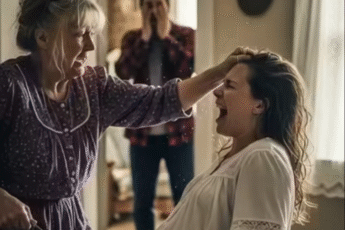
But within the four walls of our home, he found his entertainment in dismantling me, piece by piece. He didn’t just want to hurt me; he wanted to see if he could make me disappear while I was still standing in front of him. He would smile before he struck—a tight, thin curling of the lips—as if he were waiting for applause from an invisible audience. Sometimes it was a sharp slap that rang in my ears for hours; sometimes it was a calculated kick; other times, it was hours of calm, methodical insults delivered in a voice so low it sounded like a lullaby
And through it all, my mother stood in the kitchen, staring at the stainless-steel sink as if the secrets of the universe were hidden in the drain. She believed that if she didn’t see it, it wasn’t happening. But I knew the truth. The silence in our house wasn’t peaceful; it was heavy, suffocating, and loaded with a violence that was always just one heartbeat away.
I was thirteen years old when the realization finally crystallized in my mind: This is not normal.
It seems strange that it took so long, but a child’s reality is shaped by the walls they live within. I had friends at school who complained about early curfews, strict allowances, or parents who grounded them for bad grades. But I noticed something crucial—none of them flinched when a teacher raised a hand to write on the chalkboard. None of them had mastered the art of crying without making a single sound, allowing the tears to fall while keeping their breathing perfectly rhythmic so as not to draw attention.
Mark called his behavior “discipline,” a word he wielded like a weapon. But discipline implies rules, a structure where action A leads to consequence B. In our house, there were no rules. The logic shifted with the wind. If he had a bad day at work, I was the punching bag. If he was bored, I was the entertainment. If the world didn’t bend to his will, he made sure that I did.
My mother, Sarah, always had an explanation ready, wrapped in a fragile desperation.
“You shouldn’t talk back, Emily.”
“You know how he gets when the house is messy.”
“You should have moved faster.”
Every excuse she offered landed harder than his fists. Her words were a confirmation that in this war, I was entirely, devastatingly alone. She wasn’t protecting me; she was managing him. And the cost of her management was my safety.
The tension in the house had been building for weeks, like static electricity before a storm. I walked on eggshells, my body permanently coiled tight, waiting for the inevitable explosion. I didn’t know when it would come, but I knew, with a sickening certainty, that it would be worse than anything I had experienced before.
The day he broke my arm started with a deceptively sunny morning. The sky was a brilliant, cloudless blue—the kind of day that begs you to believe the world is good.
Mark stood in the doorway of the kitchen, sipping his coffee, his eyes tracking me as I ate my toast.
” The garage,” he said, his voice devoid of inflection. “It’s a disaster. I want it swept, organized, and the oil stains scrubbed before I get back from the hardware store. One hour.”
I nodded, abandoning my breakfast immediately. “Yes, Mark.”
I worked with a frantic energy. I swept the concrete until my palms burned. I reorganized the tool bench, aligning the wrenches by size, just the way he liked. I got on my hands and knees, scrubbing at old oil stains with a wire brush until the chemical smell made me dizzy. I checked everything twice. It looked perfect.
When his car pulled into the driveway forty-five minutes later, my heart hammered against my ribs like a trapped bird. He walked in, the sunlight casting his long shadow over the clean floor. He didn’t speak. He walked the perimeter of the room, running a finger along the shelves.
He stopped at the back corner, near the lawnmower. He crouched down and pointed to a small, dark smudge I had missed—a shadow of grease no bigger than a coin.
“Emily,” he said softly.
I froze. “I… I scrubbed everything. I must have missed—”
“You missed a spot,” he interrupted, turning to face me. The smile was there. That terrifying, tight smile. “Laziness is a disease, Emily. And I think we need to cure it.”
I took a step back, my hands trembling. “I’ll clean it right now. Please, Mark.”
He didn’t listen. He never listened. He lunged forward, not with the chaotic rage of a drunkard, but with the precision of a predator. He grabbed my arm, twisting it behind my back with unnecessary force. I cried out, trying to twist away, but his grip was iron.
“Stand still,” he hissed.
And then, he yanked.
I remember the sound more than the pain. It was a sharp, dry crack—like a dead branch snapping in a winter forest. It was a sound that didn’t belong to a human body.
The scream that tore from my throat was primal. It was loud enough that for a split second, even Mark looked startled. He let go, and I stumbled back, clutching my left arm. It hung at a sickening, unnatural angle, the bone clearly displaced.
The world went grey at the edges. Nausea rolled over me in a violent wave.
Mark stared at me, his face flushing red—not with guilt, but with annoyance. “Look what you made me do,” he spat. “Get in the car.”
The ride to the hospital was a blur of agony and terror. Every bump in the road sent a jolt of fire shooting up my shoulder, making me gasp. My mother sat in the passenger seat, her hands clasped so tightly in her lap that her knuckles were white. She wouldn’t look at me.
“Remember,” Mark said, his eyes meeting mine in the rearview mirror. His voice was calm, conversational. “You were riding your bike. You took a turn too fast on the gravel. You fell.”
I whimpered, cradling my shattered arm.
“Did you hear me, Emily?”
“Yes,” I whispered, tears streaming down my face. “I fell off my bike.”
“Sarah?” he prompted.
My mother nodded robotically. “She fell off her bike. She’s always so clumsy.”
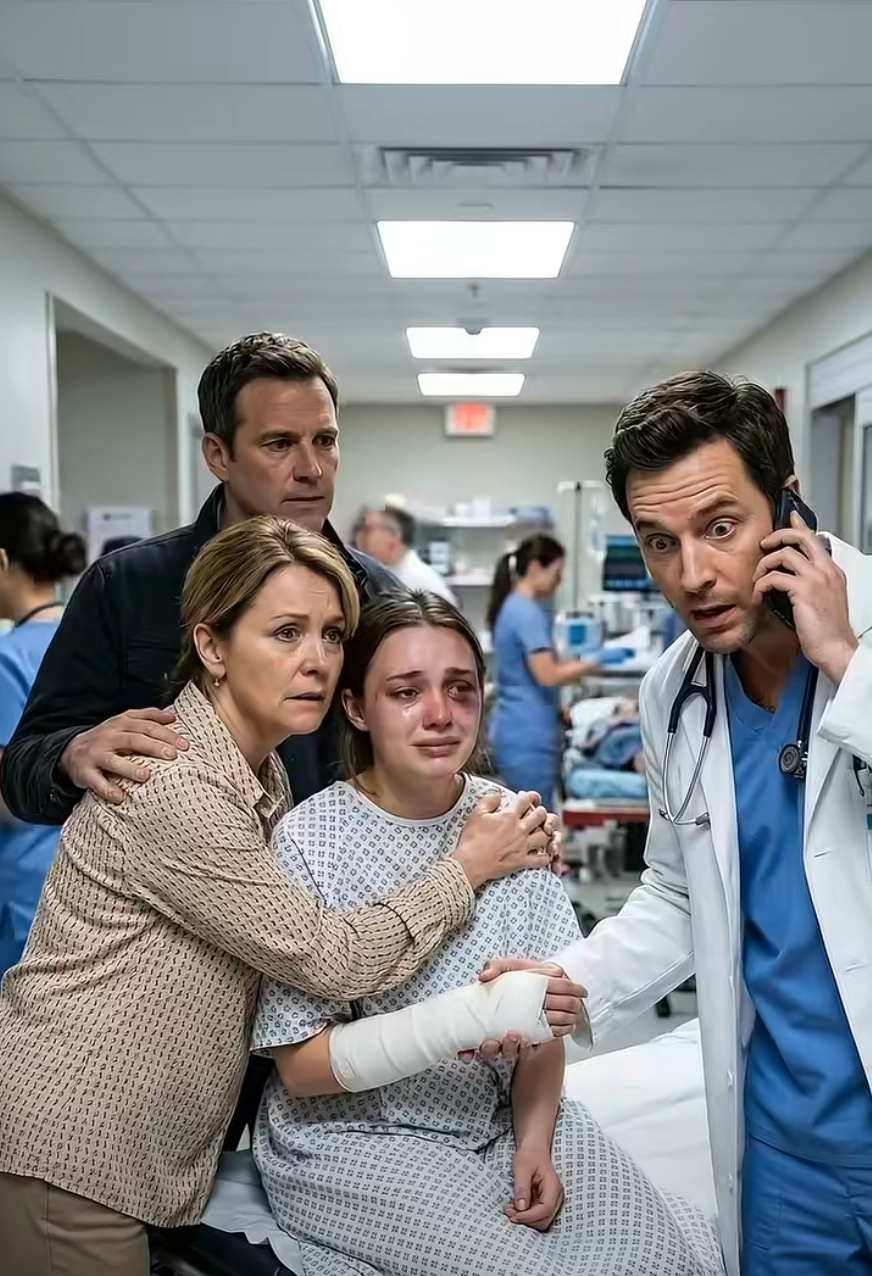
When we walked into the Emergency Room, the air smelled of antiseptic and floor wax. The bright fluorescent lights felt like an interrogation. Mark played the role of the concerned stepfather perfectly. He guided me to the chair, his hand resting on my good shoulder—a gesture that looked supportive to strangers but felt like a vice grip to me. It was a reminder: I am right here. Do not slip up.
My mother did the talking at the reception desk. She smiled that nervous, fluttering smile she used when she was terrified. “She had an accident,” she explained to the nurse. “Fell right off her bicycle. We told her to be careful.”
I sat staring at the speckled pattern of the linoleum floor, focusing on breathing. In for four, out for four. If I panicked, if I cried too much, Mark would be angry later. I had to be the brave little soldier.
Finally, we were called back. A nurse took my vitals, her eyes scanning my face, but I kept my head down. Then, the doctor entered.
He was an older man with greying hair and wire-rimmed glasses. His ID badge read Dr. Evans. He had a kind face, but his eyes were sharp, intelligent, and piercing. He didn’t breeze in and out like some doctors do. He walked in, introduced himself, and stood there for a moment, just observing the room.
He looked at Mark, standing protectively (possessively) by the door. He looked at my mother, who was picking at a loose thread on her sweater, refusing to make eye contact. And then he looked at me.
“So, Emily,” Dr. Evans said, his voice gentle but commanding. “I hear you took a spill on a bike. That must have hurt.”
I opened my mouth to recite the script, but the words stuck in my throat. The pain in my arm was a throbbing, screaming entity. I managed a nod.
He began to examine the arm. His touch was incredibly light, yet I flinched violently when his fingers grazed the skin near the break. He paused. He didn’t just look at the broken bone; he looked at the bruising pattern. He looked at the older, yellowing bruises on my upper arm—the ones from last week’s “lesson.”
“The X-rays show a spiral fracture,” Dr. Evans said, mostly to himself. He looked up, his gaze locking onto Mark’s. “That’s a simplified explanation, of course. But it’s a twisting injury.”
“She got tangled in the bike frame,” Mark said quickly. Smoothly. “It was a mess.”
Dr. Evans didn’t break eye contact with Mark. “And the bruising on the upper arm? The finger marks?”
“I grabbed her to try and catch her,” Mark said, his jaw tightening. “I didn’t want her to hit the pavement.”
The room went silent. The air pressure seemed to drop. Dr. Evans turned back to me. He crouched down so he was eye-level with me. For the first time, someone was looking at me, not through me.
“Emily,” he whispered. “I need you to be honest with me. Did you fall off a bike?”
I looked at Mark. His eyes were hard, promising retribution. I looked at my mother. She was staring at the wall, a single tear tracking down her cheek.
I looked back at Dr. Evans. In his eyes, I saw something I hadn’t seen in years. Safety.
I opened my mouth, then closed it. Fear glued my tongue to the roof of my mouth.
Dr. Evans stood up slowly. He didn’t sigh. He didn’t scold. He looked at the nurse, who was standing by the computer, her body tense.
“Excuse me for a moment,” Dr. Evans said. His voice was different now—steely, professional, and final.
He stepped out of the room, leaving the door slightly ajar. The silence he left behind was deafening. Mark shifted his weight, looking agitated. “What is taking so long? Incompetent…”
From the hallway, I heard Dr. Evans’ voice. He wasn’t whispering. He was speaking clearly, loudly enough for us to hear, as if he wanted us to hear.
“This is Dr. Evans in the ER. I have a confirmed pediatric spiral fracture inconsistent with the stated history. I need to report suspected severe child abuse. Please send officers immediately. The suspect is in the room.”
That sentence hung in the air like a guillotine blade.
The room felt instantly smaller. My mother’s face drained of all color, turning a sickly shade of grey. Mark stood up so fast his chair scraped loudly against the floor, a harsh screech that made me jump.
“That son of a bitch,” Mark hissed. He started pacing, his hands balling into fists. “Who does he think he is? Overreacting idiot. We’re leaving, Sarah. Get her up.”
“I… I can’t,” my mother stammered, her voice trembling. “Her arm…”
“I said get her up!” Mark roared, the mask finally slipping completely.
I sat frozen, my arm throbbing, my chest tight with terror and something else I barely recognized—hope. It was a fragile, dangerous thing, but it was there.
Before Mark could reach me, the door swung open. It wasn’t Dr. Evans. It was two police officers, and behind them, two large hospital security guards.
“Sir, step away from the girl,” the lead officer said. His hand rested near his belt. He wasn’t asking.
Mark drew himself up, inflating his chest. “This is ridiculous. I am a respectable member of this community. That doctor is lying. We are leaving.”
“You aren’t going anywhere,” the officer replied calmly. “Step out into the hallway. Now.”
Mark hesitated. For a second, I thought he might fight. But Mark was a bully, and like all bullies, he crumbled when faced with someone bigger than him. He sneered, shooting one last venomous look at me—a look that said this isn’t over—and walked out.
My mother tried to follow him, moving like a shadow tethered to his heels.
“Ma’am, please stay here,” a nurse said, stepping gently but firmly in her path.
“But he’s my husband,” she wept. “He didn’t mean to…”
“Please sit down,” the nurse said.
Another nurse, an older woman with kind eyes, pulled a chair right up to mine. She ignored my mother completely. She took my good hand in hers. Her hands were warm.
“You’re safe now, sweetie,” she whispered. “No one is going to hurt you here. Do you understand?”
Safe. The word felt foreign, like a language I hadn’t spoken in years.
An officer knelt in front of me. He wasn’t wearing a white coat; he was in a uniform that smelled of rain and coffee. He took off his cap.
“My name is Officer Miller,” he said. “You’re not in trouble, Emily. I promise. But I need you to be brave for one more minute. Can you tell me what happened to your arm?”
I looked at the door where Mark had disappeared. I looked at my mother, who was sobbing into her hands, muttering about how “he loves us, he just has a temper.”
I realized then that she wasn’t going to save me. She never was. If I wanted to live—truly live—I had to save myself.
“I didn’t fall off my bike,” I whispered.
“I can’t hear you, Emily,” Officer Miller said softly.
I took a deep breath, inhaling the antiseptic air, and let the truth spill out. “He broke it. I missed a spot in the garage. He snapped it.”
Once the dam broke, the words poured out like a flood. I told them about the beatings. The insults. The way he made me stand in the corner for hours. The bruises I hid with long sleeves in the summer. The way my mother turned up the radio to drown out the noise.
Saying it out loud felt like ripping open a festering wound, painful and raw, but it also felt like breathing for the first time in years.
The next few hours were a whirlwind of flashbulbs and questions.
Child Protective Services (CPS) arrived. A woman named Jessica, who carried a notepad and looked at me with a fierce sadness, took photos of my injuries. She photographed my broken arm, the fingerprints on my shoulder, and the old yellow bruises on my back that I had forgotten were there.
My mother was interviewed in a separate room. When she came out, her eyes were red and swollen. She looked at the CPS worker and pleaded, “I’m trying to keep this family together. You don’t understand the pressure he’s under.”
Jessica looked at my mother, her expression unyielding. “You are trying to keep the family together,” she said, her voice dripping with ice, “at the cost of your daughter’s life.“
Mark was arrested that night. I watched from the window of the hospital room as they led him to the patrol car. Seeing him in handcuffs didn’t feel like a victory, exactly. It felt surreal. Like watching a monster in a movie finally get caught. He looked smaller. Without his fear-tactics, without his control, he was just a man. A pathetic, angry man.
My mother wasn’t arrested, but the investigation determined she had failed to protect me. I wasn’t allowed to go home with her.
“We’re going to place you in a temporary foster home,” Jessica explained to me. “Just until we sort everything out. It’s a safe place, Emily.”
I nodded. I didn’t care where I went, as long as it wasn’t back to that house.
The foster home was a large, rambling house on the edge of town owned by the millers (no relation to the officer). It was… quiet.
That was the hardest part at first. The silence.
In Mark’s house, silence was a threat. It was the calm before the violence. In the foster home, silence was just… silence. I slept with the light on for three weeks. I lay awake, straining my ears, expecting to hear heavy footsteps in the hallway, expecting the door to fly open.
It took weeks before I stopped flinching when Mrs. Miller moved her hand too fast to grab the salt shaker. It took months before I could hear a door slam without my heart stopping.
Therapy was mandatory, and it was brutal. Sitting in a room, dissecting the trauma, realizing that “discipline” was actually abuse. Learning that it wasn’t my fault. That was the hardest pill to swallow. For years, I had believed that if I were just better—cleaner, quieter, smarter—he wouldn’t hit me.
My therapist, Dr. Aris, told me, “You couldn’t have behaved your way out of his violence, Emily. His violence was about him, not you.”
My mother tried to visit. I refused. Not out of spite, but out of self-preservation. I needed space to understand how the person who gave birth to me, who was supposed to be my first line of defense, had chosen to protect her lifestyle over my safety.
Healing didn’t happen overnight. It was a slow, jagged climb. But for the first time in my life, I was climbing toward the light.
Ten Years Later.
The scars on my arm have faded to thin, silvery lines. The bone healed, stronger than it was before—calcified and tough. The scars on my soul are still there, but they no longer define the map of my life.
Mark was convicted of felony child abuse. He served seven years. I never saw him again, and I never will. His power over me died the moment Officer Miller put him in that car.
My mother and I have a relationship now, but it is fragile. She eventually admitted her failure. It wasn’t a dramatic, movie-style apology with weeping and hugging. It was a quiet conversation over coffee, where she looked at her hands and admitted she was a coward. She admitted she traded my childhood for her security. It’s a painful truth, but it’s the truth. And we build on that.
I went to college. I didn’t become a doctor, but I entered the field that saved me. I am a social worker now.
I work with kids who remind me of my thirteen-year-old self. The quiet ones. The ones who wear long sleeves in July. The ones who flinch when you move too fast. I see them. I see the secrets hiding behind their eyes.
I often think back to that day in the ER. I think about Dr. Evans. He didn’t know me. I was just another number on a chart. He could have treated the arm, accepted the lie, and went home to his dinner. It would have been easier. It would have been less paperwork, less drama.
But he chose to see. He chose to listen to his instincts rather than the polite excuses of a suburban couple. He chose to be uncomfortable.
What I learned is this: Abuse survives in silence. It thrives in the shadows, nourished by the polite averted gazes of neighbors, teachers, and family members. It grows strong when people decide that “it’s none of my business.”
One person choosing to intervene can change the trajectory of a life. That doctor saved me. Not by fixing my bone, but by validating my reality. By saying, loudly and clearly, This is wrong.
If you are reading this, and something about my story feels familiar—if your stomach tightens when you hear the garage door open, if you walk on eggshells in your own home—please hear me: You are not weak. You are not crazy. And you are not alone.
Telling the truth is the most terrifying thing you will ever do. It feels like jumping off a cliff. But I promise you, there are people waiting to catch you.
And if you are a parent, a teacher, a neighbor, or just a stranger in a grocery store… look closer. If you see fear in a child’s eyes, don’t look away. If a story doesn’t add up, ask questions. Trust your gut.
Speaking up is messy. It creates chaos. It shatters the status quo. But sometimes, chaos is the only thing that can break the chains. Speaking up could be the moment someone else finally gets a chance to breathe.
Stories like mine happen every day, behind closed doors in houses that look just like yours. If this story moved you, if it made you think, please share it. Talk about it. Start the uncomfortable conversation.
You never know who might be silently screaming for help—just waiting for someone brave enough to listen.