Chapter 1: The Long Road Home
I had spent the last three hundred and sixty-five days dreaming of a specific shade of green. It wasn’t the olive drab of my uniform, nor the scorched, dusty brown of the foreign desert that had been my reality for far too long. It was the vibrant, swaying emerald of the tall grass in Topeka, Kansas. It was the color of home.
My name is Sergeant Daniel Miller. At thirty-eight years old, I carried the weight of three deployments in my knees and the silence of too many lost friends in my heart. But as my boots finally crunched against the gravel of my own driveway, none of that mattered. The roar of the C-130 transport plane was replaced by the familiar, rhythmic chugging of my old Chevy truck’s engine. I killed the ignition, and the silence that followed was heavy, thick with the humidity of late summer and the chirping of cicadas.
I sat there for a moment, gripping the steering wheel until my knuckles turned white. This was it. The finish line. My discharge papers were signed, sealed, and tucked in the glove box. I was done with war. My new mission—my only mission—was waiting for me inside that farmhouse: my twelve-year-old daughter, Emily.
She was the anchor that had kept me from drifting away during the darkest nights in the barracks. I had missed her eleventh and twelfth birthdays, missed the school plays, missed the scraped knees and the growing pains. But I had promised myself, and the memory of her late mother, that I would make it up to her.
I stepped out of the truck, slinging my duffel bag over my shoulder. The air smelled of heated earth and dry wheat, a scent that usually brought me peace. But as I looked up at the house, a frown creased my forehead.
The farmhouse, which I had left in pristine condition—a point of pride for me—looked… tired. Paint was peeling from the shutters in long, gray strips like dead skin. The swing set in the side yard, which I had anchored with concrete myself, was listing dangerously to the left, one chain broken and dangling in the breeze. The grass, usually kept trim, was waist-high in patches, and the flowerbeds were choked with aggressive, thorny weeds.
A cold prickle of unease started at the base of my neck. My younger sister, Rachel, had sworn up and down that she would hold the fort. She had moved in to care for Emily, promising me that the stipend I sent home every month was more than enough to keep the place running and put food on the table.
She’s probably just busy, I told myself, trying to suppress the soldier’s instinct to scan for threats. Raising a pre-teen isn’t easy.
I walked toward the front porch, but a sound stopped me. It was a low, rhythmic snuffling, coming from the direction of the old barn about fifty yards behind the house. We hadn’t kept livestock in years, not since my dad passed, but the sound was unmistakable. Pigs.
Curiosity, mixed with that gnawing sense of dread, pulled me away from the front door and toward the barn. The structure was in worse shape than the house; the roof sagged, and the wood was gray and rotting. As I got closer, the smell hit me—not the earthy, honest smell of a working farm, but the sharp, ammonia-heavy stench of neglect.
I reached the half-rotted wooden door and pushed. It groaned on rusted hinges, swinging open to reveal the dim, dusty interior. Shafts of sunlight pierced through holes in the roof, illuminating dancing dust motes and buzzing flies.
I took two steps inside and froze. My duffel bag slipped from my shoulder and hit the dirt with a dull thud.
There were pigs, yes—three massive sows rooting around in a pen that hadn’t been mucked out in weeks. But that wasn’t what stopped my heart.
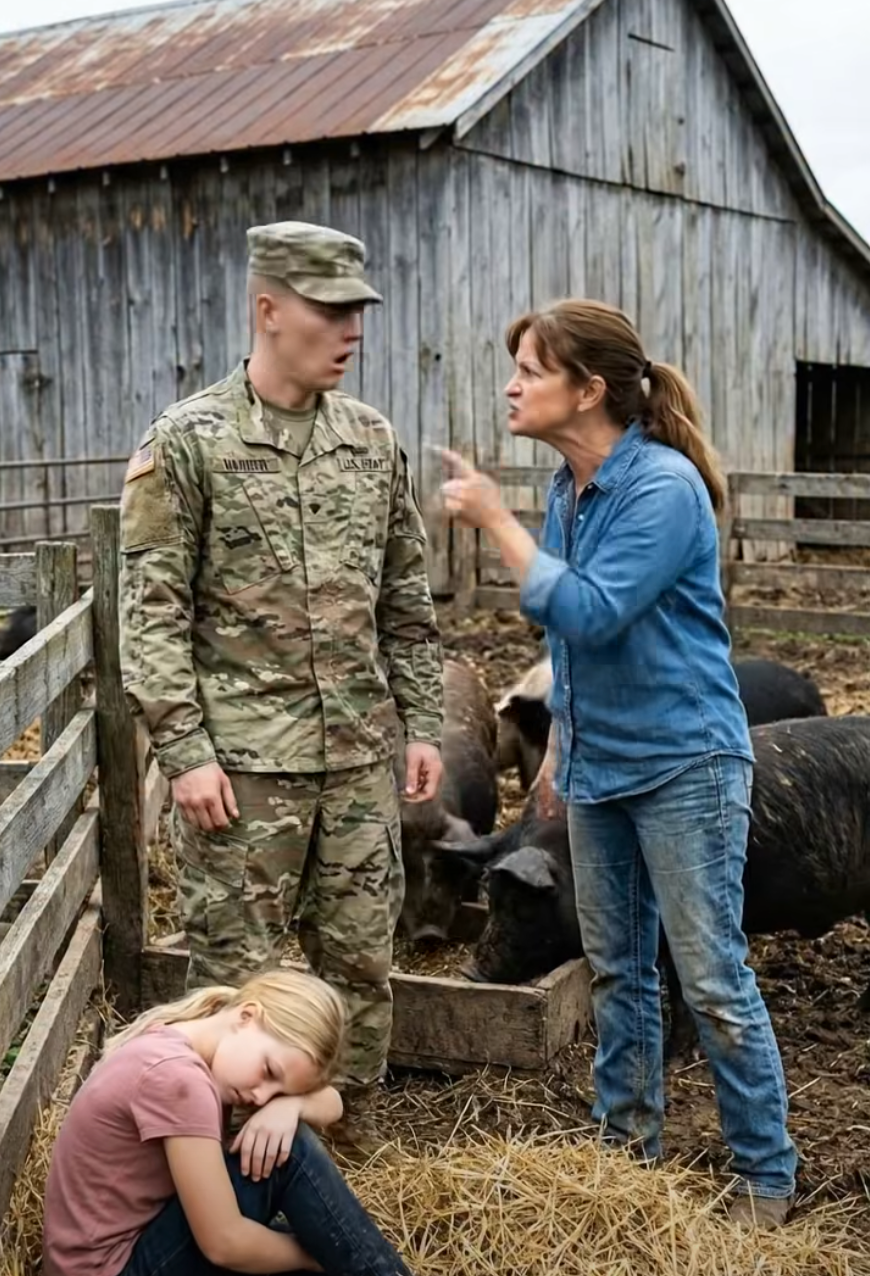
In the corner of the pen, curled up on a filthy pile of straw, was a child.
Her blonde hair, usually spun gold, was a matted, tangled mess of knots and dirt. Her clothes were two sizes too small, torn at the seams and stained with mud. Her face was streaked with grime and dried tear tracks. She was fast asleep, her small, thin hand resting on the flank of a sleeping sow as if the beast were a plush teddy bear.
It was Emily.
My chest constricted so violently I thought I was having a heart attack. Rage, hot and blinding, flooded my vision, turning the edges of the world red. I wanted to scream, to tear the barn down with my bare hands. But then I saw her shoulders rise and fall in a shallow, jagged rhythm. She looked fragile. Broken. Like a prisoner of war I’d found in a hostile village, not my beloved daughter in the safety of America.
I forced myself to breathe. In. Out. Assess the situation.
I stepped into the pen. The mud squelched over my polished boots. The pigs stirred, grunting, but they didn’t move away from her. It was as if they had accepted her into their fold, guardians of a girl who had been cast aside by humans.
I knelt beside her, the stench overwhelming, and reached out a shaking hand to brush a strand of hair from her face.
“Emily?” I whispered, my voice cracking.
She flinched violently, her eyes snapping open. For a second, there was no recognition in those blue depths—only terror. She scrambled backward, pushing herself against the rough wood of the stall, pulling her knees to her chest in a defensive ball.
“No, no, I’m sorry!” she cried out, her voice raspy and hoarse. “I didn’t steal it! I didn’t eat the bread, I promise!”
Chapter 2: The Enemy Within
The sound of my daughter begging for forgiveness for eating food shattered whatever composure I had left. The soldier in me vanished, replaced instantly by a father whose heart was being ripped out through his ribs.
“Emily, look at me,” I choked out, holding my hands up, palms open. “It’s Dad. It’s me, sweetheart.”
She froze, her wide eyes darting over my face. She scanned my features—the scar on my chin, the shape of my nose—searching for the father she knew beneath the tan and the exhaustion. Slowly, the terror began to recede, replaced by a confusion that was almost as painful to witness.
“Dad?” she whispered, the word barely more than a breath.
“Yes, baby. It’s me.” I disregarded the filth, the smell, and the pig manure. I lunged forward and pulled her into my arms.
She felt like a bird—all hollow bones and trembling skin. She didn’t hug me back immediately; she stayed rigid, as if she had forgotten how to be held. Then, a sob broke from her chest, a guttural sound of pure relief, and she collapsed against me, burying her face in my shoulder.
“I thought you weren’t coming back,” she sobbed, her tears soaking my shirt. “Aunt Rachel said you were gone forever. She said you forgot me.”
“I would never forget you,” I vowed, my voice dropping to a dangerous, low growl. “Never.”
I held her until her shaking subsided to a dull tremble. “Why are you out here, Em? Why are you sleeping with the pigs?”
She pulled back, wiping her nose on her dirty sleeve. She hesitated, biting her lip—a nervous habit she’d had since she was a toddler. “Aunt Rachel… she doesn’t like me in the house. She says I’m too loud. She says I make too much of a mess and that I cost too much money. She moved her… her friends in. There wasn’t room for me anymore.”
“She what?” The blood pounded in my ears like a war drum.
“She said the barn was good enough,” Emily murmured, looking down at her hands. “She said I was lucky she didn’t send me to the orphanage. So I started staying out here. It’s quieter. The pigs… they’re nice. They keep me warm when it gets cold at night.”
I stood up, lifting her effortlessly into my arms. She was far too light for a twelve-year-old. “We’re going inside. Now.”
“No!” Emily panicked, gripping my shirt. “She’ll be mad! She has company over. She said if I came in while they were there, she’d lock me in the cellar again.”
The cellar.
That was it. The final straw. The calm, rational part of my brain, the part that followed rules of engagement and protocols, shut down. What was left was a singular, predatory focus. I was walking into a combat zone, and the enemy was sitting in my kitchen.
“Let her try,” I said, my voice icy. “You are never going back in that cellar, and you are never sleeping in this barn again.”
I carried her out of the barn and across the yard. The sun was setting now, casting long, bloody shadows across the overgrown grass. I kicked the front door open with enough force that the handle punched a hole in the drywall.
The smell inside the house was different from the barn, but no less revolting. It reeked of stale cigarette smoke, spilled beer, and something sickly sweet. The living room was a disaster zone—pizza boxes piled high, overflowing ashtrays, and unfamiliar clothes strewn over my furniture.
Laughter drifted from the kitchen.
I walked in, Emily clinging to my neck.
Rachel was sitting at the kitchen table, a cigarette dangling from her lips, scrolling through her phone. Across from her sat a man I didn’t know—a guy with greasy hair and tattoos up his neck, leaning back in my chair, drinking my beer.
They didn’t even look up immediately.
“I told you, kid, stay out of the—” Rachel began, her tone bored and irritated, finally glancing up.
The words died in her throat. The cigarette fell from her lips, landing on the linoleum with a sizzle.
“Daniel?” she gasped, her face draining of color.
“Get out,” I said. It wasn’t a shout. It was a command, delivered with the absolute authority of a man who had stared down death and won.
“Danny! I… we didn’t expect you until next week!” She scrambled up, knocking her chair over. She tried to smile, a grotesque, twitching expression. “Look, you’re home early! That’s… that’s great! I was just—”
“I found my daughter sleeping in pig shit, Rachel,” I cut her off, stepping closer. The stranger at the table sensed the shift in the atmosphere and slowly started to stand up.
“Sit down,” I barked at him, not even turning my head. The man sat back down instantly, intimidated by the sheer violence radiating off me.
I turned my eyes back to my sister. “You told her I wasn’t coming back. You locked her in the cellar. You starved her.”
“You’re being dramatic,” Rachel scoffed, trying to regain her ground, though her hands were shaking. “The kid is difficult, Daniel! You don’t know what she’s like. She acts out. I had to be tough on her. I’m doing you a favor!”
“A favor?” I laughed, a harsh, dry sound. “I sent you three thousand dollars a month. Where is it, Rachel? Look at this house. Look at my daughter!”
“I have expenses!” she shrieked, her facade cracking. “I have a life too! You think I wanted to be stuck here babysitting your brat while you played hero overseas?”
“You had a choice,” I said, my voice dropping to a whisper. “You could have said no. But you took the money. And you treated my child worse than a stray dog.”
I gently set Emily down on a mostly clean chair. “Stay here, sweetheart.”
I turned back to Rachel and the stranger. “You have exactly ten minutes to pack your things and get off my property. If you are still here in minute eleven, I will call the police, and I will show them the condition of my child. And then, I will handle you myself.”
“You can’t kick me out!” Rachel screamed, her face twisting into an ugly snarl. “I have rights! I’ve been living here!”
“You’re trespassing,” I countered. “And you’re a child abuser. Test me, Rachel. Please. Give me a reason.”
She looked at me, really looked at me, and saw that the brother she used to bully was gone. In his place was a stranger who had seen things she couldn’t imagine.
She grabbed her purse. “Come on, Jeff,” she spat at the man. “Let’s go. This place is a dump anyway.”
She stomped toward the door, but stopped at the threshold, turning back with a sneer.
“You think you’ve won, Danny boy? You have no idea what you’re doing. That girl is damaged goods. You’ll see. You’ll be begging me to come back and help you within a month.”
Chapter 3: The Ghost of the House
The slam of the front door shook the house, knocking a picture frame off the wall. It shattered on the floor—a photo of me, my late wife, and a toddler Emily, smiling in a park. The glass spiderwebbed across our happy faces, a perfect metaphor for the reality I had returned to.
I stood there for a moment, listening to the roar of Rachel’s car peeling out of the driveway. Only when the sound faded into the distance did I let my shoulders drop. The adrenaline that had sustained me began to ebb, leaving behind a crushing fatigue.
I turned to Emily. She was sitting on the edge of the chair, her legs swinging nervously, looking at me as if I might explode.
“Are they gone?” she whispered.
“They’re gone, baby. For good.”
“Is Aunt Rachel mad at me?”
The question broke my heart all over again. “No. She has no right to be mad at anyone but herself. You did nothing wrong. Do you hear me? Nothing.”
I looked around the kitchen. The sink was overflowing with dishes that had started to grow mold. The refrigerator, when I opened it, contained a six-pack of beer, a jar of pickles, and a carton of milk that had expired two weeks ago. There was no food. No real food for a growing child.
“I’m hungry, Dad,” Emily said softly.
“I know. We’re going to fix that.”
I found a can of soup in the back of a cupboard—chicken noodle, her favorite—and heated it up on the stove, scrubbing a pot clean first. As she ate, devouring the simple meal with a ferocity that told me she hadn’t eaten a full meal in days, I walked through the rest of the house.
It was a violation. My bedroom had been rummaged through, drawers pulled out, my clothes likely sold or stolen. The guest room, where Rachel had presumably been staying, smelled of cheap perfume and rot. But it was Emily’s room that hurt the most.
The door was locked from the outside with a sliding bolt that hadn’t been there when I left.
I slid the bolt back and pushed the door open. The room was bare. Her bed was stripped of sheets. Her toys were gone. Her books were missing. It was a cell, nothing more.
I closed the door, my hand trembling on the knob. I will rebuild this, I swore to myself. I will fix this.
But the battle wasn’t over. Two days later, a black sedan pulled up the driveway. A woman in a grey pantsuit stepped out, carrying a clipboard. She had “bureaucracy” written all over her posture.
I met her on the porch. Emily was inside, coloring in a new sketchbook I had bought her.
“Mr. Miller?” the woman asked, adjusting her glasses. “I’m Sarah Jenkins from Child Protective Services. We received an anonymous tip regarding the welfare of a minor at this address.”
Rachel. It had to be. Spiteful to the bitter end.
“My daughter is fine,” I said, my posture rigid. “I just got back from deployment. I’m her father.”
“The report claims the child was found sleeping in a barn and is suffering from malnutrition,” Ms. Jenkins said, her eyes cold and assessing. “I need to see the child and inspect the home. Now.”
I wanted to slam the door in her face. I wanted to tell her to get off my land. But I knew that was the quickest way to lose Emily. Rachel knew exactly which buttons to push. She knew the system.
“Come in,” I said, stepping aside.
The house was cleaner than it had been forty-eight hours ago—I had scrubbed until my fingers bled—but it was still sparse. The “Yellow Room” I was planning for Emily was just a primer-coated box.
Ms. Jenkins walked through the house, ticking boxes on her clipboard. She ran a finger over the mantelpiece. She opened the fridge (now stocked with fresh groceries). Finally, she sat down with Emily.
I stood in the doorway, heart hammering, as she asked my daughter questions.
“Do you feel safe here, Emily?”
“Yes,” Emily said, her voice small but sure.
“Where do you sleep?”
“In my dad’s room, on a mattress on the floor. Until we fix my room.”
“Did your father hurt you?”
“No!” Emily looked offended. “My dad saved me. Aunt Rachel… she was the mean one.”
Ms. Jenkins paused, her pen hovering over the paper. She looked at Emily, really looked at her, noting the clean hair, the new clothes, but also the lingering shadows under her eyes and the way she flinched when the refrigerator hummed too loudly.
She stood up and walked over to me.
“Mr. Miller,” she said, her voice lower. “The allegations in the report… about the barn. Were they true?”
I swallowed my pride. “Yes. My sister… I left Emily in her care. I didn’t know. I came home and found her there. I kicked my sister out immediately.”
Ms. Jenkins studied me. She saw the desperation in my eyes, the fierce protectiveness.
“I can see you’re trying,” she said, closing her folder. “But this… this is a precarious situation. You’re a single father, recently returned from combat, likely dealing with your own adjustment issues. And this child has been severely neglected.”
“I can handle it,” I said instantly.
“It’s not about what you think you can handle,” she countered sternly. “It’s about what’s best for her. I’m going to keep this case open. I’ll be back in two weeks for a follow-up. If I see any sign that you aren’t coping, or that the house isn’t suitable, I will petition for emergency removal. Do you understand?”
“I understand,” I said.
As she drove away, I sank onto the porch steps. Two weeks. I had two weeks to turn a house of horrors back into a home, or I would lose the only thing I had left fighting for.
Chapter 4: Operation Restoration
The clock was ticking.
For the next fourteen days, I didn’t sleep. I attacked the renovation of the farmhouse with the same tactical precision I had used to clear villages in the desert.
I started with the Yellow Room.
“Why yellow?” Emily asked me on the third day, as she watched me pry open a can of paint.
“Because it’s the color of the sun,” I told her, dipping the brush. “And I think we both need a little more light in our lives.”
She picked up a brush, her small hand hesitant. “Can I help?”
“I couldn’t do it without you, trooper.”
We painted side by side. At first, she was quiet, fearful of making a mistake. But when she accidentally swiped a streak of yellow across my nose, I didn’t yell. I laughed. I dipped my finger in the paint and dotted her nose.
She froze for a second, then a giggle bubbled up—a rusty, unused sound that quickly turned into a genuine laugh. It was the best sound I had ever heard.
We worked from dawn until dusk. I repaired the swing set, welding the broken chain and sanding down the rust. I mowed the lawn, battling the jungle until it looked like a civilized yard again. I tore down the pig pen in the barn, board by rotting board, burning the wood in a massive bonfire that felt like a purification ritual.
But the physical repairs were the easy part. The internal repairs were harder.
At night, the nightmares came. Not just for me, but for her. I would wake up to the sound of her screaming, thrashing in her sleep, terrified that she was back in the cellar or that the pigs were biting her.
I would rush to her side, shaking her gently awake. “I’m here, Em. I’m here. You’re safe.”
One night, she woke up sobbing, unable to catch her breath.
“I’m useless,” she cried, rocking back and forth. “Aunt Rachel said I was a burden. She said you only came back because you had to, not because you wanted to.”
“That is a lie,” I said fiercely, grabbing her shoulders. “Listen to me. You are my world. The only reason I survived over there was so I could come back to you. You are not a burden. You are my purpose.”
I went to my duffel bag and pulled out a worn, dog-eared copy of The Hobbit. It was the book her mother used to read to her.
“Do you remember this?” I asked.
She nodded slowly.
“Let’s read,” I said. “Just like Mom used to.”
I started at chapter one. My voice was gruff, not soft like her mother’s, but as I read about hobbits and dragons and unexpected journeys, I saw the tension leave her body. She leaned her head against my arm, her breathing slowing.
“Dad?” she mumbled, her eyes heavy.
“Yeah, baby?”
“The barn… it wasn’t all bad. The pigs were nice to me. Better than Rachel.”
I kissed the top of her head, fighting back tears. “I know. But you deserve better than pigs, Emily. You deserve kings and elves.”
Two weeks flew by. The house was transformed. It wasn’t perfect—the furniture was mismatched, and the roof still needed work—but it was clean, warm, and filled with the smell of baking bread (a recipe I had failed at twice before getting right).
When Ms. Jenkins’ car pulled up again, I was ready.
She walked through the house, her heels clicking on the scrubbed floors. She saw the yellow room, bright and cheerful. She saw the fully stocked fridge. She saw the schedule on the wall for school and therapy appointments I had booked.
She turned to me, her expression unreadable.
“You’ve been busy, Mr. Miller.”
“I told you,” I said. “I’m on a mission.”
She looked at Emily, who was sitting at the table doing math homework. Emily looked up and smiled—a real, genuine smile.
“She looks… different,” Ms. Jenkins admitted. “Lighter.”
“She’s home,” I said.
Ms. Jenkins sighed, closing her file. “Okay. I’m going to recommend we close the active investigation, pending one final check-in next month. You’ve done good work, Daniel.”
Relief washed over me so continually my knees almost buckled. “Thank you.”
“Don’t thank me,” she said, walking to the door. “Just keep it up. She needs you.”
Chapter 5: Fireflies and Promises
A month later, the Kansas heat finally broke, giving way to a cool, crisp autumn evening.
We sat on the front porch, the old swing creaking gently as we rocked. The yard was neat, the flowerbeds mulched and ready for winter. The nightmare of the barn felt like a distant memory, though I knew the scars—for both of us—would take longer to fade than the paint on the walls.
Rachel had tried to call once, leaving a voicemail full of venom and self-pity, blaming me for “ruining her life.” I deleted it without listening to the end and blocked the number. She was a ghost now, a casualty of a war she had started.
I looked over at Emily. She was watching the fireflies dancing over the grass, their bioluminescence flickering in the twilight. She looked healthy. Her cheeks had filled out, her hair was shiny and clean, and the hunted look in her eyes was gone.
She leaned her head against my shoulder.
“Dad?”
“Yeah, Em?”
“I thought you’d be mad when you saw me in the pigpen that day,” she admitted quietly.
I wrapped my arm around her, pulling her close. The memory of that moment still made my blood run cold, but I pushed it down.
“Mad?” I asked softly. “No, sweetheart. I was heartbroken. But I wasn’t mad at you. Never at you. I was mad at myself for not being here sooner. I was mad that I trusted the wrong person.”
“I missed you so much,” she whispered.
“I missed you too. Every single day.”
I looked out at the horizon, where the last streaks of purple and orange were fading into the black of night. I had spent twenty years in the Army, following orders, securing objectives, fighting for a country that often felt millions of miles away.
But this? Sitting on a porch swing with my daughter, safe and sound? This was the most important victory of my life.
“I promise you this, Emily,” I said, my voice steady and sure. “No more barns. No more nights feeling unwanted. You’re my daughter, and that means you’ll always have a place with me. This is our fort now. And nobody breaches the perimeter.”
She looked up at me, her blue eyes reflecting the porch light. “Is that a soldier’s promise?”
I smiled. “No. That’s a father’s promise. And those are unbreakable.”
For the first time in months, Emily smiled without hesitation, without fear. It wasn’t the battlefield I had trained for, but it was the fight of my life—and looking at her, I knew I had finally won.
If you want more stories like this, or if you’d like to share your thoughts about what you would have done in my situation, I’d love to hear from you. Your perspective helps these stories reach more people, so don’t be shy about commenting or sharing.