The Fracture in the Foundation
My name is Emily Carter. I am twenty-six years old, and the events I am about to document occurred during the most vulnerable season of my life. This is not a story about the joys of motherhood, though my son is the center of my universe. This is a story about the invisible violence that happens behind the closed doors of respectable suburban homes, and the moment I realized that silence was not a shield, but a slow-acting poison.
I was eight months pregnant when the walls of my life finally collapsed.
My husband, Daniel, was a good man, hardworking and loyal, but he was often absent. As a construction site supervisor, his days began before the sun crested the horizon and ended long after the streetlights flickered on. In his absence, I was left to navigate the minefield of his childhood home in Ohio, where we were living to save money for our own place.
The house was beautiful—colonial style, manicured lawns, heavy oak doors. But inside, the air was thin. It was ruled by Margaret Carter, a woman who wore her disapproval like a string of pearls—heavy, cold, and constant.
From the day I moved in, Margaret made her position clear. She came from “old property,” a lineage of landlords and local influence. I came from a working-class family, the daughter of a mechanic. To her, this wasn’t just a marriage; it was a contamination of her bloodline.
Pregnancy did not soften her. If anything, the sight of my growing belly seemed to offend her, a physical reminder that I was permanently attached to her son.
Chapter 1: The Invisible War
The abuse was never loud. Margaret was too smart for that. She knew exactly how to inflict wounds that wouldn’t show up in a photograph.
It was the constant, low-level hum of criticism. If I sat down to rest my swollen ankles, she would bustle into the room, vacuuming aggressively around my feet.
“Must be nice,” she would mutter, loud enough for me to hear but quiet enough to deny later. “Sitting around while my son works himself to the bone. Some of us actually contribute to this household.”
I swallowed the insults. I told myself it was the hormones. I told myself she was just lonely. I convinced myself that enduring this crucible was the price of admission for a stable future for my child.
But the physical demands were worse. Despite being in my third trimester, Margaret insisted I handle the heavy cleaning. “I’m too old to be scrubbing floors, Emily,” she’d say with a saccharine smile. “And you need the exercise. Keeps the baby from getting too big.”
So, I scrubbed. I dusted high shelves while my back screamed. I carried laundry baskets up two flights of stairs, breathless and dizzy.
Daniel noticed the tension in my shoulders when he came home, but he never saw the cause. When his car pulled into the driveway, Margaret transformed. She became the doting grandmother-to-be, asking about my appetite, offering me tea.
“She’s just adjusting, Danny,” she would tell him, patting his hand. “Pregnancy makes women so emotional. I try to help, but she takes everything the wrong way.”
I learned to stay quiet. I learned to keep my head down. I learned that in the Carter household, the truth was whatever Margaret said it was.
But the body keeps the score. And my body was reaching its limit.
Chapter 2: The Spill
It was a Tuesday afternoon in late August. The heat was oppressive, hanging in the kitchen like a wet wool blanket. Daniel was at a site forty minutes away.
I was mopping the kitchen floor. The smell of lemon chemical cleaner was making me nauseous, but I pushed through. My hands were shaking from fatigue, and my belly felt heavy, tight as a drum.
Margaret was sitting at the kitchen island, drinking iced tea and watching me. She wasn’t speaking; she was just observing, like a warden watching an inmate.
“You missed a spot by the fridge,” she said, pointing a manicured finger. “Honestly, Emily, if you’re going to live off my charity, the least you can do is clean properly.”
I took a deep breath, counting to three. For the baby. Just do it for the baby.
“I’ll get it, Margaret,” I said softly.
I stepped backward to reach the spot, maneuvering the heavy, wet mop. I misjudged the distance. The damp strands of the mop head brushed against Margaret’s ankle. It was a feather-light touch, barely a graze.
But her reaction was immediate and explosive.
“You clumsy, useless trash!“
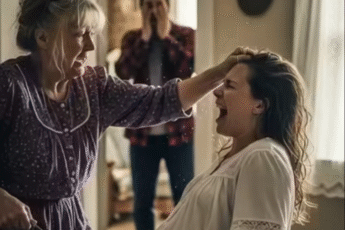
She screamed it. The veneer of the polite suburban matron shattered instantly. She jumped off the stool, her face twisted into a mask of pure, unfiltered hatred.
“I am sorry,” I stammered, gripping the mop handle. “I didn’t mean—”
“You never mean anything!” she shouted. “You just take up space! You leech off my son, you ruin my house!”
She stepped into my personal space. I could smell the mint on her breath. Before I could back away, her hand lashed out.
Slap.
The sound was shockingly loud in the tiled room. Her palm connected with my cheekbone with enough force to snap my head to the side. My ears rang. I stumbled back, shocked not just by the pain, but by the sheer escalation. She had never touched me before.
But she wasn’t done.
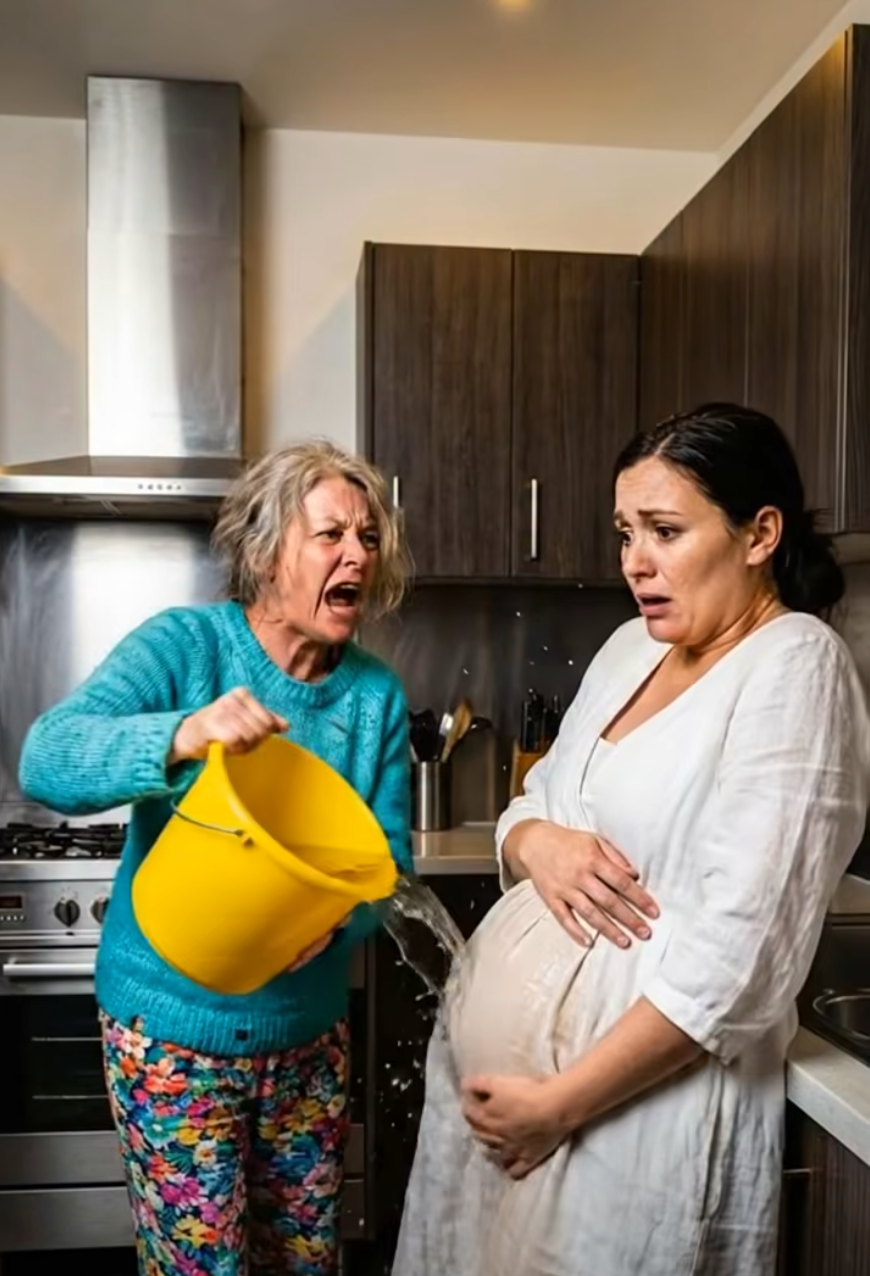
As I tried to regain my balance, clutching my face, she grabbed the bucket of gray, dirty mop water sitting on the counter.
“You want to make a mess?” she shrieked. “Here!“
She heaved the bucket.
Gallons of cold, chemical-laden water crashed into my chest and stomach. The shock made me gasp. The water hit the floor instantly, turning the tiles into an ice rink.
My feet went out from under me.
I fell hard. There was no time to catch myself. I landed heavily on my right side, my hip taking the brunt of the impact, but the force jarred my entire body.
A sharp, tearing pain ripped through my abdomen. It wasn’t a contraction. It was something wrong. Something deep.
“Oh god,” I whispered, clutching my belly.
I felt a warmth spreading between my legs that had nothing to do with the mop water.
I looked down. The water on the floor was turning pink.
“Margaret,” I gasped, looking up at her. “Help me.”
She stood there, the empty bucket in her hand, staring at the blood mixing with the soapy water. For a second, I saw terror in her eyes. But she didn’t move. She froze.
And then, the front door opened.
Chapter 3: The Arrival
“Mom? Em? I forgot my blueprints, I just need to—”
Daniel walked into the kitchen.
The scene froze. Me, lying in a pool of water and blood, clutching my stomach, gasping in pain. Margaret, standing over me with a bucket, her face pale, her hand still raised.
“Emily?”
Daniel dropped his bag. The sound of it hitting the floor broke the spell. He rushed toward me, slipping on the wet floor, falling to his knees beside me.
“Emily, look at me! What happened? What is this blood?”
I couldn’t speak. The pain was coming in waves now, a rhythmic crushing sensation that squeezed the air from my lungs.
“She…” I choked out. “She threw…”
Daniel looked up at his mother. “Mom? What did you do?”
Margaret dropped the bucket. It clattered loudly. “She slipped, Danny! She was being clumsy, she fell!”
“Call 9-1-1!” Daniel roared, his voice cracking. He ripped his shirt off and pressed it against me, trying to comfort me, trying to understand the chaos. “Now, Mom! Call them!”
Margaret fumbled for her phone, her hands shaking so badly she dropped it twice.
The minutes waiting for the ambulance felt like hours. I drifted in and out of consciousness. I remember Daniel holding my hand so tight I thought he might break it. I remember him whispering, “Stay with me, Em. Stay with me. The baby needs you.”
I remember Margaret standing in the corner, silent for the first time since I had met her. She looked small. She looked guilty.
When the paramedics arrived, they moved with terrifying speed. “Pulse is thready,” one shouted. “Possible placental abruption. We need to move. Now.”
As they lifted me onto the stretcher, a contraction hit me—violent and premature.
“I’m scared, Daniel,” I whispered.
“I’m right here,” he said, running alongside the stretcher. “I’m not leaving you.”
But as they loaded me into the back of the ambulance, the paramedic stopped him. “Family in the front, or follow behind. We need room to work.”
I saw Daniel turn back toward the house to get his keys. I saw him look at his mother, who was standing on the porch.
I didn’t hear what he said to her. But I saw the look on his face. It wasn’t the face of a son. It was the face of a stranger.
Chapter 4: The Incubator
The hospital was a blur of bright lights and urgent voices.
“Fetal heart rate is dropping.”
“She’s fully dilated.”
“We need to get him out.”
The labor was a nightmare. My body wasn’t ready. My baby wasn’t ready. I was exhausted, terrified, and overwhelmed by a crushing guilt that I had failed to protect him.
When my son, Leo, was finally born, there was no cry.
The silence in the delivery room was deafening.
” stimulating,” a nurse said sharply.
I tried to sit up, but my body was lead. “Why isn’t he crying? Daniel, why isn’t he crying?”
Daniel was by my head, tears streaming down his face. “He’s okay, Em. The doctors are helping him.”
Then, a small, weak bleat. Like a kitten.
It was the most beautiful sound I had ever heard.
They whisked him away immediately to the NICU. I only caught a glimpse of him—tiny, translucent skin, covered in wires.
I collapsed back onto the pillow, the adrenaline crashing, leaving me empty.
Later that night, the room was quiet. The only sound was the hum of the machines monitoring my vitals. Daniel sat in the chair beside my bed, holding my hand. His eyes were red and swollen.
“He’s stable,” Daniel said softly. “He’s on oxygen, and he’s small. But he’s a fighter.”
I nodded, tears leaking from my eyes. “I’m sorry. I should have been more careful.”
“Stop.“
Daniel’s voice was firm. He squeezed my hand.
“This isn’t on you, Emily.”
He took a deep breath.
“Mom told me,” he said. “At the hospital waiting room. While you were in surgery.”
I looked at him.
“The doctors told us that stress and trauma caused the abruption,” Daniel said, his voice trembling with rage. “When the doctor said that… she broke. She admitted it. She admitted she pushed you. She admitted she threw the water.”
“She said I slipped,” I whispered.
“She lied,” Daniel said. “She confessed because she thought Leo might die. She thought she was going to have to answer to God.”
He stood up and walked to the window, looking out at the parking lot.
“I didn’t know,” he said, his voice breaking. “I didn’t know what she was doing to you when I left for work. I thought… I thought you guys were just different. I didn’t know she was a monster.”
“She hates me, Daniel,” I said. “Because I’m not good enough for you.”
Daniel turned back to me. “You are the best thing that ever happened to me. And she nearly took you away.”
Chapter 5: The Severing
I spent two weeks in the hospital recovering from the infection caused by the dirty water and the trauma of the birth. Leo spent six weeks in the NICU.
I sat by his incubator every single day. I watched his chest rise and fall. I watched him grow stronger, gram by gram.
Margaret tried to visit on the third day.
I was in the NICU, my hand through the plastic porthole, resting a finger on Leo’s tiny leg. I saw her reflection in the glass. She was standing at the entrance of the unit, holding a teddy bear.
Daniel stepped in front of her.
I couldn’t hear what was said, but the body language was clear. Margaret was pleading. She was crying. She was playing the victim.
Daniel was a stone wall. He pointed to the elevator.
She left. She took the bear with her.
When I was finally discharged, Daniel drove us to a small apartment complex near the hospital. It wasn’t the house. It wasn’t fancy. It had beige carpets and a view of a dumpster.
But it was ours.
“I went back to the house yesterday,” Daniel told me as he unlocked the door. “I packed our things. I told her we aren’t coming back.”
“What did she say?”
“She begged,” he said. “She said she was sorry. She said she didn’t mean to hurt the baby. She said she was just trying to teach you a lesson.”
I felt a chill run down my spine. “A lesson?”
“Yeah,” Daniel said, looking at me with fierce protectiveness. “And that’s why she will never be alone with our son. Ever.”
Chapter 6: The Quiet Aftermath
Margaret tried to apologize in her own way. She left voicemails. She sent checks. She sent long, rambling texts about “family unity” and “forgiveness.”
I listened to them once. Then I deleted them.
I realized something profound during those long nights in the apartment, waiting for Leo to come home.
Forgiveness does not mean access.
You can forgive someone for being broken. You can let go of the hatred because it’s too heavy to carry. But that does not mean you have to invite them back into your living room to break you again.
Forgiveness is internal. Boundaries are external.
When Leo finally came home, he was still small, but he was robust. Holding him in the rocking chair in our quiet, safe living room, I understood the magnitude of what we had survived.
Margaret lives alone in that big, beautiful house now. The lawns are still manicured. The oak doors are still heavy. But inside, it is empty.
Daniel visits her on holidays, alone. He stays for an hour. He does not take Leo. He does not take photos of Leo.
She has never met her grandson.
She sends cards. She claims she is the victim of a “misunderstanding.” She tells the neighbors that I stole her son.
Let her talk. I have my peace.
Epilogue: The Echo of Truth
This story is not about villainy or heroism. It is about the insidious nature of emotional abuse, and how quickly words can turn into violence.
Too many people believe that if there are no bruises, it isn’t abuse. Too many people believe that we should endure mistreatment for the sake of “family.”
I am living proof that words hurt. I am living proof that stress can kill.
If you are reading this and you are in a situation where you are walking on eggshells, where you are being diminished day by day—please, listen to me.
You do not have to endure it.
No inheritance, no house, no family reputation is worth your peace. No one deserves to be humiliated, especially not when they are bringing life into the world.
My son is two years old now. He has Daniel’s eyes and my chin. He laughs loudly. He is safe.
And every time I look at him, I am reminded that the best decision we ever made was to walk away from the people who hurt us, and toward the people who love us.
What would you have done in my place? Should forgiveness come before accountability, or after? I invite you to share your thoughts—because your story might be the lifeline someone else needs to grab onto.