The Coldest Welcome
PART I — THE CHILL IN THE AIR
I hadn’t planned to visit my daughter that Saturday. It was a whim, born of a cancelled afternoon seminar at a work conference in Oakhaven, just forty miles from where she lived. The drive was scenic, the trees stripping down for winter, their skeletal branches scratching against a slate-grey sky. As I drove, I let myself indulge in a fantasy of maternal warmth: I imagined Laura’s face lighting up, the smell of brewing coffee, perhaps a shared laugh over a surprise pastry I’d picked up from a bakery downtown
Laura had always loved surprises. When she was a child, a sudden trip for ice cream could make her vibrate with joy. I hadn’t seen her in three months—life, work, and the subtle, creeping distance that had grown since she married Mark had kept us apart.
I pulled into the parking lot of The Pines, the apartment complex where they lived. It was a drab, beige building that seemed to absorb the gloom of the day. I checked my reflection in the rearview mirror, fixed a stray lock of hair, and grabbed the box of pastries.
When I knocked, it took a long time for the door to open.
When it finally did, it wasn’t Laura who greeted me. It was Mark. He looked annoyed, a napkin tucked into his collar, chewing on something.
“Oh,” he said, swallowing heavily. “Katherine. We weren’t expecting you.”
“I was in the neighborhood,” I said, forcing a brightness I didn’t feel into my voice. “Surprise?”
He stepped aside reluctantly. “We’re eating.”
I stepped across the threshold, and the first thing that hit me wasn’t the smell of food. It was the cold.
It was a physical assault. The air inside the apartment was frigid, damp, and heavy, carrying the scent of stale grease and unwashed wool. I instinctively pulled my coat tighter around me. The heater was silent. The windows in the living room were sealed with yellowing packing tape, condensation dripping down the glass like tears.
“Is the heat out?” I asked, my breath visible in a small puff.
“It’s finicky,” Mark muttered, turning his back on me.
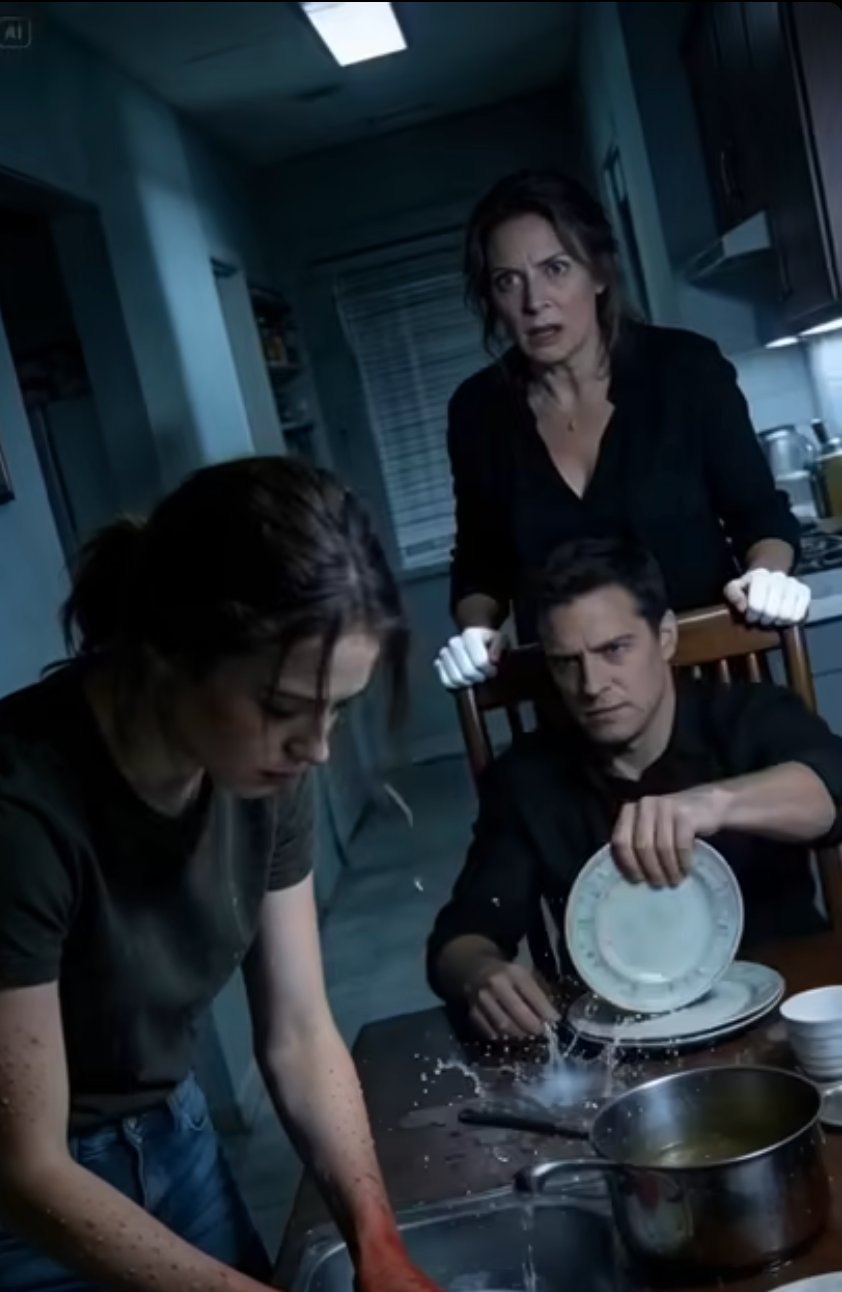
He walked back to the small dining table. His mother, Diane, was seated there. She was wearing a heavy fleece jacket, hunched over a plate of steaming pot roast. She barely glanced up as I entered.
“Hello, Katherine,” she said around a mouthful of meat. “Grab a chair if you want. Dinner’s almost done.”
But I wasn’t looking at Diane. My eyes scanned the room, searching for my daughter.
And then I saw her.
Laura was standing at the kitchen sink, her back to the room. She wasn’t wearing a coat. She was in a thin, long-sleeved t-shirt and jeans. Her sleeves were rolled up past her elbows, and her hands were submerged in a sink full of grey, soapy water.
Her shoulders were trembling. A fine, violent shiver that racked her entire frame.
“Laura?” I said softly.
She turned. Her face was pale, almost translucent, with dark circles bruising the skin beneath her eyes. Her hair, usually glossy and kept loose, was pulled back in a severe, messy knot. When she saw me, her eyes went wide—not with joy, but with panic. She darted a quick, terrified glance at Mark before looking back at me.
“Mom,” she whispered. Her voice sounded rusty, unused.
“Honey, why aren’t you eating?” I asked, walking toward her. The closer I got, the more I realized how cold it truly was near the window where the sink was. It must have been fifty degrees in there.
Diane shrugged from the table. “She eats later. It’s just easier that way. Less clutter.”
I froze. Easier?
Before I could respond, Mark finished the last bite on his plate. He didn’t stand up. He didn’t clear his place. He simply shoved the ceramic plate across the table with a loud scrape.
“Laura,” he snapped, his voice sharp and authoritative. “Stop washing those for a second. Bring the pot over. Mom wants seconds.”
The words hit me like a physical slap.
Laura didn’t argue. She didn’t sigh. She immediately pulled her red, raw hands from the water, wiped them hastily on her jeans, and moved toward the stove. She kept her head down, like a servant hoping to avoid notice. As she walked past me, I saw the goosebumps rising on her arms.
She wasn’t a wife here. She wasn’t a partner.
She was staff.
In that split second, the fantasy of the happy visit incinerated. This wasn’t a bad day. This wasn’t a misunderstanding. This was a regime. My daughter had learned to make herself invisible in her own home to survive.
I felt a rage ignite in my chest—hot, white, and terrifying. But I knew if I screamed, if I fought him right then, he would kick me out, and she would pay the price later.
“I left my phone in the car,” I said. My voice was eerily calm. “I’ll be right back.”
I turned and walked out the door. My hands were shaking so badly I dropped my keys twice in the hallway. I didn’t go to the car to get my phone. I went to the car to lock the doors, sit in the driver’s seat, and make a call I never thought I would have to make for my adult child.
I dialed the police.
And then I dialed the building superintendent, whose number was listed on the plaque in the lobby.
I waited five minutes, watching the grey sky, breathing in and out, preparing for war.
CLIFFHANGER:
When I returned to the apartment, the atmosphere had shifted. Mark was laughing at something on his phone, oblivious to the storm gathering outside. Laura was scraping leftovers onto a small saucer—her portion, I realized with a sick twist of my gut. I sat on the edge of the sofa, my purse clutched in my lap like a weapon. Mark looked at me with a sneer. “You’re awfully quiet, Katherine. Cat got your tongue?” I looked him dead in the eye and smiled a razor-thin smile. “No, Mark. I’m just waiting.” At that exact moment, a thunderous, authoritative pounding shook the front door.
PART II — THE INTERVENTION
The knock echoed through the small apartment like a gunshot.
Mark frowned, his irritation flaring instantly. “Who is pounding on the door like that?” He stood up, wiping his mouth with the back of his hand, and stomped toward the entryway. “If that’s the neighbor complaining about the TV again, I’m going to lose it.”
Laura froze. She stood by the counter, holding her small saucer of food, her eyes darting between me and the door. She sensed the shift in the air. Animals sense earthquakes before they happen; victims sense danger before it strikes.
Mark ripped the door open. “What?”
Two uniformed police officers stood in the hallway, filling the frame with an imposing mix of navy blue and authority. Behind them stood Mr. Kowalski, the building manager, looking flustered and holding a clipboard.
“Sir,” the taller officer, whose badge read Officer Reynolds, said calmly. “We received a call about a domestic disturbance and a potential code violation regarding the heating in this unit. May we come in?”
The silence that fell over the room was absolute. Diane’s fork hovered halfway to her mouth, a piece of potato falling back onto her plate with a soft plop.
Mark’s face flushed a deep, blotchy red. He tried to block the doorway with his body. “There’s no problem here. We’re having a family dinner. Who called you?”
“We need to come in, Sir,” Reynolds repeated, stepping forward. It wasn’t a request.
Mark stepped back, muttering curses under his breath. The officers entered, and the temperature inside the room seemed to drop even further, though that was likely just the psychological effect of justice arriving.
“Jesus,” the second officer, Officer Davis, said, seeing his breath fog in the air. “It’s freezing in here.”
Mr. Kowalski stepped in nervously. “I told you, Mr. Harrison,” he said to Mark. “I told you last week we needed to fix that radiator. You denied entry to my maintenance crew three times.”
“I was busy!” Mark snapped. “I work from home. I can’t have people banging on pipes all day.”
“So you let your wife freeze?” I cut in. My voice was steady, cutting through his excuses.
Mark spun to face me, eyes narrowing. “You called them.”
Officer Reynolds stepped between us. He looked at the scene. He saw Mark and Diane in their heavy fleece and coats. Then he looked at Laura.
She was still standing by the sink, shivering in her thin t-shirt, her hands red and raw. She looked like a ghost haunting her own life.
“Ma’am?” Reynolds walked over to Laura. He kept his voice low, gentle. “Are you okay?”
Laura looked at Mark. It was a reflex, a conditioned response to check for permission to speak. Mark glared at her, a silent warning etched into his features.
“I’m… I’m fine,” Laura whispered. “Just cold.”
“She likes it cold,” Diane piped up from the table, her voice shrill. “She’s always hot. It’s her metabolism. And she likes keeping busy. Washing dishes relaxes her.”
Officer Davis turned to Diane. “Ma’am, with all due respect, nobody relaxes by scrubbing dishes in freezing water while everyone else eats.”
He turned back to Mark. “Why is she working while you two are eating?”
Mark tried to laugh, a hollow, nervous sound. “It’s just how we do things. Division of labor. I pay the bills, she handles the house. My mother is a guest. It’s respect.”
“She pays half the rent,” I said loudly. “She works full-time at the library. Don’t lie, Mark.”
Mark’s jaw tightened. “This is family business. You have no right—”
“Sir, sit down,” Reynolds ordered. His hand rested casually near his belt—not threatening, but commanding. Mark sat.
Reynolds turned his back on Mark and focused entirely on Laura. “Ma’am, look at me. You don’t have to stay here tonight. If you are unsafe, if you are being prevented from accessing heat or food, that is abuse. Do you understand?”
Laura’s lip trembled. She looked at me. I nodded, tears stinging my eyes. Be brave, baby. Just be brave.
“I…” Laura started, her voice cracking. “I’m hungry.”
It was such a small admission, but it broke the dam.
“He doesn’t let me eat until they’re done,” she sobbed, the tears finally spilling over. “And he turned the heat off to save money for his… for his gaming setup. He said I didn’t deserve warmth if I wasn’t going to be ‘useful’.”
“That’s a lie!” Mark shouted, standing up.
“Sit down!” both officers barked in unison.
Officer Davis began taking notes furiously. Mr. Kowalski looked horrified. “I’m bringing up portable heaters right now,” the manager said. “And I’m scheduling the repair for tomorrow morning. Mandatory access. If you block it, Mr. Harrison, I’m evicting you.”
Officer Reynolds looked at me. “Ma’am, does she have a place to go?”
“She’s coming with me,” I said.
“No, she isn’t!” Diane shrieked, slamming her hand on the table. “She has responsibilities here! Who is going to clean this up?”
Officer Reynolds looked at Diane with a mixture of pity and disgust. “You are, Ma’am. Or your son is. But she is leaving.”
I walked over to Laura. I didn’t ask. I grabbed her arm gently. “Go pack a bag. Just the essentials. We are leaving.”
Laura looked at Mark one last time. He was staring at her with pure venom. “If you walk out that door, Laura,” he hissed, low and dangerous, “don’t you think for a second you’re coming back. You’ll have nothing.”
Laura flinched, shrinking into herself. For a terrifying heartbeat, I thought she would stay. I thought the fear was too deep, the roots of his control too thick.
Then, she looked at her red, chapped hands. She looked at the cold grease on his plate.
“I don’t want anything,” she whispered.
She turned and ran into the bedroom.
CLIFFHANGER:
I stood guard in the living room while she packed, staring Mark down. He pulled out his phone and started typing furiously. “You’re making a big mistake, Katherine,” he sneered. “You don’t know what you’re starting.” Laura emerged two minutes later, a duffel bag over her shoulder. We moved toward the door, the officers flanking us. But as I reached for the handle, Mark laughed—a dark, humorless sound. “Go ahead,” he said. “Check your bank account, Laura. Let’s see how far you get on empty.”
PART III — THE LONG DRIVE
The cold air outside the apartment building felt different than the air inside. Inside, it had been a prison. Outside, it felt like oxygen. It felt like freedom.
Laura was trembling violently as we walked to my car, but I knew it wasn’t just from the temperature. It was the adrenaline dump. The shock of upending her entire reality in the span of thirty minutes.
I unlocked the car and cranked the heat up to the maximum. Laura buckled her seatbelt with shaking hands, pulling her knees up to her chest.
“He said… he said check my account,” she stammered, fumbling for her phone.
“Don’t,” I said firmly, putting a hand on hers. “Whatever he did, we will fix it. We have lawyers. We have the police report. Don’t look at it tonight. Just breathe.”
She dropped the phone into her lap and stared out the window as The Pines disappeared in the rearview mirror.
“Thank you, Mom,” she whispered, her voice barely audible over the hum of the heater. “I… I didn’t know how to leave. I was so tired.”
“I know, baby. I know.”
We drove in silence for an hour, putting miles between us and the monster in the beige building. We stopped at a diner off the highway—a brightly lit place that smelled of coffee and bacon. I ordered her soup, a burger, fries, pie—anything hot.
She ate like a starving animal, quickly and efficiently, guarding her plate with one arm as if someone might snatch it away. It broke my heart to watch.
“How long, Laura?” I asked gently, once the edge of her hunger was dulled.
She looked down at her hands, tracing the cracks in her skin. “It started slow. Comments about my spending. Then he took my debit card ‘for safekeeping.’ Then the chores. He said… he said because he made more money, my contribution had to be physical labor. If I missed a spot cleaning, he’d dock my ‘allowance’ for groceries.”
“That’s slavery, Laura,” I said, my voice shaking. “That’s not marriage.”
“I know,” she said, tears sliding down her cheeks. “But Diane… she encouraged it. She told him he was being too soft. She said a wife should serve.”
We arrived at my house late that night. I set her up in her old bedroom. She slept for fourteen hours straight.
The next morning, the war began.
Laura checked her bank account. It was empty. Mark had transferred every cent from their joint savings and even drained her personal checking account, leaving her with a balance of negative twelve dollars.
“He took it all,” she said, staring at the screen, pale as a sheet. “My paycheck was deposited yesterday. It’s gone.”
“It’s theft,” I said, handing her a mug of hot tea. “And we are going to get it back.”
I called Sarah Jenkins, a family law attorney I knew from my own divorce years ago. She was a shark in a silk blouse. We met her that afternoon.
When Laura described the living conditions—the lack of heat, the food withholding, the financial control—Sarah’s face grew stony.
“This is coercive control,” Sarah said, tapping her pen on her legal pad. “It is a form of domestic violence. We are filing for an immediate ex parte restraining order. We are filing for divorce. And we are filing an emergency motion for spousal support and the return of marital assets.”
“He said I’d have nothing,” Laura whispered.
“He lied,” Sarah said firmly. “He’s banking on you being too scared to fight. Are you scared, Laura?”
Laura looked at me. She looked at the warm office, the hot coffee, the sunlight streaming through the window. She thought about the cold, grey water in that sink.
“Yes,” she said. “I’m terrified. But I’m more angry than scared.”
“Good,” Sarah smiled grimly. “Anger is fuel.”
The next few weeks were a blur of legal paperwork and recovery. Laura stayed with me. She started eating properly. Her skin lost that translucent, grey quality. We went shopping for warm clothes—sweaters, wool socks, a thick coat—things she had been denied.
Mark tried to call. Dozens of times. He left voicemails that swung wildly between tearful apologies (“I was just stressed, baby, I love you”) and vitriolic rage (“You’re a thief, you abandoned your family”).
We saved every single one as evidence.
Diane never called. Her silence spoke louder than any insult. To her, Laura was a broken appliance, discarded because it stopped working.
Three weeks later, the court date for the restraining order arrived. Mark showed up without a lawyer, looking disheveled and arrogant. He thought he could charm the judge the way he had charmed Laura three years ago.
He was wrong.
The judge, a stern man with zero tolerance for nonsense, listened to the police report. He read the statement from Officer Reynolds about the temperature in the apartment. He looked at the bank records showing the withdrawal of funds.
“Mr. Harrison,” the judge said, peering over his glasses. “You stripped your wife of warmth, food, and funds. You treated a human being like a indentured servant.”
“She’s exaggerating,” Mark protested. “It was just a rough patch.”
“Granting the Order of Protection,” the judge slammed his gavel. “You are to have no contact. You are to return fifty percent of the seized funds within forty-eight hours, or I will issue a warrant for your arrest for contempt of court.”
Mark looked stunned. For the first time, the bully had been punched back.
We walked out of the courthouse, Laura holding her head high. But as we reached the parking lot, I saw a car idling near mine. It was Diane’s old sedan.
Diane rolled down the window as we approached. She didn’t look at me. She looked straight at Laura.
CLIFFHANGER:
Diane’s eyes were cold, hard flint. She didn’t shout. She just smiled—a cruel, knowing twist of her lips. “You think you won, girl?” she said softly. “You think Mark is the only one who keeps records? We know about the ‘accident’ at your old job, Laura. And we know you didn’t tell your mother about it.” She rolled up the window and drove away. Laura stopped dead in the middle of the parking lot, the blood draining from her face. “Mom,” she whispered, gripping my arm until it hurt. “I… I have to tell you something.”
PART IV — THE THAW
I looked at my daughter, standing in the wind-swept parking lot, terror etched into her features once again. The joy of the court victory evaporated instantly.
“What is she talking about, Laura?” I asked, keeping my voice level.
Laura looked down at her boots. “Two years ago… before the strict budget started… I had a job at a jewelry store. There was a discrepancy in the inventory. A diamond bracelet went missing on my shift.”
My heart stopped. “Did you take it?”
“No!” Laura looked up, eyes fierce. “I swear, Mom. I didn’t. But Mark… Mark came to pick me up that day. He came inside to use the restroom. After the bracelet was gone, the manager fired me. They didn’t have proof to charge me, but they fired me. Mark told me later… he told me he took it.”
I felt sick. “He framed you?”
“He used it as leverage,” she explained, tears spilling over. “That was when the control really started. He said if I ever tried to leave him, he would turn himself in but say we did it together. That I stole it and gave it to him. He said he kept the bracelet as ‘insurance’.”
I pulled her into a hug, holding her tight against the cold. “He is bluffing, Laura. He is a narcissist and a liar. If he admits to having the bracelet, he incriminates himself.”
“But what if he plants it?” she sobbed. “What if he ruins my life?”
“Then we fight that too,” I said fiercely. “We tell Sarah. We tell the police. We stop hiding.”
We went straight back to Sarah’s office. When Laura told her about the bracelet, Sarah didn’t flinch.
“Let them try,” Sarah said. “If they produce stolen property now, after the divorce filing and the restraining order, it looks exactly like what it is: retaliation. Extortion. We will add it to the file.”
The threat hung over us for months, but Diane and Mark never played that card. It was a phantom weapon, meant to keep Laura looking over her shoulder. Like everything else in their lives, it was built on fear, not substance.
Six months passed.
The divorce was finalized in the spring. Mark dragged his feet, but the threat of jail time for hiding assets eventually forced him to settle. Laura got half the savings back. It wasn’t a fortune, but it was enough for a deposit.
Laura moved into her new apartment on a rainy Tuesday in April.
It was a small place—a one-bedroom on the second floor of a converted Victorian house. The floors creaked, and the view was just of the street, but it had big windows and, most importantly, a brand new thermostat that Laura controlled.
That first night, she invited me over for dinner.
I climbed the stairs, carrying a bottle of wine and a housewarming plant. When I opened the door, a wave of warmth hit me. Real, dry, comforting heat. The apartment smelled of roasted chicken and rosemary.
Laura was in the kitchen. She was wearing a thick, fuzzy sweater and leggings. Her hair was loose, curling around her face. She was humming.
“Hi, Mom!” she beamed, turning from the stove.
She wasn’t scrubbing dishes. She wasn’t rushing.
“Dinner’s almost ready,” she said. “Sit down. Relax.”
I sat at her small, round table. She brought over a platter of roasted chicken, potatoes, and carrots. Steam rose from the food, curling into the warm air.
She sat down across from me. She didn’t wait for permission. She didn’t look at me fearfully. She poured the wine and raised her glass.
“To showing up,” she said, her eyes shining.
“To showing up,” I echoed, clinking my glass against hers.
We ate. We laughed. We talked about her new job at a bakery, about the book she was reading, about the paint color she wanted for the bathroom.
Halfway through the meal, she put her fork down and looked at me seriously.
“I didn’t realize how bad it was,” she said quietly. “Until you walked in that day. I was so deep in the fog… I thought I deserved the cold. I thought I deserved the hunger.”
“No one deserves that,” I said.
“I know that now,” she smiled, a genuine, warm smile that reached her eyes. “But I needed you to break the window so I could see out.”
EPILOGUE
I think about that Saturday often. I think about how easy it would have been to just drive past Oakhaven. To send a text instead. To assume that because she was married, she was fine.
It is terrifyingly easy to miss suffering when it hides behind closed doors and polite excuses. Mark and Diane thrived in the shadows, relying on the social contract that says we shouldn’t pry, we shouldn’t interfere in “family business.”
But family business stops being private when it becomes a prison.
Laura is thriving now. She still has nightmares sometimes. She still flinches if someone raises their voice too quickly. Healing isn’t a straight line. But she is free. She pays her own bills, she controls her own heat, and she never, ever eats cold food unless she wants to.
If this story moved you, take a moment today. Reflect on the people you care about. Not just the ones who call you every day, but the quiet ones. The ones who have drifted away. The ones who seem a little too eager to please, or a little too nervous when their partner speaks.
Have you checked in on them lately? Really checked in?
As parents, friends, and neighbors, we can’t fix everything. We can’t save everyone. But sometimes, one knock on the door, one refusal to accept “I’m fine,” can change the trajectory of a life.
It changed Laura’s. It changed mine.
So, if you were in my place, standing in that freezing hallway, what would you have done? Share your thoughts. Because conversations like these—loud, open, and unapologetic—are the sunlight that drives the shadows away.
THE END
Like and share this post if you find it interesting.