Title: The Thirty-Day Eviction
Chapter 1: The Eulogy of Hate
The funeral hall smelled of stale lilies and expensive perfume, a cloying mixture that always made my stomach turn. It was packed with people wearing varying shades of black, their faces masks of performative grief. For fifty years, I had been Margaret Chen, the teacher who stayed late to help children read, the wife who stood silently beside her successful husband.
Today, I was the widow.
But as my daughter, Emma, walked to the podium, I realized I was something else entirely: the target.
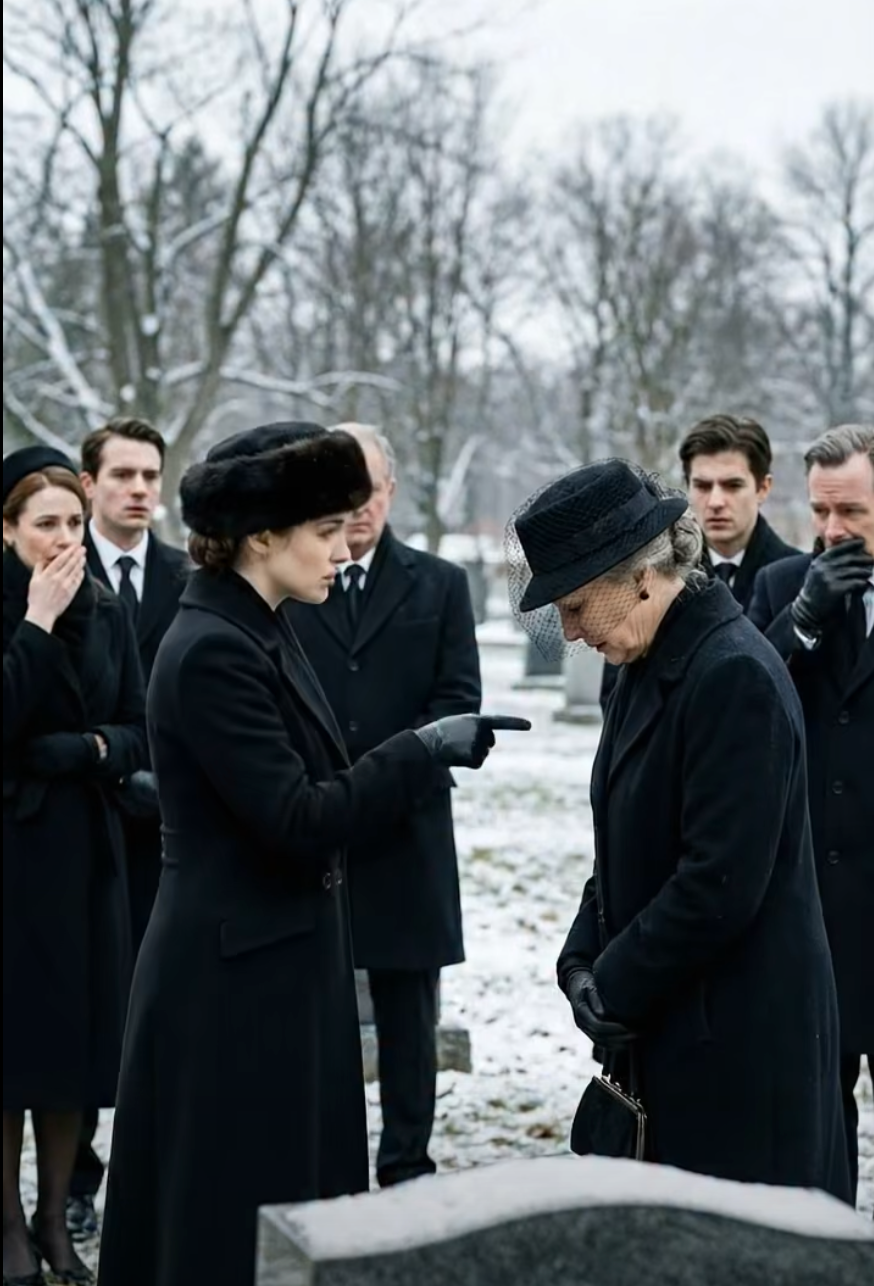
Emma stood at the front, gripping the wooden lectern until her knuckles turned white. She was forty-eight, elegant in a designer suit that cost more than my first car, her hair perfectly coiffed. She looked like her father. But her eyes—her eyes were burning with a hatred I had seen flickering for years, now fully ablaze.
She pointed a manicured finger directly at me.
“Mommy should be the one who died,” she said, her voice ringing clear and cold in the silent hall. “Not my daddy.”
A collective gasp sucked the air out of the room. It was a physical sound, like a sudden drop in pressure before a storm.
I sat frozen in the front row. My back was straight, a habit from decades of teaching, but inside, I felt my bones turning to dust. My son, Tommy, sat next to me. He grabbed my hand, his grip tight and trembling. He started to stand, fury radiating off him in waves.
“Not now,” I whispered, pulling him down. “Let her speak.”
And she did. Emma spoke for ten minutes. She painted a portrait of David Chen as a saint—a generous restaurant owner, a philanthropist, a perfect father who suffered in silence. And the villain of her story was me.
According to Emma, I was a negligent wife who cared more about my students than my own family. I was the selfish career woman who left her poor husband lonely while she collected teaching awards. I was the reason he died of a broken heart, not the massive coronary his doctor had warned him about for a decade.
“She forced him to be both mother and father,” Emma declared, tears streaming down her face—tears that looked real to everyone else but felt like acid to me.
When she finished, the room didn’t applaud. It just breathed a sigh of awkward relief.
After the service, the reception at our house was a blur of whispered condolences and averted eyes. People looked at me differently now. I was no longer the grieving widow; I was the suspect.
I escaped to David’s office, needing a moment of quiet. The room still smelled of his cologne—sandalwood and something sharper, metallic.
The door opened behind me. It wasn’t Tommy.
“Mother,” Emma said. She didn’t call me Mom anymore. “Richard and I will handle Daddy’s money and properties. I already talked to his lawyer.”
I turned to look at her. Richard, her husband, stood in the doorway, checking his watch as if he had a merger to get to.
“The lawyer will read the will next week, Emma,” I said, my voice surprisingly steady. “And I’m still alive. Even though you wish I wasn’t.”
Emma’s face flushed, but she didn’t back down. “I was emotional. But I meant what I said. You never loved him. You were always at school. Do you know how many times I had to explain why my mother wasn’t at my plays?”
“I missed some plays,” I acknowledged, the old guilt flaring up. “But I was teaching children to read, Emma. I was working.”
“He hated it,” she spat. “He told me. He told me how you made him feel abandoned.”
“That’s enough!” Tommy’s voice boomed from the hallway. He stepped into the room, placing himself between us. “Dad isn’t even buried yet, and you’re attacking Mom? What is wrong with you?”
Emma grabbed her purse. “I’m going home. Richard and I will come back tomorrow to look through Daddy’s important papers. Don’t touch anything until we get here.”
She stormed out, leaving a wake of hostility that seemed to vibrate in the air.
Tommy hugged me, apologizing for his sister, but I barely heard him. My mind was racing. Arrangements. Consequences. I remembered an email I had glimpsed on David’s tablet weeks ago, a notification I hadn’t understood at the time.
After Tommy left, I went upstairs. I didn’t go to bed. I went to the window and looked out at the town I had lived in for fifty years.
Then I turned to David’s nightstand. His tablet was there. I picked it up. It unlocked with my fingerprint—a convenience we had set up years ago and never changed.
I opened his email. I searched for “Emma.”
There were hundreds of emails. Complaints about me. Strategies for hiding assets. And one from three months ago that made my blood run cold.
“The transfer of the Lake House is complete. Technically, it’s yours now, Emma. Your mother suspects nothing. When the will is read, she’ll understand that choices have consequences.”
The Lake House. My parents’ wedding gift to us. The place where I had taught Tommy to swim.
I sat down on the bed, the tablet heavy in my hands. David hadn’t just died. He had been planning my destruction for years.
Cliffhanger: I heard the front door open downstairs. Heavy footsteps echoed in the foyer—too heavy to be Mrs. Kim, my housekeeper. I glanced at the clock. 2:00 AM. Who would be coming into my house in the middle of the night? I crept to the landing and peered over the banister. Emma and Richard were down there, moving quietly toward David’s office, carrying empty banker’s boxes.
Chapter 2: The Silent Investigation
I watched them from the shadows of the landing, my heart hammering against my ribs like a trapped bird. Emma and Richard were like thieves in the night, raiding the tomb before the body was even cold. They weren’t grieving; they were looting.
I retreated to the bedroom, locking the door silently. They were looking for the papers. They wanted to sanitize the history before the lawyers got involved.
I didn’t sleep. I sat in the chair by the window, clutching David’s tablet, and I read.
I read emails going back fifteen years. I saw the slow, deliberate poisoning of my marriage. David hadn’t just been unhappy; he had been envious. He resented my “little teaching awards,” my community recognition, the independence I maintained by working part-time. He felt diminished by my light, so he had decided to extinguish it.
By dawn, I had a plan.
I waited until I heard their car pull away at 5:00 AM. Then, I got dressed. Not in widow’s weeds, but in my best gray suit—the one I wore to parent-teacher conferences when I needed to command respect.
I called Sarah Jenkins.
Sarah was a former student, a brilliant girl who had grown up to be a ferocious estate attorney. I had written her recommendation letter for law school.
“Mrs. Chen?” she answered on the second ring, her voice groggy. “Is everything okay?”
“No, Sarah. I need your help. And I need it before Monday morning.”
We met at her office an hour later. I brought the tablet. I brought the bank statements I had managed to download before Emma could change the passwords.
Sarah listened in silence as I laid out the betrayal. The secret transfers. The forged power of attorney documents I had found photos of in David’s sent folder.
“This is fraud,” Sarah said, her face grim. “Massive, systematic spousal fraud. He moved millions, Margaret. The Lake House, the investment accounts, even the art collection.”
“He left me nothing?”
“He left you a message,” she corrected. “He wanted you to be helpless.”
She looked at me, her eyes fierce. “What do you want to do?”
I thought about the woman I used to be. The peacemaker. The one who apologized for taking up space.
“I want to burn it down,” I said softly. “But not with fire. With the truth.”
Monday morning arrived with a leaden sky. The reading of the will was at Jensen & Associates, David’s firm for forty years.
The conference room was imposing, lined with leather books that probably hadn’t been opened in decades. Emma and Richard sat on one side of the mahogany table, looking smug. Tommy sat next to me, vibrating with anxiety.
Harold Jensen, the family lawyer, looked uncomfortable. He avoided my eyes.
“To my daughter, Emma,” Jensen read, his voice monotone, “I leave the family home, valued at six million dollars, and the contents therein.”
Emma smirked.
“To my son, Tommy, I leave the sum of one hundred thousand dollars.”
Tommy flinched but didn’t speak.
“And to my wife, Margaret,” Jensen paused, clearing his throat. “I leave the sum of five hundred thousand dollars, on the condition that she vacate the family residence within thirty days. I also leave her personal effects and her teaching materials.”
Five hundred thousand. A fraction of an estate worth forty million. A pittance meant to humiliate.
“There is a letter,” Jensen added, pulling a sealed envelope from the file. “David wished for it to be read aloud.”
He read it. It was a manifesto of resentment. David claimed he had supported my “hobbies” for fifty years, endured my neglect, and now, in death, he was correcting the balance. He called Emma the only one who truly loved him.
The silence in the room was absolute.
“Well,” Emma said, breaking the quiet. “I think Daddy made his wishes clear.”
“He certainly did,” Sarah Jenkins said, standing up. “However, there is a problem.”
Emma rolled her eyes. “Here we go. You’re going to contest it? Good luck. There’s a no-contest clause.”
“We aren’t contesting the will based on fairness,” Sarah said coolly. “We are contesting the estate based on theft.”
She slid a file across the table.
“These are records of transfers made over the last five years using a power of attorney that Mrs. Chen never signed. We have a handwriting expert prepared to testify that the signature is a forgery. Likely yours, Emma.”
Emma’s face went white. Richard grabbed her arm.
“This is ridiculous,” he blustered.
“Is it?” I spoke for the first time. “I’m also filing a civil suit against you, Emma, for conspiracy to commit fraud. And I’m releasing a statement to the press.”
“The press?” Emma whispered.
“You wanted to tell a story at the funeral,” I said. “Now it’s my turn to tell one.”
Cliffhanger: Jensen looked at the documents Sarah had provided, his face paling. He picked up his phone. “I need to make a call,” he muttered, stepping out of the room. When he returned five minutes later, he wasn’t looking at me. He was looking at Emma. “The police are on their way,” he said. “They want to ask you about the missing artwork from the vault.”
Chapter 3: The Exodus
The investigation that followed was not the quiet, dignified affair Emma had hoped for. It was a spectacle.
The police didn’t arrest her that day, but they opened a file. The local newspaper ran the story Sarah had drafted: “Prominent Widow Alleges Massive Estate Fraud.”
The town of Oak Creek thrived on gossip, and for fifty years, David had been its golden boy. But the evidence was overwhelming. The forged documents. The secret accounts. The emails where David and Emma discussed how to leave me destitute.
Emma tried to fight back. She gave interviews painting me as senile, vindictive. But then Mrs. Kim spoke up.
My loyal housekeeper gave a deposition. She told the lawyers about the arguments she had overheard. About David mocking my teaching career to his friends. About Emma taking silverware and paintings out of the house while I was at school.
The public tide turned.
But the legal battle would take years. And in the meantime, I had to leave the house. The will’s clause about vacating in thirty days was still technically in effect until a judge froze the assets.
“You don’t have to go, Mom,” Tommy insisted. “We can get an injunction.”
“No,” I said, looking around the living room where I had raised my children. It felt like a stage set now. Fake. “I want to go.”
I packed only what mattered. My books. My grandmother’s quilt. The photos of the children before David had turned them against each other.
I left the expensive furniture. I left the jewelry David had bought me as “apology gifts” over the years.
I moved to California.
My goddaughter, Amy, had offered me her guest room in Los Angeles. It was sunny, bright, and far away from the shadows of Oak Creek.
“Are you sure?” Amy asked as we sat on her balcony, drinking iced tea. “You’re leaving everything behind.”
“I’m leaving the things that weighed me down,” I said.
I started over. At seventy.
I volunteered at a local literacy center. I walked on the beach. I reconnected with the woman I was before I became David’s wife.
Six months later, Sarah called.
“They want to settle,” she said.
“Who?”
“Emma. Richard’s firm is threatening to fire him because of the scandal. They need this to go away. They’re offering to return the Lake House and give you a cash settlement of two million dollars if you drop the fraud charges.”
I thought about the Lake House. My parents’ legacy. The only thing David hadn’t earned, but had stolen.
“I want the Lake House,” I said. “And I want the journals.”
“Journals?”
“I found a key in his desk,” I explained. “There are journals in the safe. I want them.”
Sarah negotiated. Emma was desperate. She agreed.
When the journals arrived in a FedEx box, I sat on the floor and read them.
They were the final confirmation. David hadn’t just been indifferent; he had been competitive. He hated my success because he couldn’t control it. He recruited Emma because she was weak, because she needed his approval in a way Tommy didn’t.
He had played us all like pawns.
I closed the last journal. I didn’t feel angry anymore. I felt free.
I returned to Oak Creek one last time to sign the settlement papers.
We met at the Lake House. It was dusty, neglected. Emma had let it rot while she waited for the title to clear.
She looked terrible. Thin, haggard. The town had turned on her. She had the money, but she had lost her standing.
“Is this how it ends?” she asked, looking at me across the dusty porch. “Fifty years of family, just over?”
“It ended a long time ago, Emma,” I said. “You just didn’t notice because you were too busy counting the money.”
“I didn’t hate you,” she whispered, her voice cracking. “I just wanted him to look at me the way he looked at his business. And he told me… he told me the only way to get that was to help him fix his ‘mistake’ with you.”
“He used you,” I said gently. “And you let him.”
I signed the papers. I took the keys.
Cliffhanger: Emma walked to her car, her shoulders slumped. But as she opened the door, she turned back. “Mom,” she called out. “There’s one more thing. The safety deposit box in Zurich. He never told me the code. He said only you would know it.”
Chapter 4: The Final Lesson
I stared at her. Zurich?
David had a secret account in Switzerland? Of course he did.
“I don’t know any code,” I said.
“He said it was the date of the day you ‘ruined’ him,” Emma said.
I thought back. The day I ruined him?
I remembered a day thirty years ago. I had been offered a job as a principal. It was a huge promotion. David had demanded I turn it down, saying it would interfere with his hosting schedule.
I turned it down.
But that wasn’t it.
Then I remembered the day I won the National Teacher of the Year award. He had sat in the audience, smiling for the cameras, but his hand had crushed mine so hard it bruised.
That date. October 14, 1995.
I didn’t tell Emma.
“I have no idea,” I lied.
She got in her car and drove away.
I went inside the Lake House. I opened the windows, letting the fresh air blow out the stale scent of betrayal.
I called Tommy.
“It’s ours,” I said. “The Lake House is ours.”
I spent the next year renovating it. I turned it into a retreat for retired teachers—a place where they could come, rest, and be appreciated. I named it the Margaret Chen Center for Education.
I never accessed the Zurich account. I didn’t want his money. I wanted his silence.
Emma moved away. Richard divorced her six months later. She sends me a card at Christmas. I don’t open them.
Sometimes, I sit on the dock and watch the sun set over the water. I think about David. I think about the man I loved, and the man who hated me.
He tried to erase me. He tried to write me out of my own life.
But he forgot one thing.
I’m a teacher. I know how to correct a draft.
And this is my story now.
Epilogue
I am seventy-two years old.
I have a garden full of hydrangeas. I have a son who looks at me with pride. I have a goddaughter who calls me every Sunday.
I have scars, yes. But scars are just proof that you survived the wound.
David’s grave is in the town cemetery. I’ve never visited it.
But Mrs. Kim tells me the grass is overgrown. No one goes there. Not even Emma.
He died alone, surrounded by the money he loved more than us.
I live surrounded by the truth.
And the truth is a much warmer blanket.
Like and share this post if you find it interesting.