The Water of Forgotten Things
Chapter 1: The Bankruptcy of Power
Five days.
That was the timeline. It hung in the sterile, recycled air of the private suite like a guillotine blade waiting for gravity to do its work. Five days until the systems began to cascade irrecoverably. Five days until the machines, which were currently doing the work of God, would be turned off, admitting that science had hit a wall it could not scale.
My name is Arthur Sterling. For forty years, I have built an empire on the premise that everything has a price, and every problem has a solution if you throw enough capital at it. I own shipping lines, data centers, and skyscrapers that scratch the belly of the sky. But standing there, in the quietest corridor of the Mercy General Institute, I realized that my net worth—billions of dollars in liquid assets and equity—was utterly worthless. It could buy the silence of this VIP wing. It could buy the most advanced ventilators and the most renowned neurologists from Zurich and Tokyo. But it could not buy a miracle for my son, Julian.
Julian lay in the center of the room, pale and motionless, a small figure lost in a sea of white linens and beeping monitors. He is only nine. He should be scraping his knees on a playground, not fading away from a neuro-degenerative anomaly that the doctors whispered about in hushed, terrified tones. They used words like “irreversible” and “zero neurological response.” These words felt heavier than any market crash I had ever survived.
I stood frozen at the foot of his bed, my hands clenched so tight in my pockets that the knuckles turned white. I was drowning in a polished, climate-controlled hell.
And then, the impossible happened.
It was a breach of security so absurd it shouldn’t have been real. The door to the suite, guarded by private security and coded locks, slid open. I expected the Chief of Surgery. I expected the chaplain.
Instead, a child walked in.
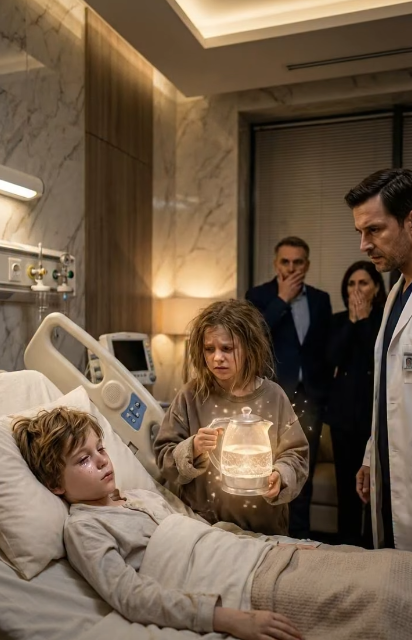
She couldn’t have been older than eight. Her hair was a tangled mess of dark curls, matting with dust. Her clothes were oversized, worn thin at the elbows and knees, smelling faintly of river mud and rain. In a room defined by millions of dollars of medical technology, she was a glaring error—a weed sprouting through a crack in a marble floor.
I was too stunned to speak. I watched, paralyzed by a mixture of confusion and rising fury, as she approached the bed. She didn’t look at the machines. She didn’t look at me. She moved with a strange, unsettling calm, as if she were walking into her own living room.
In her small, grime-streaked hands, she held a Golden Kettle. It was battered, dented, the kind of cheap brass trinket you find in the discard pile of a street market, yet she held it with the reverence of a priestess holding a chalice.
“Hey!” I finally choked out, my voice cracking. “What are you doing? How did you get in here?”
She ignored me. She didn’t even flinch. She stepped up to the bedside rail, her eyes fixed on Julian’s face.
The anger inside me flared hot and fast. This was my son’s dying sanctuary. How dare security let a street urchin wander in? I took a step forward, ready to grab her, ready to throw her out, ready to fire everyone in the building.
But then she looked at me.
Her eyes stopped me cold. They weren’t pleading. They weren’t afraid. They were ancient. They held a depth of stillness that felt terrifyingly out of place on a child’s face. It was the look of someone who has read the end of the book while everyone else is still struggling with the first chapter.
“He is thirsty for the old things,” she whispered. Her voice was barely audible over the hum of the ventilator.
Before I could process the absurdity of her statement, she tilted the kettle.
“No!” I shouted, lunging forward.
I was too late. She poured a stream of clear, shimmering water directly over my son’s face.
It wasn’t normal water. Under the harsh halogen lights, the liquid seemed to catch the light and hold it, glowing with a faint, impossible luminescence. It splashed over his closed eyelids, ran down his cheeks, and soaked into the expensive pillow.
The monitors exploded into a cacophony of alarms.
“Contamination!” a nurse screamed, rushing in from the hallway. “Get her away! Sterile field compromised!”
Doctors flooded the room like a white tide. Security guards grabbed the girl by her thin shoulders, dragging her back. The room descended into chaos—shouting, beeping, the squeal of rubber soles on linoleum.
I stood trembling, caught between a father’s protective rage and a strange, paralyzing shock. I should have been furious. I should have been demanding arrests. But as the guards hauled her toward the door, the girl didn’t fight. She didn’t cry. She just looked at Julian one last time and whispered words that cut through the noise like a knife.
“The water listens,” she said, her voice carrying an eerie weight. “But only when you stop shouting.”
The door slammed shut. The doctors were frantically wiping Julian’s face, checking his vitals, talking about infection protocols and suing the security firm.
But I wasn’t looking at them. I was looking at the monitor.
Just for a second—a fraction of a heartbeat—I saw it. A fluctuation. A spike in a line that had been flat for three days. It was gone as quickly as it came, dismissed by the staff as interference from the water or the commotion.
But I knew what I saw. And as the silence slowly returned to the room, heavier and more suffocating than before, I realized with a jolt of terror that the only person who had seemingly done anything to affect my son was the girl they had just thrown out into the rain.
Who was she? And what had she just done to my boy?
Chapter 2: The Echo in the Machine
The night that followed was an exercise in madness.
The hospital staff was in damage control mode. The Chief of Medicine spent twenty minutes apologizing to me, assuring me that the “incident” would be investigated, that the girl was a homeless wanderer who had slipped through a delivery bay, and that prophylactic antibiotics were being administered to Julian to prevent any infection from the dirty water.
I nodded, I signed forms, I played the part of the aggrieved billionaire. But my mind was elsewhere.
I sat in the leather armchair beside Julian’s bed, staring at his face. The water had dried, but there was a subtle difference in his skin. It wasn’t the gray, waxy pallor of the dying anymore. There was a faint flush to his cheeks, a warmth that defied the ambient temperature of the room.
I replayed the scene in my head a thousand times. The Golden Kettle. The shimmering liquid. The look in her eyes. The water listens.
What kind of nonsense was that? I was a man of science and logic. I dealt in tangible assets. And yet, when you are watching your only child slip into the void, logic feels like a betrayal. When you are drowning, you don’t check the pedigree of the rope thrown to you; you just grab it.
Just before dawn, exhaustion blurred my grief into a heavy numbness. I dozed off, chin on my chest.
I was woken by a sharp intake of breath.
It wasn’t mine.
My head snapped up. I looked at the nurse, Valerie, who was standing by the monitors, her hand covering her mouth.
“What?” I demanded, standing up so fast the chair tipped over. “What is it? Is he gone?”
Valerie shook her head, her eyes wide. “No, Mr. Sterling. Look.”
I looked at the screen. The green line, usually kept moving by the mechanical rhythm of the ventilator, was out of sync. There was a tiny, jagged spike in between the forced breaths.
“It’s a glitch,” I said, my voice trembling. “A sensor malfunction.”
“I don’t think so,” she whispered, moving to check Julian’s pulse manually. She placed two fingers against his wrist. She stood there for a long time, her brow furrowed. Then, she looked at me, tears forming in her eyes. “He’s fighting the machine, sir. He’s trying to take a breath.”
A breath. One single, independent breath. It was medically impossible. The scans showed his brainstem was degrading. He shouldn’t be able to trigger a respiratory response.
The doctors rushed back in. They ran tests. They recalibrated the machines. They argued in low, aggressive whispers in the hallway about “spontaneous reflex” and “Lazarus syndrome.” They were terrified of giving me false hope, but the energy in the room had shifted. The air was charged with electricity.
By the second day, the impossible was becoming undeniable. Julian’s chest was rising on its own, slow and uneven, but undeniably his.
I sat closer to the bed, afraid to blink. But every time I closed my eyes, I saw the girl. I saw the calm way she poured that water. And guilt began to creep in where the anger had been. I hadn’t even asked her name. I had let them drag her away like trash.
I pulled out my phone and dialed Viktor, the head of my private security detail.
“Find her,” I ordered. My voice was hoarse.
“Sir?” Viktor asked. “You want to press charges?”
“No,” I snapped. “I want you to find her and bring her back. Use every camera feed in the city. Use the facial recognition software. I don’t care what it costs. Find the girl with the golden kettle.”
The search began. While my resources scoured the city, Julian stirred more often. His fingers curled. His lips trembled as if he were dreaming of voices just beyond his reach.
The nurses whispered that the water must have been contaminated with something experimental—a drug, a stimulant. The doctors insisted on coincidence. But I knew.
Late that evening, as a cold rain began tapping against the hospital windows, Viktor called.
“We found her, Mr. Sterling.”
“Where?”
“She’s in the Canal District. The old industrial zone. She’s sitting by the overflow drain… filling that kettle.”
“Bring her here,” I said. “Gently. Do not frighten her.”
“Sir,” Viktor hesitated. “She’s not frightened. When my guys approached her, she didn’t run. She just asked if the boy was breathing yet.”
A chill went down my spine. “How could she know?”
“I don’t know, sir. But she’s waiting for you.”
They brought her in an hour later. They had cleaned her up slightly, wrapped her in a blanket, but she still clutched that battered golden kettle like it was the crown jewels.
When she walked into the room this time, the silence was different. It wasn’t the silence of death; it was the silence of awe. Even the doctors stepped back to let her pass.
I stood up. I am a tall man, used to intimidating CEOs and politicians. But standing before this tiny, ragged child, I felt small.
“Who are you?” I asked, my voice breaking.
She looked up at me with those old, knowing eyes. “I am just the carrier,” she said.
“What did you do to him?”
“I gave him a memory,” she answered simply. “Water remembers pain, and it carries kindness forward if you ask it the right way.”
“That’s impossible,” I whispered.
“Is it?” She gestured to the bed, where Julian’s color was returning, pink and healthy. “My grandmother taught me to listen to the places where the world still speaks softly. Your son… his story is tied to others. He isn’t finished.”
She moved to the bed. This time, no one stopped her. The doctors watched, notebooks in hand, skeptical but desperate to see.
She didn’t pour the water on his face this time. She took his limp hand in hers. She poured the water gently over his palm, letting it pool in his fingers.
“Hold on,” she whispered.
The room held its breath.
And then, Julian’s fingers closed.
It wasn’t a twitch. It was a grip. He squeezed her hand.
The monitor alarms didn’t go off this time. Instead, a steady, rhythmic beep filled the room. Stronger. Faster.
I fell to my knees. The weeping of the nurses behind me was the only sound that broke the spell. My wealth, my power, my logic—it all shattered on the floor.
But as I looked up at the girl, expecting a smile, I saw something else. She looked tired. Drained. And she looked at me with a sadness that terrified me.
“The water gives,” she said softly, “but the flow must be balanced.”
“What does that mean?” I asked, panic rising again.
She pulled her hand away from Julian’s grip and looked toward the window, where the city lights flickered in the rain.
“It means,” she said, “that now the real work begins.”
Chapter 3: The Science of Wonder
By the third day, the word “miracle” had begun to circulate in the hospital corridors. It was never written in the official reports—science does not like to admit wonder—but it was carried carefully between glances and pauses in the cafeteria.
Julian’s eyes fluttered open at 10:00 AM.
They were unfocused and fragile, glassy with the residue of a long sleep, but they were undeniably awake. The shockwave that went through the room was palpable. Dr. Aris, the lead neurologist, actually dropped his clipboard. He spent the next hour shining lights into Julian’s eyes, muttering about “synaptic rebounding” and “unprecedented recovery curves.”
I sat in the chair, gripping Julian’s hand, weeping openly. I didn’t care who saw. I wasn’t Arthur Sterling, the Titan of Industry. I was just a dad whose son had looked at him and blinked.
“Dad?”
The word was a croak, barely a vibration of air, but it was the most beautiful symphony I had ever heard.
“I’m here, Jules. I’m right here.”
Behind us, the girl—Elara, she told me her name was—stood quietly in the corner. She sat on a plastic stool, hands folded in her lap, watching not with triumph, but with the patience of a stone watching a river.
The doctors rushed in and out, voices overlapping, tests ordered, theories collapsing one after another. Improvement was undeniable, and denial had become the least scientific position in the room.
Yet, no one could explain the correlation. Julian’s vitals stabilized most clearly after Elara’s visits. His breathing deepened when she spoke softly near him. His brain activity responded to her voice as if recognizing a familiar rhythm, a song he had heard in the dark.
I found myself ignoring the doctors and turning to her. I, the man who trusted only contracts and audited numbers, was now asking a homeless child for answers.
“Tell me about the water,” I asked her during a quiet moment when Julian was sleeping.
“It comes from the hidden spring,” Elara said, tracing the dent on her golden kettle. “Under the Old Iron Bridge. My grandmother said it’s where the city cries, but also where it heals. Pain leaves echoes, Mr. Sterling. In walls, in streets, in people. Kindness does too. But only if someone is willing to carry it.”
“Why did you come here? Why Julian?”
She looked at my sleeping son. “Because the water told me someone was drowning in a high place. And because… the world breaks when people forget how to care for what they cannot own.”
Her words hit me like a physical blow. What they cannot own.
I had spent my life owning things. I acquired companies, land, art, people. I thought possession was security. I thought if I owned the hospital wing, I could control the outcome. But I couldn’t own life. And I certainly couldn’t own this grace that had walked in through the door.
That evening, as the sun faded into the smoky city haze, Julian spoke his first full sentence.
“I saw the river,” he whispered. “It was blue. And she was there.” He pointed a shaky finger at Elara.
Elara smiled, a sad, weary smile. “You are safe now, Julian.”
Reporters had begun gathering outside the hospital gates. Rumors of the “Billionaire’s Miracle Boy” had leaked. My PR team was frantic, asking for statements, asking how to spin this.
“Tell them nothing,” I ordered Viktor. “Keep them out.”
Security tightened, turning the wing into a fortress. But Elara remained untouched by the urgency. She sat by the bed as if she were anchored there by gravity.
However, as night fell, I noticed something concerning. While Julian grew stronger, Elara seemed to fade. Her skin was paler. Her movements were slower. She leaned heavily against the wall when she thought I wasn’t looking.
“Are you okay?” I asked, bringing her a tray of hospital food—the first real meal she’d probably had in days.
She nodded, but didn’t eat. “The vessel gets heavy,” she murmured.
“Let me help you,” I said. “I can get you anything. A doctor? Medicine?”
She shook her head. “It’s not that kind of sickness. It’s the balance.”
I didn’t understand. But as the third day ended, I stood by the window, watching the city lights reflect like scattered stars in the distant canal water. I realized the countdown had shattered completely.
This was no longer about five days. This was about a transfer of energy.
My son was living. But what was it costing her?
Chapter 4: The Transaction
By the fourth day, the hospital no longer felt like a place of death. It felt like a crossroads where realities were colliding.
Julian was sitting up. He was eating gelatin from a spoon, laughing weakly at a cartoon on the tablet. The doctors were rewriting charts, retracting predictions, and speaking in conditional language they had avoided before. They called it a “spontaneous remission.” They called it a “medical anomaly.”
I moved through the corridors no longer as an owner of space, but as a guest inside a fragile miracle. I greeted nurses by name. I thanked the cleaners. I noticed, for the first time, the invisible labor that had always surrounded my life without ever touching my awareness.
Elara was preparing to leave.
She had filled the golden kettle at the sink, her movements slow and deliberate. She tied her oversized coat tighter around her small frame.
“You’re leaving?” I asked, panic flaring in my chest. “You can’t go. What if… what if he regresses? What if he needs the water?”
“He doesn’t need the water anymore,” Elara said softly. “He has his own strength now. And there are others.”
“Others?”
“The city is full of thirsty people, Mr. Sterling.”
I stepped in front of her, blocking the door. I reached into my jacket pocket and pulled out my checkbook. It was a reflex. It was how I solved problems. It was how I expressed gratitude.
“Wait,” I said. “I can’t let you just walk away. You saved his life. I want to give you something. Name your price. A house? I can buy you a house today. Education? I can set up a trust fund that will take care of you and your family for generations. Anything. Just ask.”
I held the pen, ready to write a number that would change anyone’s life.
Elara looked at the checkbook, then up at my face. Her expression wasn’t greedy. It wasn’t even grateful. It was disappointed.
She shook her head. “Water does not ask to be paid, sir. It only asks to be respected.”
“Please,” I insisted, feeling desperate. “I have to repay you. It’s how the world works. A transaction. You gave me a service, I give you compensation.”
“My grandmother warned me,” she said, her voice hardening slightly. “She said gifts turn sour when trapped by ownership. If I take your money, the water stops listening. It becomes just… water. Dead and cold.”
“Then what do you want?” I cried. “I can’t just owe you this!”
“You don’t owe me,” she said. “You owe it.”
“It?”
“The source.” She looked me dead in the eye. “You want to pay? You want to use your power?”
“Yes. Tell me.”
“The canal where I sleep,” she said. “The one under the Old Iron Bridge. It is dying. It is clogged with the waste from your factories. It is choked with plastic and oil. The people who live there are sick because the water is sick. You built your towers, Mr. Sterling, but you poisoned the veins of the city to do it.”
I stood stunned. The Sterling Petro-Chemical Plant operated in that district. I hadn’t visited it in ten years. I just signed the profit reports.
“If you truly wish to honor what happened here,” Elara said, opening the door, “start there. Not for me. But for those who will never reach a hospital room like this.”
She walked out into the hallway.
I watched her go, a small figure disappearing into the antiseptic white distance, carrying a golden kettle that was worth more than my entire portfolio.
I looked back at Julian. He was watching me.
“Dad?” he asked. “Why are you crying?”
I touched my face. I hadn’t realized I was weeping. It wasn’t relief. It was the collapse of the man I had been before—the man who believed power could outpace loss.
“I’m not crying, son,” I said, my voice trembling. “I’m just… waking up.”
Chapter 5: The River’s Debt
I didn’t go to the office the next morning.
Instead, I stood on the muddy bank of the Canal District, wearing Italian leather shoes that were quickly being ruined by sludge and oil. The smell was atrocious—a mix of rotting algae and chemical runoff.
Shanties made of corrugated metal lined the banks. People watched me from the shadows—eyes full of hunger and suspicion, the same look Elara had when she first entered the hospital.
I saw the Old Iron Bridge. And there, sitting on a crate, was Elara. She was pouring water from her golden kettle into a plastic cup for an old man coughing on a mattress.
She saw me. She didn’t smile. She just nodded.
I pulled out my phone. I didn’t call my broker. I called my Director of Operations.
“Shut down the discharge pipes at the South Plant,” I ordered.
“Sir?” The voice on the other end sputtered. “That will cost us millions in production delays. The shareholders will—”
“I don’t care about the shareholders,” I roared. “Shut it down. Now. And send the remediation team to the Canal District. I want this water clear. I want it drinkable. And I want it done starting today.”
I hung up.
I walked over to Elara. I took off my expensive suit jacket and rolled up my sleeves.
“Where do I start?” I asked.
She looked at me, surprised. Then, she pointed to a pile of debris blocking the flow of a small stream feeding the canal.
“The water needs to move,” she said.
I walked into the mud. I grabbed a rusted piece of metal and pulled. It was heavy, filthy work. But as I pulled, the water rushed through, clear and fast.
Julian recovered fully. The doctors wrote papers about him. They called it a medical marvel. But Julian and I knew the truth.
We never saw Elara after that summer. She moved on, like water does. But every year, on the anniversary of the day Julian woke up, we go to the canal.
It’s different now. The water is clear. The banks are green. The shanties are gone, replaced by housing my foundation built.
I stood there last week, watching the river flow. I realized that the countdown had never really been about death. It was a countdown to a choice.
I thought I owned the world. I was taught by a poor child and a kettle of remembering water how small I truly am.
And how powerful kindness can be when it arrives without asking permission.
I dipped my hand into the cool water. It felt like forgiveness.
Like and share this post if you believe that true wealth isn’t what you keep, but what you give away.