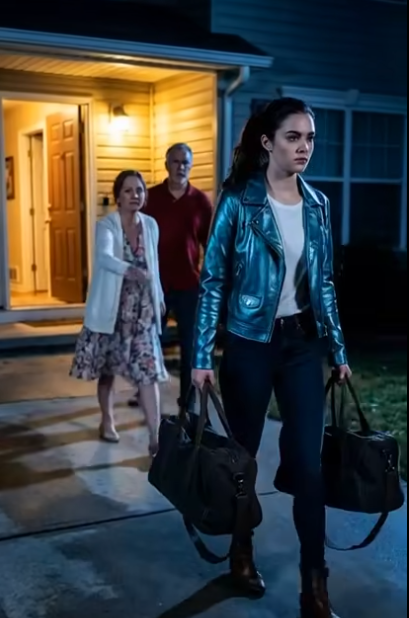
The final phone call wasn’t a shouting match. There was no grand explosion, no cinematic climax of thrown plates and slammed doors. It was worse. It was a quiet, suffocating death of a thing I had once called family. I stood in the driveway of the house I paid for but never owned, my packed duffel bag a lead weight in my hand, my car keys digging into my palm.
“I don’t understand what the big deal is,” my mother’s voice, thin and reedy through the phone, whined. “We just need a little more this month. The property taxes are due.”
I looked at the house—the neat lawn I mowed, the flowerbeds I weeded, the roof I had paid to have repaired last fall. “Mom,” I said, my own voice unnervingly calm, “the ‘little more’ this month is on top of the mortgage, the utilities, the insurance, and your car payment. I’m already covering everything.”
“Don’t be so dramatic,” she sighed, a masterclass in dismissal. “It’s what family does. We support each other.”
“No,” I said, the word a stone in my throat. “I support you. There is a difference.”
That’s when my father got on the line. I always pictured him lurking in the background, a silent partner in their emotional extortion, only stepping in to deliver the final blow. Rick, my dad, had a booming voice that he used to project authority he’d never earned.
“Listen here,” he started, no preamble. “Your mother is under a lot of stress. You’re being incredibly selfish. After everything we’ve done for you, giving you a place to live…”
“A place to live?” The question slipped out, laced with a bitterness that had been fermenting for years. “I moved back in to save money for a down payment on my own place. Instead, my savings have become your personal slush fund. I’m not living here; I’m a live-in ATM.”
The silence that followed was heavy with unspoken truths. I had finally said the quiet part out loud.
My mother’s voice came back, no longer whining, but sharpened to a razor’s edge. “If that’s how you feel, then maybe you should leave.”
It wasn’t a suggestion. It was a decree. An ultimatum designed to make me fold, to apologize, to crawl back and promise to be a better, more compliant source of income. They had played this card before, and I had always caved.
But this time, something inside me had fractured beyond repair.
“Okay,” I said. The single word was so quiet, I wondered if they’d heard it.
“What?” my father barked.
“Okay. I’ll leave,” I repeated, louder this time. I opened my car door, the squeak of the hinge a sound of finality. “I’m leaving right now.”
I didn’t wait for a response. I ended the call and tossed my phone onto the passenger seat. I didn’t look back at the house as I pulled out of the driveway. I couldn’t. If I did, I knew I might see my own reflection in the window—the ghost of a daughter trapped behind glass, forever paying a debt she didn’t owe.
That was the last time we spoke. After that phone call, the silence from my parents lasted five agonizing days. Five days where I swung wildly between terror and exhilaration, convinced I had either ruined my life or saved it. In my tiny, bare studio apartment, the silence was a physical presence. It was the backdrop to the hum of the ancient mini-fridge and the scuttling of roaches who were, for the moment, my only roommates. I’d lie awake on my mattress on the floor, tracing the water stains on the ceiling, and wonder if they were waiting for me to break. To call. To beg for forgiveness.
I was the one who had always fixed things, who had always smoothed things over. My silence was a language they didn’t understand, and its power was intoxicating.
Then, on the sixth day, the texts came. The first assault in a war I didn’t know how to win, but knew I could no longer afford to lose.
The buzz of my phone on the cheap particleboard nightstand was jarring. For five days, it had been a lifeline to friends, a tool for job hunting, a portal to a world outside my suffocating family drama. Now, it felt like a leash, yanking me back.
The first text was from Dad. Rick. His messages always had a blunt, almost perfunctory tone, as if he were negotiating a business deal he found slightly distasteful.
“Your mother didn’t mean it.”
I stared at the words, a cold knot tightening in my stomach. It was the classic opening gambit: absolve Mom of all responsibility. Frame her as a victim of her own emotions. I imagined him typing it, his brow furrowed in performative concern, while she watched over his shoulder.
I didn’t reply. A minute later, another buzz.
“You know how she gets when she’s stressed.”
This one was meant to trigger my empathy, my lifelong conditioning to manage my mother’s moods. For years, her stress had been the weather system our entire family revolved around. Her anxiety dictated our plans, her anger curdled our dinners, her sadness draped the house in a thick, gray fog. I was her emotional lightning rod, expected to absorb the shock so everyone else could carry on.
My thumb hovered over the keyboard. I could write a novel in response. I could detail the years of walking on eggshells, of swallowing my own feelings to make room for hers. I could ask him where he was when she was “stressed,” other than hiding in his workshop or conveniently having an errand to run.
Instead, I put the phone down. My heart was hammering. Responding, even to argue, was a form of engagement. It was an admission that his words had power over me. Silence was my only armor.
The final text from him that day was the most revealing.
“Let’s just put this behind us. You’re still on the mortgage.”
There it was. Not “We miss you.” Not “Are you okay?” But a stark, transactional reminder of my entanglement. It wasn’t a plea for reconciliation; it was a threat veiled as an olive branch. You can’t really leave. We still own a piece of you.
The rage that surged through me was so potent it was clarifying. It burned away the fog of guilt and obligation, leaving behind a hard, crystalline certainty.
I spent the rest of the day in a flurry of activity. I scrubbed the grimy floors of my studio, unpacked the last of my boxes, and bought a small hot plate. As I cooked ramen, stirring the noodles with a fork in the single pot I owned, I felt a strange sense of joy. The music from my phone’s tiny speaker was tinny, and a large cockroach ambled across the wall with an unnerving lack of haste, but it didn’t matter. This tiny, imperfect space was mine. The air in it was mine to breathe. I wasn’t holding my breath, waiting for the next emotional storm to break.
For two more days, my father’s texts went unanswered. Then, my mother broke through the silence with her signature blend of saccharine guilt and simmering venom. Her texts were a masterclass in psychological warfare.
“This is so selfish. We gave you everything.”
I pictured her sitting in the living room I had furnished, watching the television I had bought, using the internet I paid for, typing those words. Everything. The word was a lie so vast it was almost laughable. They had given me life, and they had spent the subsequent twenty-six years handing me the bill for it.
“You want us to be homeless?”
This was her favorite weapon: catastrophic thinking. Any boundary I set was interpreted as a direct wish for their complete and utter ruin. Years ago, when I’d suggested they consider a budget, she’d accused me of wanting them to starve. Now, by refusing to be their bank, I was apparently trying to throw them onto the street.
“You’re abandoning your family.”
Funny. They never saw it as abandonment when they were perfectly content with me footing every single bill. Groceries, electricity, car insurance, even Mom’s yearly car registration—all of it had migrated into my name, onto my credit cards. It had started so innocently when I moved back in during my last year of college. I’d offered to help with the groceries. “Just until I’m on my feet,” I’d said.
But my help wasn’t a bridge; it was a foundation they were happy to build upon. Over time, that “help” morphed into expectation, then hardened into obligation. Finally, it became a matter of survival—because if I didn’t pay, the lights would simply go out. I hadn’t realized how deep I’d sunk until I was out, breathing this new, thin air of freedom.
I blocked her number. My thumb trembled as I did it, a lifetime of filial duty screaming in protest. It felt like cutting off a limb. But as the confirmation message flashed on the screen, I didn’t feel loss. I felt relief.
I thought that would be the end of it for a while. I thought I had earned a reprieve. I was wrong. The real crisis wasn’t going to come through a text message. It was going to arrive in a crisp, white envelope with a window, delivered by the United States Postal Service. Three weeks later, a letter arrived, forwarded from my old address. It was from their mortgage lender.
The paper felt cold in my hands, a stark contrast to the flush of heat rising in my face. The legal jargon was dense, but the message was brutally simple. The mortgage payments for the past two months were delinquent. The bank wasn’t as understanding as they had assumed I would be. Foreclosure proceedings had officially begun.
I sank onto my mattress, the letter trembling. They hadn’t paid. After I left, after they told me to get out, they simply… hadn’t paid. The assumption was breathtaking in its audacity. They had thrown me out, then expected me to continue paying for the house I was no longer allowed to live in. It was a level of entitlement so profound it defied logic. They hadn’t even called to ask. They had just waited, assuming my conditioning would kick in, that my sense of responsibility would override my own survival.
A new kind of anger, colder and sharper than before, sliced through my shock. This wasn’t just emotional manipulation anymore. This was my name, my credit, my financial future they were setting on fire out of pure spite and incompetence.
My phone rang, and I knew, with sickening certainty, who it was. My father’s name flashed on the screen. He must have received a notice too. I let it ring, the sound shrill in the quiet room. It went to voicemail. A moment later, it rang again. And again. On the fourth try, I answered, my voice a low, steady calm I didn’t know I possessed.
“What,” I said. It wasn’t a question.
“You’re seriously going to let this happen?” he roared, the sound distorted by the speaker. The bargaining was over. This was pure, undiluted rage. “This is your fault! You just walked away!”
“I walked away after you told me to leave,” I stated, my voice level. Each word was a carefully placed stone in the wall I was building around myself. “And I seem to recall paying that mortgage for the last three years. What have you been doing with your money, Dad?”
There was a sputtering on the other end of the line. It was a question he had no answer for, because the answer was a thousand small indulgences: dinners out, new gadgets for him, shopping trips for her. A lifestyle built on my income while their own mysteriously vanished each month.
“We raised you!” he shouted, falling back on the oldest, most worn-out weapon in his arsenal. “We gave you a roof over your head!”
“And I paid to keep it from collapsing,” I shot back, the words like ice. “I am not your financial hostage, Dad. I was your daughter. And you lost the right to call me that when you stood by and watched her drown, saying nothing.”
I could hear his breathing, ragged and furious. He tried a different tactic, his voice shifting abruptly into a tone of pained reason. Bargaining. “Look, just… just make the payments. Get us out of default. We’ll figure it out. Your mother… she’ll apologize. I’ll make sure of it. Things will change, I promise.”
But I’d heard that song before. It was a melody of empty promises I had danced to my entire life. They had treated me like a credit card with feelings. A convenient appliance that dispensed cash and absorbed blame. They believed they were owed this—owed my income, my future, my peace—as payment for the basic act of raising me.
“No,” I said. The word was a slammed door. A locked gate. A burned bridge.
“What do you mean, no?” he asked, his voice laced with genuine disbelief. The possibility of my refusal was a concept so alien to him it simply didn’t compute.
“I mean, no. I will not be fixing this. This is the consequence of your own actions. You wanted me gone? You got it. All of me. Including my bank account.”
“You’ll ruin our credit!” he yelled.
“You mean my credit?” I countered. “The credit I’m going to need to build a life for myself? A life that doesn’t involve being your personal safety net?”
He said something else, a stream of venom and threats, but I wasn’t listening anymore. I was looking around my small studio, at the secondhand lamp casting a warm glow on my books, at the single pot from my ramen dinner drying on the counter. It wasn’t much. But it was mine. And it was safe.
“I didn’t owe you a second chance, Dad,” I said, my voice soft but unyielding. “Not when the first one cost me my dignity.”
I hung up before he could respond. Then, I did something I should have done years ago. I went into his contact and I pressed ‘Block’. The finality of the act was a deep, shuddering breath. The digital siege was over. Now, I just had to survive the fallout.
Months passed in a blur of work and exhaustion. I picked up extra shifts at the restaurant, my life shrinking to a simple, grueling rhythm: work, eat, sleep, repeat. Every dollar I saved was a brick in the foundation of my new life. I enrolled in a night class for bookkeeping, the dry certainty of numbers a welcome antidote to the chaotic emotions I was still processing.
I didn’t hear from them, but their presence lingered like a phantom limb. Every time an unknown number called, my stomach would lurch. Every official-looking envelope in the mail would send a spike of anxiety through me.
The foreclosure was finalized in late October. I found out by accident. I was scrolling through a real estate website, idly dreaming of a day I might be able to afford a one-bedroom apartment, when I typed in my old address out of a morbid sense of curiosity.
There it was. A blurry photo of the exterior, the lawn already showing signs of neglect. A garish red banner was slapped across the image: FORECLOSURE AUCTION.
I expected to feel a pang of guilt, a wave of sadness. I had celebrated birthdays in that house. I had mourned the loss of a grandparent under that roof. But looking at the picture, I felt nothing but a profound sense of finality. A quiet, hollow emptiness. I felt… done.
Friends, the few I had confided in, offered well-meaning but misguided advice. “They’re still your parents,” someone said over coffee, her voice full of gentle pity. “Maybe you could just reach out, see if they’re okay.”
But blood wasn’t the issue. Respect was. Love, I was learning, couldn’t survive without it.
One crisp Sunday afternoon, I found myself driving through my old neighborhood. I told myself I was just going for a drive, but I knew where I was headed. I parked across the street from the house and just sat for a while, watching.
It was boarded up now. Plywood sheets covered the windows and door, stark and ugly against the familiar brick. The lawn was overgrown, littered with fallen leaves. The mailbox, the one I had painted a cheerful blue one summer, was gone, leaving a small, raw patch of dirt where it once stood.
That house had eaten years of my life.
It had heard my muffled crying through its thin walls after another fight about money. It had hosted silent, tension-filled dinners where the only sounds were the scraping of forks and my mother’s cold glares. It had been a prison decorated with family photos, a testament to a happiness that was purely for public consumption.
Now it was just an empty, derelict shell. A monument to their failure and my escape.
I never asked where my parents went. I didn’t want to know. I assumed they had moved in with a relative, someone else to shoulder the burden for a while. After I’d blocked his number, my father had tried calling from new ones. The voicemails he left were a desperate, pathetic cycle. First came the guilt trips, then the angry threats, and finally, the wheezing, broken-sounding begging. I deleted them all without listening to the end.
Instead, I focused on rebuilding. The night class led to a certification. The certification led to a better job in the accounting department of a small firm. The better job led to a cleaner, brighter apartment in a safer neighborhood. It had a real bedroom, and the only cockroaches were the ones in my memory.
Every time I turned the key to my own door, a quiet ritual of gratitude washed over me. I had walked away from a lifetime of emotional and financial debt. I had paid it in full with my youth and my peace of mind. And I didn’t owe a single cent back.
I was finally solvent.
One year to the day after I left, an email landed in my inbox. The subject line was simply: “Hey.” The sender was a cousin I barely knew, someone from my father’s side of the family who I hadn’t seen since a wedding a decade ago. My first instinct was to delete it, assuming it was another attempt by my parents to get to me through a proxy.
But curiosity won. My finger trembled as I clicked it open, bracing myself for another attack. But the words on the screen weren’t what I expected.
The email was short, just a few lines.
“Hey. Uncle Rick and your mom are staying with us for a bit. He told me his version of what happened. I just wanted you to know—I think you did the right thing.”
I read the words once. Then twice. I leaned back in my office chair, the world around me seeming to fall away. The quiet hum of my computer, the distant sound of traffic, the ticking of the clock on the wall—it all faded into a dull roar in my ears.
For a year, I had been the villain in a story I never wanted to be a part of. The cruel daughter. The selfish, ungrateful child who had abandoned her loving parents in their time of need. I had heard their version of the story echoing in my own head, a chorus of self-doubt and guilt that I had to fight back against every single day. I had built my new life on a foundation of my own conviction, but it was a lonely, unsupported structure.
And now, this. This small, quiet message from a near-stranger. It was a single voice cutting through the noise. A hand reaching out in the darkness to affirm that I wasn’t lost.
I didn’t reply to the email. There was nothing to say. But a slow, wide smile spread across my face, and I felt the sting of a single, hot tear as it traced a path down my cheek. It wasn’t a tear of sadness or of anger. It was a tear of pure, unadulterated relief. The relief of being seen. The relief of being understood.
Because for the first time, someone in the family, someone who had seen them up close, had said it.
I wasn’t crazy.
I wasn’t cruel.
I was just finally, blessedly, choosing me.
My life is quiet now, and I’ve learned to love the sound of it. The peace is something I cherish, something I protect fiercely. My apartment is filled with plants and books and the smell of coffee. It’s a home I built myself, not with money wrested from me by obligation, but with the steady, quiet work of my own two hands. My future is no longer a debt to be paid, but a path to be walked. And for the first time, I am walking it for myself.
If you want more stories like this, or if you’d like to share your thoughts about what you would have done in my situation, I’d love to hear from you. Your perspective helps these stories reach more people, so don’t be shy about commenting or sharing.