The first thing I noticed wasn’t the violation of a rule, but a disruption of rhythm.
As a man who has spent his life restoring the crumbling architecture of San Belluno, I have learned to listen to the city. I know the cadence of the afternoon lull, the heavy, sun-washed silence that settles between the hills and the sea, and the specific, shuffling tempo of pedestrians navigating the cobblestones of the Plaza Mayor. Life here moves slowly; strangers brush past one another without concern, their movements predictable, their paths logical.
But on that Tuesday afternoon, the air around me seemed to tighten with a quiet, suffocating urgency. A chill, entirely unrelated to the weather, crawled up my spine and settled deep in my chest. I lifted my gaze from the glowing screen of my phone, my thumb hovering over a meaningless email, and felt my reality fracture.
My daughters were no longer walking carefully beside Elena, their caregiver.
They were running.
I froze. My mind, usually so adept at analyzing structural integrity, failed to process the physics of what I was seeing. Sofia, Isabella, and Lucia—my triplets, my fragile angels—were not stumbling. They were not reaching their hands out in the trembling uncertainty that had defined their existence for six years. They were not calling for help.
They were moving with a strange, fluid grace, a terrifying confidence that I had never witnessed. Their matching navy coats fluttered behind them like banners of insurrection as they crossed the stone-paved square. They wove through the afternoon crowd with instinctive precision, swerving to avoid a street musician’s violin case, stepping effortlessly around a toddler chasing pigeons, and banking sharply toward the fountain.
“Girls!” Elena cried out. Her voice, usually a blade of polished steel, cracked. It was the sound of a jailer losing the keys. “Please, stop! It is unsafe!”
My heart hammered against my ribs, a violent drum solo in a quiet room. I shouted their names, my voice echoing uselessly off the ancient stucco walls. They did not slow. They did not hesitate. They did not turn their heads to orient themselves to my sound.
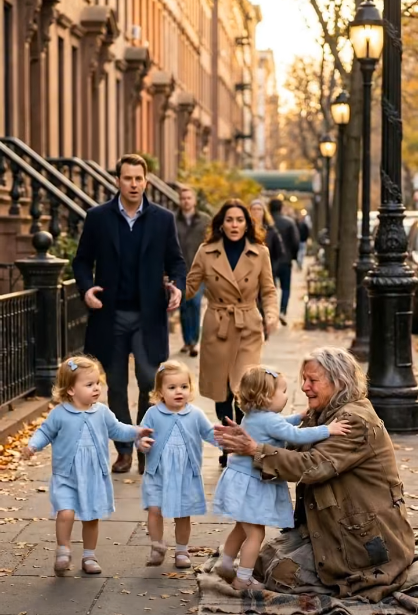
They ran straight toward a figure seated near the edge of the fountain—an elderly woman with silver hair cascading over worn clothing—and threw themselves into her open arms as if that stranger’s embrace was the only home they had ever known.
“Grandma!” they called out in unison.
The word struck me with the force of a physical blow. I stopped walking. The world grayed at the edges.
“Grandma.”
Their voices were bright with certainty. They were vibrating with joy.
My daughters had been diagnosed with cortical blindness in infancy. Dr. Valerius, a specialist Elena had brought into our lives, had explained it to me with grim finality: their eyes worked, but their brains could not process the images. Their world was shaped by sound, touch, and the terrifying dark.
Yet now, they stood pressed against a stranger in the middle of a crowded plaza, their faces lifted, their eyes focused, drinking in her presence with a calm, visual recognition that should have been medically impossible.
The woman wrapped her arms around them. She didn’t look surprised. She looked relieved. She held them with a tenderness that made something deep inside my gut twist—a mixture of jealousy and dread.
I forced my legs to move. When I finally reached them, breathless and trembling, my voice came out sharper than I intended, fear masquerading as authority.
“Please step away from my children,” I commanded, forcing steadiness into my tone. I looked at the woman. “Who are you?”
The woman looked up at me slowly. Her face was a map of weathered sorrow, etched with lines of hardship, but her eyes were clear. She was not frightened. She was not defensive. She looked at me with a quiet, devastating pity.
“They found me, Matteo,” she replied softly. “I did not call them.”
The use of my name sent a shockwave through me. But before I could demand an explanation, Sofia turned her face toward me. She didn’t tilt her head to listen. She looked. Directly. Into. My. Eyes.
The accuracy was lethal. It stole the breath from my throat.
“Papa,” she said gently, her small hand clutching the stranger’s shawl. “Why did you never tell us she existed?”
I stared at her, unable to speak. The logic I had built my life upon—the medical reports, the darkened rooms, the sensory toys, the endless appointments—was dissolving like sugar in hot water.
“You… you cannot see,” I whispered hoarsely. The words sounded hollow, a rehearsed lie I had been forced to memorize.
“Yes, we can,” Isabella replied calmly, stepping closer to the woman. “When she is here.”
Lucia reached up and touched the old woman’s cheek with careful affection, tracing a tear track that I could see glistening in the sunlight.
“She smells like Mama,” Lucia said. “Like the lavender soap she used at night. Before she went away.”
The sounds of the plaza—the fountain, the pigeons, the chatter—faded into a dull roar. The caregiver, Elena, finally caught up to us. She was pale, her chest heaving, her pristine uniform suddenly looking like a costume that no longer fit. She stood frozen, unable to offer a reprimand, unable to offer an explanation.
Because there was no explanation that her version of the truth could provide.
I looked from Elena’s terrified face to the calm, defiant eyes of my blind daughters, and I realized with a sickening lurch that the darkness in my home had never been in their eyes.
It had been in my own.
That evening, the house felt different.
Usually, our home was a fortress of silence. I had soundproofed the walls; we kept the furniture in rigid, unmovable positions to prevent accidents. It was a sterile environment, curated by Elena for the safety of “the invalids.”
Tonight, it felt like a stranger’s house.
The girls talked continuously. I stood in the doorway of the nursery, listening as they lay in their beds, their voices filled with an excitement that bordered on delirium. They were describing the colors of the sky. The sparkle of the water in the fountain. The way the pigeons bobbed their heads. The redness of a passerby’s scarf.
Each adjective was a dagger. They were not imagining these details. They were recalling them.
“How do you know these things?” I asked at last, stepping into the room. My voice was strained, the voice of a man walking on a frozen lake that is beginning to crack.
Sofia sat up. She looked at the lamp on the nightstand, then at me.
“We saw them, Papa,” she replied simply.
“You have never seen,” I said, grasping at the remnants of my authority. “Dr. Valerius said—”
“The Doctor lies,” Isabella said. Her voice was small but hard. “He tells us to close our eyes. He tells us it hurts to look. He tells us we are broken.”
“But today,” Lucia whispered, “the lady… the Grandma… she showed us how to open them. She said the light belongs to us.”
I looked at Elena, who was standing in the corner, folding laundry with aggressive precision. Her back was to me, but I could see the tension in her shoulders.
“It is a hysterical episode,” Elena said sharply, not turning around. “A collective hallucination brought on by overstimulation. I have already called Dr. Valerius. He will increase their dosage tomorrow.”
“No,” I said.
The word hung in the air. Elena stopped folding. She turned slowly, her expression cool and condescending, the look one gives a petulant child.
“Matteo,” she said, her voice dropping to that soothing, manipulative register she used so well. “You are emotional. It was a traumatic event. The girls are confused. They mimic what they hear. They are echoing the descriptions of others.”
“They described the color of the woman’s shawl,” I said, my voice rising. “They ran around obstacles. They made eye contact, Elena.”
“Coincidence,” she snapped. “Muscle memory and sound localization. Do not give them false hope. It is cruel.”
She walked past me, smelling of antiseptic and starch, and for the first time in years, the scent made me gag.
Sleep never came that night.
I sat alone in my study, the heavy oak door locked against the silence of the house. In my hands, I held a photograph of my late wife, Isadora. It was taken years ago, in the very plaza where my world had collapsed today. She was laughing, her head thrown back, her eyes bright with a mischief I had loved and failed to protect.
Isadora had died three weeks after the triplets were born. Complications, I was told. A weakness of the heart.
I looked at her face. Elena had come into our lives shortly before the birth, a specialized nurse recommended by a distant acquaintance. When Isadora died, Elena had stayed. She had become the pillar I leaned on, the expert who navigated the terrifying diagnosis of three blind infants.
She smells like Mama, Lucia had said.
I opened the bottom drawer of my desk, digging through the chaotic pile of papers I couldn’t bear to organize. I found the file. The medical reports. The glossy, expensive stationary of Dr. Valerius.
I began to read. Really read. Not with the eyes of a grieving, overwhelmed father who just wanted to be told what to do, but with the eyes of a Restoration Architect looking for a stress fracture.
The jargon was dense, circular. Cortical visual impairment. Psychosomatic negation. Sensory processing disorder.
I looked at the dates. Every major diagnosis coincided with a period where I had tried to seek a second opinion. Every time I had suggested a specialist in the capital, Elena had reported a sudden regression, a fever, a terrifying episode that kept us grounded in San Belluno, tethered to her and Dr. Valerius.
A cold sweat broke out on my forehead.
I wasn’t looking at a medical history. I was looking at a blueprint. A blueprint for a prison.
I needed to know who the woman in the plaza was. Lucia had called her Grandma. Isadora had told me she was an orphan, raised in state care. She had said she had no family.
But Isadora had been young, vulnerable, and heavily influenced by the “mentors” in her life.
I stood up. The sun was beginning to bleed through the curtains. I wouldn’t wait for the appointment with Dr. Valerius. I was going back to the source.
The next afternoon, I returned to the plaza.
I went alone. I left the girls with Elena, explicitly ordering her not to administer any medication until I returned. The look she gave me was venomous, a flash of pure hatred that vanished as quickly as it appeared, replaced by her mask of professional concern.
The woman was there.
She was seated in the same place, on the cool stone lip of the fountain, feeding the pigeons. It was as if she had not moved in twenty-four hours. As if she was a statue waiting to be animated.
When I approached, she didn’t flinch. She looked up at me with those eyes—eyes that mirrored my dead wife’s so perfectly it made my knees weak.
“You want the truth, Matteo,” she said quietly. It wasn’t a question.
I sat down beside her, ignoring the dust on the stone. “Who are you?”
“My name is Lucinda Morel,” she said, her voice rasping like dry leaves. “And I am the woman who was forced to sell her daughter to save her.”
The sounds of the city seemed to warp around us.
“Sell?” I whispered.
“Not for money,” Lucinda said, looking at the water. “For safety. Or so I was told.”
Piece by jagged piece, she laid the story out before me.
Thirty years ago, Lucinda had been a housekeeper for a wealthy, influential family in the north. A scandal. A pregnancy. The family couldn’t have the maid’s child running around. They didn’t fire her; they offered to “place” the child with a good family, a family that could provide. If she refused, they would ensure she never worked again, that she and the child would starve.
She had given Isadora up. She had been told the records were sealed.
But she had kept track. Shadows have a way of watching.
“I watched her grow from afar,” Lucinda said, tears finally spilling over. “I watched her marry you. You looked kind. You looked strong. I thought she was safe.”
“She told me she was an orphan,” I said.
“She was told her mother abandoned her,” Lucinda corrected. “Cruelty requires lies to sustain itself.”
“And Elena?” I asked, the name tasting like ash.
Lucinda turned to me, her expression hardening into something ancient and fierce.
“Elena was the agency caseworker,” she revealed. “She was the one who brokered the adoption. She was the one who monitored Isadora’s placements. She was obsessed with the ‘perfect family.’ When Isadora grew up and escaped the system, Elena couldn’t let go. She found her way back in.”
I felt the bile rise in my throat. “She inserted herself.”
“She preyed on Isadora’s fear of being a bad mother,” Lucinda said. “And when your wife died… Elena saw a chance to create the perfect dependents. Children who would never leave. Children who would need her forever.”
“They aren’t blind,” I said, the realization solidifying into absolute fact.
“They see perfectly,” Lucinda said. “But if you bind a child’s eyes from the day they are born, and tell them the light is pain, and punish them when they look… they will learn to be blind. The mind is a powerful thing, Matteo. It bends to survival.”
She reached into her worn bag and pulled out a stack of faded envelopes.
“These are the letters I tried to send,” she said. “Elena intercepted them all. But she kept them. I found them in the trash outside your home three days ago. That is how I knew it was time to show myself.”
I took the letters. They were addressed to Isadora.
My hands shook. The anger that flooded my veins was not hot; it was glacial. It was the cold, calculating fury of a man who realizes his home has been infested by termites for a decade.
“Come with me,” I said, standing up.
Lucinda looked hesitant. “She will call the police. She has power, Matteo. She has doctors.”
“I am an architect,” I said, extending my hand to my mother-in-law. “I know how to demolish a structure that is rotting from the inside. And today, I am bringing the sledgehammer.”
The confrontation was inevitable, but it was not loud.
When we entered the house, the silence was absolute. The girls were in their room, likely sedated, a thought that made my vision swim with red.
We found Elena in the kitchen, mixing a powder into three glasses of juice. She looked up, and for the first time, her composure fractured completely.
She didn’t look at me. She looked at Lucinda.
“You,” Elena hissed. “You filthy old witch. I told you to stay away.”
“Get out of my house,” I said. My voice was low, terrifyingly calm.
Elena laughed. It was a brittle, sharp sound. “You are making a mistake, Matteo. You are a broken man with three disabled children. The court will give custody to the primary caregiver. I have the medical records. I have the documentation of your depression. You cannot manage them without me.”
“I know about the agency,” I said.
Elena froze. The spoon clattered against the glass.
“I know who you are,” I continued, stepping into her space. “I know you conditioned my children. I know you gaslit my wife. And I know that Dr. Valerius is likely getting a kickback from your agency fees.”
She stared at me, her eyes darting to the phone on the counter.
“I have already called the police,” I lied. “And the Medical Board. And a private investigator.”
Elena’s face drained of color. The arrogance vanished, replaced by the cornered snarl of a predator caught in a trap.
“You ungrateful bastard,” she spat. “I gave up my life for this family. I kept them safe! The world is dangerous! They needed to be protected!”
“You made them believe they were blind!” I roared, the control finally snapping. I swept the glasses of juice off the counter. They shattered, splashing orange liquid across the pristine white tiles. “You stole the sun from them!”
“I made them need me!” she screamed back, her face twisting into something ugly and raw. “That is love! Dependence is the purest form of love!”
“That is not love,” Lucinda’s voice cut through the air. She stepped forward, small but indomitable. “That is hunger.”
Elena looked at the old woman, then at the shattered glass, then at me. She saw the end.
She didn’t fight. She didn’t beg. She simply straightened her uniform, smoothed her hair, and walked to her room to pack her bag. She knew that if she stayed another ten minutes, my restraint would fail, and I would kill her with my bare hands.
She left ten minutes later. The slamming of the front door echoed like a gunshot, signaling the end of the regime.
But the silence she left behind was heavy.
I ran upstairs. The girls were groggy, but awake. Elena hadn’t given them the juice yet.
I fell to my knees beside their beds, gathering them into my arms. I wept. I wept for the six years of darkness. I wept for Isadora. I wept for the fear that had ruled our lives.
“It’s okay, Papa,” Sofia whispered, stroking my hair. “The witch is gone?”
“Yes,” I choked out. “She is gone.”
“Good,” Isabella said, opening her eyes wide. “I want to see the moon.”
Healing did not come quickly. It came in agonizing, beautiful increments.
The investigation that followed uncovered everything. Altered medical records. Unauthorized prescriptions. Psychological conditioning disguised as therapy. Dr. Valerius lost his license and faced charges. Elena disappeared before the trial, fleeing the country, a ghost I hope never to see again.
Specialists confirmed what I had begun to fear and hope: My daughters had 20/20 vision.
What they had lost was confidence, freedom, and time. Their brains had been wired to ignore visual input, a condition known as “psychogenic blindness.” They had to learn how to see. They had to learn depth perception, how to read expressions, how to navigate a world that didn’t stop at their fingertips.
Lucinda became the anchor of our new life. She moved into the guest room, filling the sterile house with the smell of baking bread and old stories. She didn’t force affection; she simply offered presence.
Slowly, the girls grew stronger. The fortress became a home. I removed the soundproofing. I threw away the sensory toys and bought paints, telescopes, and cameras.
One afternoon, six months later, we were back in the Plaza Mayor.
The sun was setting, casting long, golden shadows across the stones. The girls were playing near the fountain—not running with reckless abandon, but exploring. Watching.
Sofia ran up to me, holding a pigeon feather she had found.
“Look, Papa,” she said, holding it up to the light. “It has green in it. And purple.”
“I see it,” I said, smiling.
She looked up at me, her dark eyes sharp and clear.
“You look kind,” she said suddenly. “Just like Mama described in her diary.”
I froze. “What diary?”
“Grandma found it,” she said, pointing to Lucinda, who was watching us from a bench. “She read it to us.”
I looked at my mother-in-law. She smiled and held up a battered leather book. Another secret Elena had failed to destroy.
I walked over and sat beside Lucinda.
“Thank you,” I said.
“They are resilient,” she replied, watching her granddaughters chase the light. “Like their mother.”
Years later, I would transform that experience into purpose. I used my inheritance and my architectural firm to open the Isadora Center, a facility dedicated to children affected by psychological trauma and medical fraud. It is a place filled with light—floor-to-ceiling windows, skylights, open courtyards. A place where fear is replaced by clarity.
Lucinda became its soul, the grandmother to a hundred children who had lost their way.
On the day the center opened, I stood beside my teenage daughters. They were poised, confident, and radiant. They spoke to a room filled with donors, parents, and survivors.
“We were taught to be afraid of the dark,” Isabella told the crowd, her voice steady. “But the darkness wasn’t the enemy. The enemy was the lie that told us we couldn’t turn on the light.”
The applause was deafening.
That night, as I tucked them into bed—a ritual I refused to give up, even as they grew older—Lucia grabbed my hand.
“Papa,” she whispered. “Everything feels clear now.”
I kissed her forehead gently. My heart was full, not because the past had disappeared—the scars would always be there—but because the future had finally come into focus.
I walked to the window and looked out at San Belluno. The city lights were twinkling, a million tiny stars mirroring the sky. I didn’t close the curtains.
I left them open.
If you want more stories like this, or if you’d like to share your thoughts about what you would have done in my situation, I’d love to hear from you. Your perspective helps these stories reach more people, so don’t be shy about commenting or sharing.