The Bear and the Honey: How I Toppled a Small-Town Empire
The morning I left for the emergency management conference in Seattle, I lingered in the doorway of my daughter’s bedroom, watching the gentle rise and fall of her chest. Emma was six, small for her age, with my unruly dark curls and her father’s piercing green eyes. A knot of guilt, heavy and cold, tightened in my stomach. Three days felt like a lifetime to be away, but my husband, Shane, had been dismissive of my hesitation.
“My mom and dad are coming over to help,” Shane had said, his smile tight, the expression of a man who hated confrontation. “You know how much Emma loves them, Jules. Go. You need the certification for the promotion.”
Over eight years of marriage, I had learned that arguing with Shane about the Anderson clan was like screaming into a void. In our insular Missouri town, the Claytons and the Andersons weren’t just families; they were institutions. They owned the dealerships, the insurance firms, and the mortgages of half the population. They were a black hole of influence and old money that swallowed everything in its orbit.
When I, an outsider raised by a single father in the rugged Cascade Mountains of Oregon, married Shane, I thought I was gaining a support system. I didn’t realize I was being absorbed by a corporation that viewed autonomy as a defect.
I grew up differently. My father taught me to read topography lines before I could read books. I spent my twenties in the Forest Service, eventually becoming a specialized Wilderness Rescue Coordinator. My office was the avalanche zone, the flash flood, the deep ravine. I dealt in the raw, unpolished reality of survival.
Shane’s father, Dick Anderson, dealt in leverage and fear. He was a man of imposing bulk and suffocating charisma, a patriarch who demanded absolute fealty. His wife, Carol, was his silent enforcer, smiling thinly while she judged the world.
I tried to skip the conference. But my supervisor insisted, and Shane pushed, claiming I was being “neurotic.” So, I went.
I called Emma twice on the first day. Shane sounded distracted, almost annoyed. “We’re fine, Julia. Stop hovering. She’s playing with Dad.”
The second day, I was in a breakout session on High-Angle Rescue Techniques when my phone buzzed against my hip. It was Tom Beach.
Tom lived next door. A retired Marine Raider who had done three tours in the sandbox, Tom didn’t send casual texts. We had bonded over early morning runs and the mutual, silent recognition of people who had seen the fragility of human life.
The text was simple: Check your backyard camera. Now.
A cold spike of adrenaline—the kind I felt right before rappelling into a crevasse—pierced my chest. I opened the security app. I had installed the system myself, ignoring Shane’s complaints that I was being paranoid. The Andersons always made the hair on my arms stand up.
The feed loaded. My vision narrowed to a pinprick.
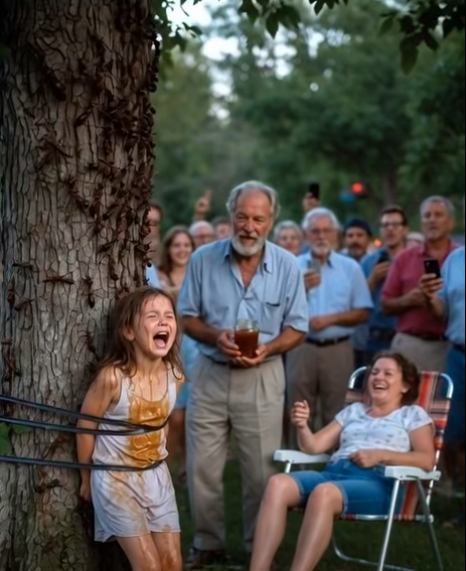
My backyard, usually a sanctuary of swing sets and sandbox toys, had been turned into a theater of cruelty. Emma was tied to the old oak tree. Her small arms were bound behind the trunk, her ankles lashed together with zip ties. She was screaming—a raw, primal sound of terror that the tiny phone speaker couldn’t fully contain, yet it shattered my heart instantly.
She was covered in something thick and amber. It glistened in the afternoon sun.
Dick Anderson stood nearby, holding an empty plastic bear-shaped honey container. He was laughing. It wasn’t a chuckle; it was a full-bellied, head-thrown-back guffaw of pure entertainment. Carol stood with her arms folded, a thin, approving smile on her lips, watching like a critic at a play.
And Shane? My husband? The father of my child? He was setting up a lawn chair. He sat down, crossed his legs, and raised a glass of iced tea in a mock toast to our weeping daughter.
Then I saw the movement on the ground. A dark, writhing line marching up the bark of the oak tree. Ants. Thousands of them, drawn by the scent of sugar. Fire ants.
My daughter thrashed against her bonds as they began to swarm her legs.
I saw the others then. Norman, Shane’s uncle, recording with his phone. Alan, Shane’s brother, pointing and jeering. Twelve members of the Anderson clan, gathered like spectators at a medieval execution, taking bets on my daughter’s torture.
Tom’s next text arrived: I called 911. Police are 8 minutes out. What do you need?
I stood up so abruptly my chair crashed backward. The instructor stopped speaking. Every eye in the room turned to me, but I was already gone. I was no longer a wife or a conference attendee. I was a rescue operator in crisis mode.
“Curtis Bower,” I barked into the phone as I sprinted down the hotel corridor. Curtis was a lawyer back home, the only one brave enough to not be in Dick Anderson’s pocket. “I need you at my house. Now. My daughter is being tortured by my husband and his family. I have video. I want emergency custody, restraining orders, everything. Burn them to the ground.”
“Jesus, Julia, I’m moving,” Curtis replied, the shock evident in his voice.
I burst out into the Seattle rain. My rental car was waiting. I didn’t think about flights; the wait for TSA would make me homicidal. I threw my bag in the passenger seat and tore out of the parking lot. Thirty hours of driving lay between me and my daughter.
My phone buzzed again. Tom.
Police arrived. Taking statements. Ambulance is treating Emma. Family is claiming it was a ‘game.’ Teaching her resilience.
My hands gripped the steering wheel until my knuckles turned white. A game. They were watching my child be eaten alive, and they called it a game.
“Tom,” I said when he answered, my voice terrifyingly calm. “I need you to stay with her. Do not let a single Anderson near her. I don’t care if you have to physically bar the door.”
“Already done,” Tom said, his voice grim. “I’ve got photos of everyone present. I gave the cops my footage too. And Jules… this wasn’t just dysfunction. This was organized. They planned this.”
“I know.” I merged onto the highway, watching the Seattle skyline vanish in the rearview mirror. “I need you to do one more thing. Start digging. I want everything on Dick Anderson. Every dirty deal, every skeleton, every person he’s ever crushed. Can you access your old networks?”
There was a pause. “You planning a war, Julia?”
“They tortured my daughter for sport, Tom. I’m not planning a war. I’m planning an extinction event.”
“Give me forty-eight hours,” Tom said. “Drive safe. Emma needs her mama.”
The drive was a blur of asphalt, caffeine, and a rage so hot it felt cold. I crossed state lines like checkpoints in a race against my own sanity. Washington, Idaho, Montana. The vast emptiness of the West usually calmed me, but now it felt like a prison keeping me from Emma.
My phone was a war zone. Fifty-three missed calls from the Anderson clan. Voicemails from Dick ranged from conciliatory (“Julia, honey, let’s talk about this misunderstanding”) to menacing (“You bring the law into family business, you’ll regret it”). Shane sent texts claiming I was overreacting, that his father was just “toughening Emma up” because I coddled her.
I saved everything. Every threat, every gaslighting excuse. It was all ammunition.
By the time I hit the Missouri state line, I had been awake for twenty-six hours. I pulled into the hospital parking lot just as the sun was bleeding over the horizon, painting the sky the color of a bruise.
Tom was waiting outside Room 417. He looked like a sentinel, arms crossed, eyes scanning the hallway. When he saw me, his shoulders dropped an inch.
“She’s asleep,” he whispered. “The bites are treated. No anaphylaxis, thank God. But Jules… she flinches if the nurse moves too fast. She told the social worker that Daddy said she was being punished for being ‘bad.’ That if she was a tougher girl, Mommy wouldn’t have to work so much.”
The rage that surged through me was absolute. They hadn’t just hurt her body; they had tried to break her spirit. They had weaponized my career against my child.
I walked into the room. Emma looked so small in the hospital bed, her skin welted and bandaged. I sat beside her and took her hand. Her eyes fluttered open. For a second, I saw terror—then recognition.
“Mommy?”
“I’m here, baby,” I choked out, tears finally spilling. “I’m right here.”
She launched herself into my arms, sobbing. “I’m sorry, Mommy. I’m sorry I wasn’t strong.”
“No,” I said firmly, pulling back to look her in the eye. “You listen to me. You were never the problem. What they did was wrong. Evil. And I promise you, Emma, they will never, ever hurt you again.”
She clung to me, her tears soaking my shirt. “I want to go home. But not… not to Daddy.”
“We aren’t going there,” I promised. “It’s just you and me now.”
An hour later, Curtis Bower arrived to take me to the courthouse. “Emergency hearing is in forty minutes,” he said, handing me a black coffee. “We drew Judge Rivera. She’s fair, which means Dick hates her.”
“What’s their defense?” I asked.
“Vincent Price is their lawyer. He’s going to paint you as a career-obsessed absentee mother who doesn’t understand ‘traditional discipline.’ They’re going to say you’re hysterical and absent.”
“Let them try.”
The courtroom was a theater of the absurd. Shane sat with his parents, dressed in conservative pastels. Shane looked pale and stared at the floor, but Dick Anderson wore a suit that cost more than my annual salary, looking indignant. Carol sat beside him, dabbing at dry eyes.
Price launched his attack immediately. “Your Honor, Mrs. Keenan is a wilderness rescue worker. She disappears for days into dangerous environments. She leaves the parenting to my client. This incident, while perhaps… overzealous… was a grandfather trying to teach resilience to a spoiled child. A character-building exercise.”
I sat perfectly still. My training taught me to conserve energy, to wait for the critical moment.
When it was our turn, Curtis didn’t make a speech. He just played the video.
The courtroom filled with the sound of Emma’s screams. We watched the honey being poured. We watched the ants swarm. We heard the laughter. We heard Shane say, “Five bucks says she cries in under two minutes.”
The silence that followed the video was heavy enough to crush a man.
Judge Rivera looked at Shane, then at Dick. Her expression was one of profound disgust.
“Mr. Anderson,” the judge said, her voice icy. “You call this character building? I call it sadism.”
“Now see here!” Dick blustered, standing up. “I’m a pillar of this community! You can’t—”
“Sit down!” Rivera snapped. “Emergency custody is granted to the mother, Julia Keenan. Mr. Keenan, you are to have no contact with the child pending a full psychiatric evaluation. Mr. and Mrs. Anderson, if you come within five hundred feet of that little girl, I will have you thrown in jail so fast your head will spin.”
Dick’s face turned a violent shade of purple. As the bailiff escorted him out, he leaned toward me. “You think you’ve won, little girl? You have no idea who you’re dealing with. I will bury you.”
I looked him dead in the eye. “No, Dick. You have no idea who you are dealing with.”
We moved into a short-term rental on the edge of town, a safe house arranged by Tom. For three weeks, my life narrowed to the essentials: Emma’s therapy, my remote work, and the files Tom Beach had compiled.
While Emma slept, I studied the anatomy of the Anderson empire. Tom had been thorough.
“Dick Anderson is a bully,” Tom explained one evening, spreading photos across the kitchen table. “But he’s a leveraged bully. He owns the dealerships, the bank shares, the real estate. But he manages it all through fear. High employee turnover. Vendors who hate him. He’s got silent partners who only tolerate him because he makes them money.”
“And the family?”
“Cult dynamics,” Tom said. “Shane, Alan, the cousins—they were all abused too. Locked in sheds, starved, humiliated. They think it’s normal. They perpetuate it to survive Dick’s wrath.”
I looked at a photo of Shane. I felt a pang of pity, quickly extinguished by the memory of him sitting in that lawn chair while our daughter screamed.
“We have the custody hearing in three weeks,” I said. “Price is going to fight dirty. He’s investigating my background, trying to find dirt. Claiming my job puts Emma at risk.”
“Let him look,” Tom grinned. “You save lives. But Dick? Dick has skeletons dancing a conga line in his closet.”
Tom slid a folder toward me. “Foster kids. Back in the eighties. The Andersons took in three wards of the state. All removed within a year. Records sealed, but I found the social worker. She says Dick used them as free labor at the car lot and disciplined them with… ‘outdoor exposure.’”
“He’s a predator,” I said quietly.
“He is. And Jules? He’s going on his annual hunting trip next Thursday. Montana. Private ranch. Just him and his inner circle of sycophants.”
I felt a click in my brain. The tumbler of a lock falling into place.
“Montana?” I asked. “Remote?”
“No cell service. Miles from civilization. Why?”
I stood up and walked to the window. “Because Dick Anderson likes to use nature as a weapon. He thinks the wilderness is a place to prove how tough you are. I think it’s time he learned that nature doesn’t take bribes.”
I took leave from work. I arranged for Emma to stay with Aaron Strickland, Alan Anderson’s ex-wife, who had escaped the family years ago and was one of our fiercest allies.
Then, I drove to Montana.
I didn’t take a gun. I didn’t need one. I took my pack, my knowledge of the topography, and a patience born of a thousand stakeouts in freezing rain.
I found their camp easily. It was a glamping setup that insulted the very concept of “outdoors.” Massive tents, generators, cases of expensive bourbon. Dick and his cronies—Alan, Norman, and three dealership managers—were playing mountain men.
I watched them for a day. They relied entirely on their GPS units and their hired guide. They were loud, drunk, and careless.
On the second night, while they slept off a whiskey bender, I moved in. I didn’t hurt anyone. I simply… adjusted their reality.
I recalibrated their GPS units, introducing a subtle drift. I moved their trail markers. I poured out half their water reserves, leaving just enough to seem like carelessness.
The next morning, they set out. Dick, arrogant as ever, overruled their guide on the direction of the elk herd. He led them straight into a box canyon I had scouted.
By noon, they were turned around. By 3:00 PM, they were lost. The guide was arguing with Dick. The group was fracturing.
I waited until Dick separated from the group to relieve himself. He had wandered about a hundred yards into the dense pine forest, muttering curses about incompetent guides.
I stepped out from behind a Douglas fir. “Hello, Dick.”
He jumped, nearly tripping over his own boots. He fumbled for the rifle slung over his shoulder, but his hands were shaking from dehydration and a hangover.
“Julia?” He stared at me, eyes bulging. “What the hell are you doing here? You stalking me?”
“I’m rescuing you,” I said calmly, leaning against a tree. “Or, I could be. It depends.”
“I’ll have you arrested! This is harassment!”
“You’re five miles off course, Dick. The temperature is dropping. It’ll be freezing in two hours. You’re dehydrated, your group is panicking, and you are wearing boots that are giving you blisters because you bought them for looks, not function.”
I took a step closer. The forest went silent around us.
“You tied my daughter to a tree,” I whispered. “You poured honey on her. You laughed while she screamed. You think you’re a hard man, Dick. You think suffering builds character?”
Dick tried to puff up his chest, but he looked small against the towering pines. “I did what was necessary. She’s weak. Like her mother.”
“I have spent fifteen years pulling men like you off mountains,” I said. “Men who think their money makes them invincible. Out here, nature doesn’t care about your bank account. It doesn’t care who your grandfather was. It only cares about survival. And right now? You are prey.”
I pulled out my phone and snapped a photo. Dick looked terrified—sweaty, red-faced, eyes darting like a trapped animal.
“What are you doing?”
“Collecting evidence,” I said. “Proof that when the safety net is gone, you’re just a scared old man.”
I pointed south. “Follow the creek bed. It leads back to your camp. If you hurry, you won’t freeze. If you panic… well, that’s a character-building exercise.”
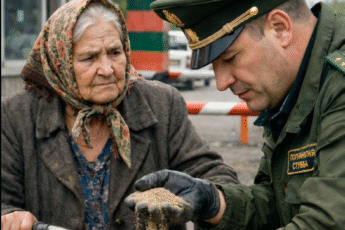
I vanished into the trees before he could respond. I shadowed them until they stumbled back to their camp hours later, broken and terrified. They packed up and left the next morning.
Dick returned to Missouri furious. He called a family council, demanding they destroy me. He didn’t know that Tom Beach had bugged his office during the chaos of the bankruptcy filings we had initiated.
We listened to the recording.
“She hunted me!” Dick screamed. “She’s insane! We need to hit her with everything. Vincent, file for full custody. Say she’s unstable. Say she followed me across state lines! Shane, get on TV. Cry about how she stole your daughter.”
They thought they were escalating the war. They didn’t realize the ground had already crumbled beneath them.
The week before the final custody hearing, I triggered Phase Two.
It started with the victims. Tom and I organized a town hall in the neighboring county. We expected twenty people. Sixty showed up.
There were ex-employees fired for refusing to defraud customers. There were women harassed by Norman Barber. There were the grown foster children, finally ready to speak. Stacy Berg, Alan’s estranged daughter, stood up and told the room how Dick had locked her in a basement for giggling in church.
“You are not alone,” I told them. “He relies on your silence. He relies on you thinking he’s untouchable. But I saw him in the woods. He is not a god. He is a scared, small man.”
The floodgates opened.
We handed over a mountain of evidence to Frederick Nelson, an investigator with the FBI’s white-collar crime division. He had been trying to nail the Anderson Auto Empire for years but lacked the witnesses. Now, he had dozens.
The local newspaper, emboldened by the sudden shift in public opinion, ran the story. THE HONEY TRAP: Allegations of Abuse and Fraud Rock Anderson Empire.
The reaction was swift. Franchise licenses were pulled. Insurance underwriters dropped the Anderson businesses. The bank called in their loans.
By the time we walked into the courtroom for the final hearing, Dick Anderson looked like a man whose soul had been repossessed.
Vincent Price tried his best. He called in his paid experts. He tried to paint me as a dangerous stalker.
But Curtis Bower was ready. He called Dick to the stand.
“Mr. Anderson,” Curtis asked, holding up the photo I took in Montana. “Is this you?”
“Yes,” Dick grunted.
“You look terrified. Why?”
“She… she threatened me.”
“Did she touch you? Did she have a weapon?”
“No, but…”
“So, you were terrified because you were lost in the woods, and the woman you tormented—an expert in survival—found you and let you go. Is that correct?”
Dick stayed silent.
Then Curtis brought in the character witnesses. Not just friends, but the victims. Stacy. Aaron. The foster kids.
Judge Rivera’s ruling was scathing. She awarded me full legal and physical custody. Shane was granted one hour of supervised visitation a month, pending intensive therapy.
As the gavel banged down, Dick Anderson stood up, trembling. “This isn’t over! I built this town!”
“Mr. Anderson,” Judge Rivera said calmly. “Sit down before I add contempt to your problems. And I suggest you save your energy. Federal Marshals are waiting for you in the lobby.”
The collapse was total.
Within six months, Anderson Auto Empire was liquidated to pay creditors and victim restitution. Dick Anderson was sentenced to eight years in federal prison for racketeering and fraud.
Shane moved into a small apartment, working at a warehouse. He is trying, in his broken way, to deprogram himself from a lifetime of his father’s cult. He sends Emma cards, but he hasn’t fought for more visitation. I think he knows he failed her in a way that can’t be fixed with a court order.
Emma is eight now.
We live in a house with a big backyard, but there are no swings near the trees yet. We spend our weekends hiking. I teach her how to track deer, how to identify edible plants, how to build a shelter. I teach her that her body is strong, capable, and hers alone.
Last week, we planted a young oak tree together.
“Mommy?” she asked, patting the dirt down around the sapling. “Is this a good tree?”
“It’s a great tree,” I said.
“Will it hurt me?”
I stopped, wiping the soil from my hands, and pulled her into a hug. “No, sweetheart. This tree is yours. It grows because you take care of it. Nature isn’t cruel, Emma. Only people are. But you? You know how to survive.”
She smiled, a genuine, eye-crinkling smile that looked just like mine, but without the shadows.
“I’m strong,” she said.
“You are,” I agreed. “Stronger than they ever were.”
We walked back to the house where Tom was waiting with burgers on the grill. The Anderson empire was dust, scattered by the wind. But here, in this garden, we were putting down roots that no one could ever tear up again.
If you found this story of justice satisfying, please hit the like button and share it with someone who needs to know that giants can be toppled. Subscribe to Cheating Tales Lab for more stories of survival and redemption.