The Honorable Eleanor Hayes
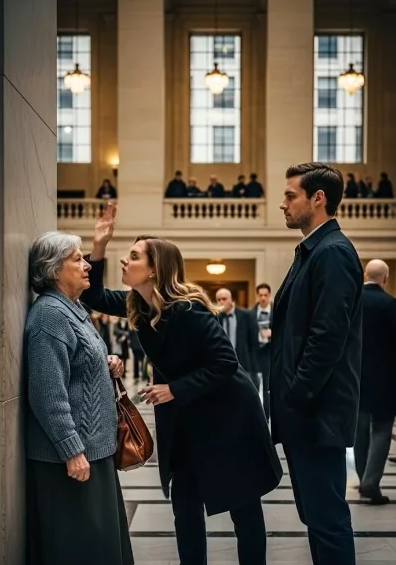
The cold of the marble wall bit through the thin fabric of my sweater, a sharp contrast to the fire in Isabella’s eyes. She had shoved me hard against the east wall of the Harrison County Courthouse lobby. Her perfectly manicured finger, painted a deep, menacing crimson, was inches from my face.
“You are a filthy old woman, Eleanor,” she hissed, her voice usually so controlled and melodic, now sharp enough to cut glass. “You are an embarrassment to this family. A burden.”
The lobby—usually a river of noise, clicking heels, anxious murmurs, the rustle of legal briefs—fell into a sudden, shocked silence. Attorneys clutching briefcases, clerks pushing carts piled high with files, even the security guards by the metal detectors—everyone stopped. They stared. The ambient sound of the grand hall seemed to be sucked into a vacuum, leaving only Isabella’s venomous words echoing in the high-vaulted space.
My daughter-in-law, Isabella Reed, was not whispering. She was projecting, as if holding court, ensuring everyone within earshot heard her pronouncement. She was humiliating me publicly, deliberately, in the one place where reputation was currency.
A few feet away, my son Marcus stood motionless, a statue carved from expensive wool and crippling indifference. His hands were buried deep in the pockets of his tailored suit. He stared at the geometric pattern of the marble floor, his gaze fixed on a point somewhere between shame and apathy. He didn’t look up when she pushed me. He didn’t say her name. He didn’t make a sound.
His silence was his complicity, a blade sharper than Isabella’s words.
I didn’t react. I didn’t cry out. I didn’t raise my voice. I didn’t even push back. I simply absorbed the impact, the cold of the stone, the weight of dozens of pitying, curious stares. I, Eleanor Hayes, seventy-three years old, was being treated like refuse by the woman who had married my only child.
I took a slow, steadying breath, the air tasting like dust and floor wax. I lowered my head, giving them the performance they expected—the weak, voiceless old woman, the dependent mother who had nowhere else to go, the matriarch reduced to a footnote in her own family’s life.
But beneath the surface, something else was happening. It wasn’t my heart that broke—that had happened years ago. It was the last frayed thread of hope. The naive belief that my silence, my willingness to make myself smaller, my endless capacity for absorption, still mattered. The hope that deep down, they still needed me. That I was still family.
That thread snapped.
Isabella knew nothing. Marcus, my son, knew even less. Neither of them had any idea who I really was. And as Isabella continued her tirade, her voice dripping with contempt, and as the spectators began to shuffle away pretending they hadn’t seen the ugly spectacle, one thought, and one thought only, solidified in my mind.
Ten minutes.
In ten minutes, they would know. In ten minutes, the world they had built on the foundation of my invisibility would shatter.
My name is Eleanor Hayes, and for thirty-five years, I was a judge in this very courthouse. I had presided over Courtroom 4, just two floors above where we stood. But they never knew. I had never told them.
Chapter 1: The Invisible Judge
When I retired five years ago, I packed away my robes, my gavels, and my identity. I had chosen consciously to be just “Mom,” just “Grandma.” Just the woman who made roast chicken on Sundays, the woman who quietly slipped Marcus money when his fledgling law firm struggled, the invisible woman who wasn’t invited to the table when important guests were over.
I had hidden my life’s work as if it were a shameful secret. I concealed the degrees, the accolades, the landmark cases, the decades of jurisprudence. I had done it because I believed, in my deepest, most foolish heart, that if I were less, I would be loved more. If I were simpler, quieter, smaller, they would need me. They would include me.
How devastatingly wrong I was.
Isabella finally finished, giving me one last look of utter disdain. She smoothed her silk blouse, picked up her designer briefcase, and turned. Her heels clicked with arrogant confidence as she walked toward the main security line, the victor of a battle I hadn’t even fought. Marcus followed, a silent shadow in her wake, without a single backward glance, without a word of apology.
I stayed pressed against the wall for another moment, letting the cold seep into my bones. I adjusted the beige cardigan Isabella always said made me look ancient. I ran a hand over my silver-gray hair, which she constantly insisted I dye because it “gave a bad impression.”
Then, I moved.
I did not follow them toward the main entrance. I did not scurry away in shame. I turned left and walked down the side hallway—the one marked Judicial and Staff Only. The one that required a key card I no longer had, but whose security guard, Frank, had worked the post for twenty years.
He saw me, and his face broke into a wide smile.
“Good morning, Judge Hayes. It’s an honor to have you back.”
“Good morning, Frank. It’s good to be back,” I said, my voice steady for the first time that day.
He buzzed me through the heavy oak door. The sounds of the public lobby vanished, replaced by the quiet, carpeted hush of the inner sanctum. I walked past the portraits of my predecessors, judges who had served this county since 1920. My own portrait hung there, third from the end. Marcus and Isabella had walked past it dozens of times on their way to other courtrooms. They had never seen it. They had never looked. They had never cared to ask.
I reached the judicial robing room. Inside, my old clerk, Gloria, was waiting. She had been my clerk for thirty years and was now the Chief Clerk of the Court.
“Eleanor,” she said, her eyes warm but searching. She had seen me in the lobby. I knew from the tightness in her jaw. “Are you ready for this?”
“More than ready, Gloria,” I said.
I took off the beige cardigan, the uniform of my subservience, and folded it neatly. I removed the sensible flat shoes Isabella despised. And from the closet, Gloria retrieved the black robe.
It was heavy—the familiar weight of wool and authority. My name was still embroidered in gold thread on the inside: Judge Eleanor Hayes.
I put it on. I looked in the mirror. The seventy-three-year-old woman stared back, but she was no longer just the burden. The wrinkles around my eyes were not just from age; they were from decades of scrutiny. My silver hair was not a sign of neglect; it was a crown. My hands, which trembled slightly, were not shaking from fear, but from anticipation.
I put on the reading glasses I only used for dense legal texts. I adjusted the robe.
“They’re waiting for you, Your Honor,” Gloria said.
Chapter 2: The Reveal
I walked down the private corridor that led to the back of Courtroom 4. I reached the small door. I pushed it open. The bailiff saw me and immediately held it wide.
Inside, the room was packed. Lawyers, witnesses, observers. And in the front row on the plaintiff’s side sat Isabella Reed. Her back was ramrod straight, her attention focused on a stack of papers, whispering confidently to her young assistant. She was poised, arrogant, and utterly sure of her impending victory. Two rows behind her, Marcus sat scrolling through his phone, a passive spectator in his own life.
I entered through the side door, the one that led directly to the bench. I climbed the three wooden steps. I sat in the high-backed leather chair, the one that still felt molded to my form. I placed my hands on the smooth, worn wood of the desk. I took a breath, and I waited.
The low murmur of the room continued for a few seconds. Then, a lawyer in the front row looked up. His eyes widened. He nudged the person next to him. A wave of silence spread from the front of the room to the back, like ink dropped in water.
Isabella didn’t notice. She was still reviewing her notes, laughing softly at something her assistant said, so insulated by her own importance that she failed to notice the entire room had frozen.
Then Gloria, acting as clerk for the day, stood up. Her voice, clear and strong, resonated through the stillness.
“All rise! The Harrison County Court, Civil Division, is now in session. The Honorable Judge Eleanor Hayes presiding.”
Isabella’s head snapped up. Her eyes, confused, scanned the room, trying to make sense of the words.
And then, they found me.
She saw me sitting on the bench, wearing the robe, holding the gavel, with the exact same face she had insulted and shoved against a wall not fifteen minutes prior. The color drained from her face. Her perfectly painted mouth fell open. The paper she was holding slipped from her fingers and scattered across the floor. For the first, and perhaps only time in her life, Isabella Reed was utterly, profoundly speechless.
I did not smile. I did not gloat. I simply held her gaze, my expression as neutral and calm as the marble wall she had pinned me against.
Marcus had jumped to his feet, knocking his chair over with a loud clatter. His face was a mask of pure, unadulterated horror. He looked from me to his wife and back to me, the terrible, impossible truth dawning on him.
I gave them no time to process. I picked up the heavy wooden gavel. I raised it high, and I brought it down with a sharp, definitive crack that echoed through the stunned silence.
“This court is in session. Please be seated.”
Everyone sat. Everyone except Isabella. She was paralyzed, frozen in a half-standing, half-sitting position, her eyes locked on me as if I were an apparition. Her assistant tugged at her sleeve, and she sank into her chair, her movements stiff and robotic.
I kept my gaze forward—professional, cold, exactly as I should have been with them from the beginning.
“This is Case Number 2025-20418. Reed and Associates representing the Plaintiff, Kinetic Solutions, versus the Defendant, Apex Design.” I looked directly at her. “Attorney Reed, are you ready to present your opening arguments?”
Silence. She couldn’t speak. She could only stare, her mind visibly reeling.
“Attorney Reed,” I repeated, my voice slightly firmer. “The court asked if you are ready to proceed.”
She blinked. She swallowed, a dry, rasping sound. She tried to speak, but her voice came out as a fractured whisper.
“I… yes… Your… Your Honor.”
Your Honor.
The same woman who had called me a “filthy old woman” ten minutes ago was now trembling, addressing me by my title. The same woman who had put her hands on me in violence was now awaiting my permission to speak.
And as I watched her crumble, I, Eleanor Hayes, mother of Marcus, grandmother of Sophia and Chloe, thought only one thing.
It is just beginning.
Chapter 3: The Hidden Life
There was a time when I believed being a mother was my highest calling. When my husband, Robert, was alive, our life was simple and full. He was a good man, an architect with a kind heart and a laugh that filled our small suburban home. His sudden death from an aneurysm when Marcus was just fourteen shattered our world.
I was left a forty-year-old widow with a grieving teenage son and a mortgage that suddenly seemed insurmountable. For a year, I drifted in a fog of grief and insurance paperwork. But one night, watching Marcus struggle with his homework, his face etched with a silent sorrow he couldn’t articulate, I knew I couldn’t fail him. I had to be more than just a grieving widow.
I had finished my bachelor’s degree before I married Robert. I decided, at forty-one, to go to law school. The next years were a blur of sheer exhaustion. I worked as a paralegal during the day. At night, after making dinner for Marcus and ensuring his homework was done, I studied. I sat at our small kitchen table until three in the morning, cold coffee at my elbow, highlighting casebooks, my mind aching.
I graduated with honors at forty-four. I passed the bar. I got a job at the District Attorney’s office. I climbed. I worked twice as hard as everyone else, proving my worth against colleagues twenty years my junior. At forty-eight, I was appointed to the bench.
I did it all for Marcus. To give him the life Robert would have wanted for him. To show him that tragedy was not an end, but a redirection.
And Marcus thrived. He went to a good university, then law school himself. He opened his own firm. He was successful, wealthy, and ambitious. I was so proud it felt like a physical ache in my chest. All those sleepless nights, all the sacrifices—they had been worth it.
Then he met Isabella.
The first time he brought her to my house was for Thanksgiving. She arrived an hour late, dressed in a black sheath dress that was more appropriate for a cocktail party than a family dinner. She carried a bottle of expensive wine I had never heard of. Her smile never reached her cold, appraising eyes. She scanned my living room, her gaze lingering on my comfortable, slightly worn furniture, the framed photos of Robert, the curtains I had sewn myself. I saw the judgment in that single, sweeping look. My home, my life, was “quaint.” It was less.
I served the dinner I had spent two days preparing. A roasted turkey, my grandmother’s stuffing, potatoes whipped with cream, two kinds of pie. Homemade food made with love. Isabella took microscopic portions.
“It’s all delicious, Eleanor,” she said, pushing a single green bean around her plate. “But I’m watching my figure. We have a gala this weekend.”
Marcus, who used to devour my cooking, ate quietly, nodding along as Isabella dominated the conversation, talking about her clients, the cases she was winning, the judges she had impressed. She never once asked me about my life, my work, or my interests. I was simply the backdrop.
Later, as they were leaving, I was in the kitchen washing dishes. The door was ajar, and I heard her voice, low and sharp.
“Marcus, darling, you can’t seriously be okay with your mother living in this… this tiny house. It’s a bad look. What will our colleagues think? It implies you don’t care for her.”
I heard Marcus mumble something indistinct, something about me being comfortable here. He didn’t defend me. He didn’t defend my home, the home he grew up in. I stood there, my hands submerged in soapy water, and felt the first hairline crack in my heart. But I dismissed it. I told myself she was nervous, that she was just trying to impress, that she would soften.
She never softened.
They married six months later in an opulent ceremony at a country club that must have cost a fortune. I was not consulted on the guest list, the food, or the date. I was told when and where to be. At the ceremony, I was seated in the fourth row, behind Isabella’s partners and Marcus’s college friends. I was just another guest.
After the wedding, the distance became a chasm. Marcus visited less. The calls became shorter, more perfunctory. The Sunday dinners we had shared for his entire life vanished. There was always an excuse—a work emergency, a client dinner, a trip to the Hamptons.
When they did visit, Isabella’s critiques were constant, delivered with a saccharine smile. The paint on my walls was drab. My garden was overgrown. I should really hire someone to help. I should consider moving to a managed care facility—”one of the nice ones.”
I smiled. I nodded. I thanked her for the advice. I made myself small. I made myself agreeable. I refused to be the “difficult mother-in-law.” I was terrified that if I caused a ripple, if I pushed back, they would cut me off completely.
Then my granddaughters were born. Sophia first, then Chloe two years later. Beautiful girls with Marcus’s eyes and my smile. I thought this would be the bridge. I thought being a grandmother would give me a non-negotiable place in their lives.
Isabella used them as leverage.
I was rarely allowed to see them. There was always a reason. The girls were sick. They had a playdate. They were on a specific nap schedule. Isabella preferred they spend time with her mother, a woman with a sprawling estate and a full-time staff. I knit them blankets; I never saw them used. I bought them classic books; they were never read. I sent birthday gifts chosen with painstaking care; I never received a thank-you call.
Once, I gathered my courage and asked Marcus if I could take the girls to the park, just for an afternoon.
“I’ll talk to Isabella,” he promised, his eyes already drifting back to his phone. He never mentioned it again. I didn’t dare ask twice.
The years blurred. I retired at sixty-eight. My thirty-five-year career ended with a small ceremony in the courthouse cafeteria. My colleagues gave me a commemorative plaque and a lovely bouquet. Marcus didn’t come. He had an “unavoidable hearing” that day. Isabella didn’t even text.
I went home alone that afternoon, plaque under my arm, and sat in my quiet living room. And in that silence, I made the decision. I would never tell them. I would never tell them I had been Judge Hayes. If my own son didn’t care enough to attend my retirement, then my career, my life’s work, meant nothing to him. It was my secret. My failure.
Chapter 4: The Text Message
But my silence, my invisibility, came at a price. The more I retreated, the more they treated me as if I didn’t exist. Family parties, birthdays, holiday gatherings—I was not invited. I learned about them through tagged photos on social media, seeing my son and granddaughters smiling, celebrating a life from which I was completely, surgically excluded.
Six months ago, the floor fell out from beneath me.
Marcus had stopped by—a rare solo visit—to find some old insurance documents of his father’s that I kept in my study. He was in a hurry, stressed about work. He left his phone on the kitchen counter while he rummaged through the files.
The screen lit up. A text message from Isabella.
Spoke to the lawyer. We can file for incompetence in 6 months. The house is worth 300k. We sell, put her in a home. She won’t even notice.
I read the words once. Twice. A third time. The letters burned into my retina. The air in my kitchen turned thin and cold. I couldn’t breathe. I gripped the counter to keep from falling.
Incompetent.
They were going to have me declared mentally unfit. As if I were a senile burden, an object to be disposed of.
The house is worth 300k.
My home. The house Robert and I built. The house I raised my son in. The house I paid off with thirty-five years of hard work. They weren’t just excluding me. They were planning to steal my life from under me and discard me in an institution.
I heard Marcus’s footsteps returning. I placed the phone exactly as it had been. I smoothed my apron, my hands shaking so violently I had to clench them into fists.
When he walked into the kitchen, papers in hand, I was staring out the window, my expression, I prayed, serene.
“Found them. Thanks, Mom. Gotta run. Big meeting,” he said, giving me a quick, automatic kiss on the cheek.
“Of course, dear. Drive safely,” I replied, my voice a hollow echo of itself.
He grabbed his phone. He left. The door clicked shut.
I stood in the kitchen for a very long time. The grief I had felt for years, the loneliness, the exclusion—was gone. In its place, something cold, hard, and unfamiliar bloomed. It was rage. A precise, analytical, judicial rage.
I was not a defenseless old woman. I was not incompetent. And I was not going to a home.
I was Judge Eleanor Hayes. And my son and his wife had just declared war.
Chapter 5: The Preparation
The next morning, I called Samuel Vance.
Samuel was a brilliant attorney whom I had met twenty years prior under very different circumstances. He had been falsely accused of fraud by a vindictive ex-partner. The evidence was circumstantial, the prosecution overzealous. But I had read every line of the briefs, listened to every witness. I saw the truth. I acquitted him. I saved his career. He never forgot. Every year, on the anniversary of the verdict, he sent me a card. Every Christmas, a basket of fine cheese and wine. He was one of the few who attended my retirement ceremony.
He answered on the second ring. “Judge Hayes! What a pleasant surprise. How are you?”
“I need your help, Samuel,” I said, my voice flat. “It’s urgent.”
We met in his downtown office that afternoon. I told him everything. The years of emotional abuse, the exclusion, and finally, the text message. I relayed the words verbatim. Samuel listened, his face growing darker with every word.
When I finished, he put down his pen. “Eleanor, this is monstrous. But they’ve made a critical error. They underestimated you.”
“They don’t even know who I am,” I said.
“Then we will remind them.”
First, we bulletproofed me. Over the next two weeks, Samuel arranged a battery of tests. I met with two different neurologists and a forensic psychologist. I underwent cognitive exams, memory tests, and hours of evaluation. The results were ironclad. My mind was not just healthy; it was, in the psychologist’s words, “exceptionally sharp.” Any attempt to have me declared incompetent would be laughed out of court.
Next, Samuel redrafted my will and all my power of attorney documents. Marcus was removed. My entire estate—the house, my savings, my judicial pension—was placed into a complex, irrevocable trust. The new executor: Samuel Vance. The new beneficiary: my granddaughters, Sophia and Chloe, but only upon their twenty-fifth birthday, and only if they had maintained a consistent, independent relationship with me.
Marcus was left with one dollar.
“This,” I said, signing the last document with a steady hand, “is defense. Now I want offense.”
Samuel raised an eyebrow. “What do you have in mind?”
“I want to know why she’s so desperate for my three hundred thousand dollars.”
Samuel hired a private investigator, a discreet woman who specialized in financial forensics. What she found was staggering. Isabella Reed was not the financial wizard she pretended to be. She was drowning in debt. Over $150,000 in personal credit card charges. Massive loans against her firm. And worst of all, she had been embezzling from the firm she shared with Marcus—diverting client funds into a private account to cover her losses.
But the final piece, the one that made even Samuel gasp, was the mortgage. Isabella had taken out a second mortgage on the home she shared with Marcus—a home he owned outright before their marriage. She had forged his signature on the documents.
She was not just a bully. She was a criminal. And she was desperate. My house was her lifeline, her last-ditch effort to cover the holes before her entire financial world imploded.
“We have enough here to have her disbarred and likely imprisoned,” Samuel said, closing the thick binder of evidence.
“Not yet,” I said.
A new plan was forming in my mind. A plan that felt more like justice than simple legal retribution. There must be a better way. A more public way.
Samuel, understanding me perfectly, made a call. He checked the Harrison County court docket.
“Well, well,” he said, a slow smile spreading across his face. “It seems Attorney Reed is the lead counsel on the Kinetic Solutions case. A half-million-dollar contractual dispute. It’s her biggest client. The hearing is in three weeks. And…” He paused for dramatic effect. “The assigned judge just had emergency appendicitis. They’re scrambling for a visiting judge to take over the docket.”
He looked at me. I looked at him.
“Gloria is Chief Clerk now, isn’t she?” I asked.
“She is,” Samuel replied.
“Make the call, Samuel. Tell her Judge Hayes is feeling refreshed from retirement and would be honored to help.”
Chapter 6: The Reckoning
The courtroom was still reeling from the shock when I instructed Isabella to begin. She stood, her legs visibly shaking. She fumbled with the papers her assistant had retrieved, her usual grace replaced by a jerky, panicked uncertainty.
“Your… Your Honor,” she began, her voice strained. “My client, Kinetic Solutions, entered into a contract with the defendant for the sum of… 1.5 million dollars.”
I raised a hand, interrupting her. “Excuse me, Attorney Reed. The briefs I reviewed this morning state the contract value was 1.8 million. Are you mistaken, or are my documents incorrect?”
Isabella froze. Panic flashed in her eyes. She frantically searched her notes. “I… yes… your… 1.8. My apologies, Your Honor. A slip of the tongue.”
“A three-hundred-thousand-dollar slip? Counsel, please be precise. This court does not have time for imprecision. Proceed.”
The entire room watched as the formidable Isabella Reed, known for her sharp tongue and ruthless litigation style, withered. She stumbled over dates. She confused contractual clauses. She cited an irrelevant precedent from another district. I let her continue for ten agonizing minutes before I interrupted again.
“Attorney Reed, you are citing Thompson v. Bell, a case concerning intellectual property rights. This is a contractual dispute. Is Thompson v. Bell truly the precedent you wish to hang your argument on?”
The opposing counsel, a man I knew to be meticulous, hid a smile behind his hand.
“No, Your Honor… I meant… I meant Martin v. Davis,” she stammered, naming a case that was, in fact, favorable to the defendant.
I sighed, a quiet, disappointed sound. “Counselor, Martin v. Davis directly contradicts your client’s position. Are you, in fact, arguing against your own case?”
From the back of the room, there was a loud scrape. Marcus had stood up so abruptly his chair toppled over. His face was ashen. He didn’t look at his wife. He looked only at me. His expression one of dawning, catastrophic understanding. He turned and fled the courtroom, the heavy doors swinging shut behind him.
Isabella watched him go, and the last shred of her composure crumbled.
“Attorney Reed,” I said, my voice softening just a fraction. “You seem distressed. Your co-counsel is absent, and you are frankly unprepared for a case of this magnitude. This court does not tolerate negligence. Do you need a recess to compose yourself and review your own files?”
The humiliation on her face was stark. To ask for a recess now was to admit defeat. To admit incompetence—the very thing she had planned to accuse me of.
“No, Your Honor,” she whispered, her voice trembling with a toxic mixture of shame and rage. “I am… I am prepared.”
“Then I suggest you demonstrate it.”
The rest of the hearing was a methodical dismantling. She had built her case on arrogance, assuming she could charm or bully her way to a victory. She had not anticipated facing a judge who had read every line, who knew the law better than she did, and who had absolutely no patience for her theatrics.
When the defense attorney, Mr. Chen, stood, his argument was clear, concise, and supported by every document. He methodically pointed out the exact breaches of contract by Isabella’s client. After two hours, I had heard enough.
“This court has reviewed the briefs and heard the oral arguments from both sides,” I announced, my voice filling the silent room. “The plaintiff’s case is, to put it mildly, fraught with inconsistencies and unsupported by the evidence provided. In fact, the evidence clearly shows the plaintiff, Kinetic Solutions, was the first party to breach the contract. Therefore, this court finds in favor of the defendant, Apex Design. The plaintiff’s claim is dismissed with prejudice. This court is adjourned.”
I struck the gavel. The sound was like a gunshot. Isabella collapsed into her chair as if her bones had dissolved. Her career, her reputation, had just been incinerated in front of her colleagues by the “filthy old woman” she planned to discard.
I stood and walked through the side door to the robing room, my back straight. I could feel every eye in the room on me.
Chapter 7: The Aftermath
I was slowly folding my robe when the door to the office burst open. It was Isabella. Her face was a terrifying mask of rage, her makeup streaked by tears.
“You!” she seethed, all pretense of respect gone. “You planned this! You humiliated me!”
“I did no such thing,” I said calmly, placing the robe on its hanger. “You humiliated yourself, Isabella. You came into a court of law completely unprepared. You failed your client. The verdict was based on the law and the evidence. Nothing more.”
“You lied to us! All these years… you let us believe you were… you were nothing! Just some pathetic old woman!”
“I never lied,” I said, turning to face her. My voice was cold. “You never asked. Marcus never asked. You were so convinced of my insignificance that you never once thought to ask me about my life. You saw what you wanted to see—a burden, a problem to be managed. You never saw me.”
“You did this to destroy me!”
“You destroyed yourself, Isabella,” I said, my voice dropping. “You are a fraud. And I don’t just mean in the courtroom.”
Her breath hitched. She knew. I could see the sudden, cold terror in her eyes.
“I don’t know what you’re talking about.”
“You forged Marcus’s signature on a second mortgage. You’ve been embezzling from your own firm for two years. You are drowning in debt. That is why you wanted my house. That is why you planned to have me declared incompetent. You weren’t trying to care for me. You were trying to liquidate me.”
She stared, speechless, her entire world collapsing.
Before she could speak, the door opened again. It was Marcus. His eyes were red, his suit jacket rumpled. He looked at his wife, then at me.
“Mom,” he whispered, the word sounding foreign, choked. “Mom… I… I didn’t know.”
“You didn’t want to know, Marcus,” I said, my voice hard. “It was easier for you to believe I was small. It made your life simpler. You stood by in that lobby and let your wife assault me. You stood by for years while she cut me out of your life, out of my granddaughters’ lives. You stood by because you are a coward.”
“Eleanor, please…” he begged, taking a step toward me.
And then I continued, relentless. “You were going to let her declare me incompetent. You were going to sign the papers, weren’t you? You were going to sell my home and put me away.”
“She… she told me you were getting confused,” he cried, desperation cracking his voice. “She said you were wandering, that you were a danger to yourself. I thought… I thought I was protecting you!”
“You thought you were solving a problem,” I corrected him. “The problem of an inconvenient mother. But you never came to me. You never asked me, ‘Mom, are you okay?’ You just believed her.”
I picked up my beige cardigan, the one I had arrived in. I looked at this broken man, my son, and the venomous woman he had chosen.
“Well, now you know,” I said, walking toward the door. “I am not confused. I am not incompetent. And I am not your victim.”
Marcus looked at the evidence of his wife’s crimes, which I had left on the desk in a neat folder prepared by Samuel. He looked at Isabella’s terrified, guilty face. And for the first time, he had to make a choice.
I left them in that room, the silence heavy with the wreckage of their lives.
I did not go home. I went to Samuel’s office. He had already heard. He poured me a small glass of whiskey.
“The Harrison County legal community is on fire, Eleanor,” he said, a grim smile on his face. “You didn’t just win a case. You held an execution.”
“I delivered justice,” I said, the whiskey warming me. “Now, I want to finish it.”
I called a reporter I knew at the City Paper, a woman who had covered my court for fifteen years, who respected the law. I told her I had a story about judicial integrity, about a last-minute visiting judge, and a case of profound familial conflict of interest that was handled by the letter of the law. I gave her the case number. I gave her the names. I gave her everything.
The next morning, the story was on the front page. It didn’t mention the assault in the lobby or the incompetence plot. It didn’t need to. It was a cold, factual account: Retired Judge Hayes Returns, Presides Over Daughter-in-Law’s Failed Case. It detailed my thirty-five-year career. It detailed Isabella’s unprepared and chaotic arguments. It noted that the verdict was reviewed by the presiding judge and found to be impeccable.
Isabella’s reputation was ruined. Her clients, seeing the embezzlement investigation that Marcus was forced to launch to save his own skin, fled. She was disbarred within three months. He filed for divorce, taking the binder of evidence from my office as his primary exhibit.
Marcus lost his firm. He lost his wife. He lost the life he had built.
He came to my house a month later, not as a successful lawyer, but as a broken man. He stood on my doorstep holding a small, wilted bouquet of grocery store flowers.
“I don’t expect you to forgive me, Mom,” he said, his voice raw. “I just… I wanted to ask. Why? Why did you hide who you were? If I had known… if I had known you were Judge Hayes…”
I looked at my son, this stranger who was only impressed by a title.
“I hid it, Marcus, because I wanted my son to love me for being his mother,” I said sadly. “Not because I was a judge. Not because I had power or a reputation. I just wanted to be Mom. I thought if I made myself smaller, you would have more room to love me. That was my mistake. I taught you that I was disposable.”
He wept then, on my doorstep, for the first time since Robert died.
It has been a year. Marcus is rebuilding his life. He works for a small legal aid clinic now, making very little money but, for the first time, doing work that matters. He is quiet, humbled. He brings Sophia and Chloe to my house every Sunday.
At first, the girls were shy; they had been taught I was a strange, sad old woman. But now, they know me. They know Judge Hayes. They ask me to tell them court stories. They sit on the floor of my study looking at my old case files, and I tell them about justice, about fairness, about truth.
I did not return to the bench, but I did accept a position as a mediator for complex family law cases. I sit at a table with broken families, with warring spouses and distant children, and I listen.
I learned the hardest lesson of my life in that cold courthouse lobby. I learned that you cannot shrink yourself for the comfort of others. You cannot dim your own light in the hopes that others will see you. Dignity is not something people give you; it is something you must refuse to let them take.
My worth was never defined by Isabella’s approval or Marcus’s attention. It was defined by my own life. The one I had built, the one I had hidden, and the one I finally reclaimed.