Your mother is a maid. Let her eat in the kitchen with the dog.”
My husband spat the words out, loud enough to cut through the hum of conversation and the clinking of crystal. He shoved my elderly mother away from the table, his hand rough against the silk of her dress. Around us, the room went dead silent. My mother-in-law, Margaret Sterling, sat at the head of the table, a glass of vintage Pinot Noir in her hand, and nodded in slow, satisfied approval.
In that frozen second, the world tilted. I didn’t scream. I didn’t cry. I silently rose from my chair, the heavy oak scraping against the floor, took my mother’s trembling hand, and walked toward the man I had loved for ten years.
What I did in the next moment was something they would remember for the rest of their lives. But to understand the explosion, you have to understand the fuse.
My name is Alana Hayes. To the outside observer, my life was a glossy magazine spread come to life. I stood by the panoramic window of our living room, watching the last rays of the October sun gild the tops of the pine trees in our high-end gated community just outside Dallas, Texas. At thirty-five, I seemed to have it all: a spacious colonial-style house, a stable job at a major corporate firm, and a husband, Victor Sterling, whom the local elite considered a rising star in the logistics world.
The air in the house was thick with the aroma of freshly brewed Arabica and the lingering scent of Victor’s expensive cologne—the scent of comfort and prosperity I had worked myself to the bone to create. But beneath the surface of this perfect picture, a quiet, nagging anxiety had settled in my chest like a sliver of glass I couldn’t pull out.
Today, that anxiety felt particularly sharp. In three days, Victor would turn thirty-eight. He had decided to celebrate extravagantly. Not just a dinner out, but a massive reception right in our home. The guest list, compiled with the eager assistance of his mother, Margaret, looked less like a gathering of friends and more like a registry of the local business aristocracy. It included partners from his firm, TransGlobal Logistics, a couple of city councilmen, and socialites from the highest circles.
“Alana, did you double-check that the catering service got the order right?” Victor’s voice yanked me from my thoughts. “I need the canapés with genuine Beluga caviar and that specific vintage of Brut. No compromises.”
He approached and wrapped his arms around me, burying his nose in my hair. He smelled of confidence—the arrogance of a man accustomed to getting the best without asking the price.
“Yes, sweetie, I checked everything,” I answered softly, though my stomach churned. “Top tier. Just the way you like it.”
“That’s why I value you,” he said, kissing the top of my head. “You know how to create the right atmosphere. This is going to be an important event. Everything has to be flawless.”
The right atmosphere. Lately, that phrase was a shackle. The right people, the right drinks, the right topics. And into this “right” world, I was supposed to bring my parents.
“I was just thinking,” I began, turning to face him, searching his eyes for the man I married. “My parents are driving in Saturday morning. I want them to be at the party, too.”
Victor frowned. His handsome, groomed face momentarily lost its amiable mask. He walked over to the fireplace, running his hand along the cold marble mantelpiece.
“Alana, we discussed this. My partners are serious people. Your parents are… wonderful people. I respect them, but they…” He stumbled, searching for a word that wouldn’t sound cruel, and failed. “They’re just too simple for this kind of event. They’d feel awkward.”
There it was. Too simple.
My father, Arthur Hayes, had worked in construction his whole life. My mother, Lydia, was a former registered nurse. They were the people who raised me, paid for my education, and supported me when the world was unkind. Their calloused hands and weary, kind eyes were dearer to me than anything else on earth.
“They are my parents,” I said, my voice quiet but laced with steel. “And this is my house, too. I want them to share this celebration with us.”
Victor sighed heavily, feigning the exhaustion of a genius dealing with a dullard. “Fine. Whatever you say. Just, please, ask them not to start talking about the garden or their endless canning projects. And tell your mother not to try and help in the kitchen. We’ll have service staff for that.”
He said it casually, as if giving instructions to an assistant. But the words felt like a slap. He wasn’t just embarrassed by them; he despised them.
The next day, the tension in the house was palpable. Victor’s comment about the “service staff” ran on a loop in my mind, leaving a bitter taste of ash. I tried to convince myself he was just stressed about TransGlobal. But that evening, as we finalized the seating chart, the illusion cracked further.
“Alright, let’s decide where to put them,” Victor said, tracing his finger over the diagram. “Maybe at that small table by the sunroom. It’ll be quieter there. They’ll be more comfortable.”
I looked at the chart. The table by the sunroom was in the furthest corner, behind a decorative pillar, practically isolated from the main table where Victor, Margaret, and the VIPs sat.
“You want to seat my parents in the corner? Like naughty children?” My voice trembled.
“Alana, don’t start,” he winced. “They won’t understand the talk about the stock market or logistics futures. Out there, they can chat about… their own things. Things they understand.”
Things they understand. Cucumbers. Tomatoes. Poverty.
Just then, his phone rang. Mother. He put it on speaker—a habit he used when he wanted me to learn a lesson.
“Vic, darling,” Margaret Sterling’s modulated voice boomed. “I spoke with Eleanor Jenkins, the councilman’s wife. They are coming. I insist they sit next to us. And… have you sorted out the matter of Alana’s relatives?”
I froze, my fingernails digging into my palms.
“Yes, Mom, don’t worry,” Victor assured her hastily. “We’re seating them at a separate, cozy table.”
“Wonderful,” Margaret sighed with relief. “We wouldn’t want the evening spoiled by inappropriate stories about country life. It could damage your reputation, son. You’re at a level now where every detail matters.”
Victor glanced at me—a mix of guilt and a plea for silence. But I was done being silent. I walked out to the terrace, gulping down the cold air. My husband and mother-in-law discussed my parents as if they were inconvenient furniture.
I remembered how it all began. When I met Victor, he was a mid-level manager with ambition but no capital. It was my father, Arthur, who saw potential in him. Dad set up the firm, poured money into it, and made Victor CEO so his son-in-law would feel secure. And now, the man whose career was entirely owed to my “simple” father was ashamed of him.
That night, my mother called. She was worried about what to wear. “The dress I wore to my cousin’s wedding is old,” she whispered. “Maybe we shouldn’t come? We don’t want to embarrass you.”
That broke me.
“Mom,” I said, tears stinging my eyes. “You are coming. And tomorrow, I am picking you up at six. We are going shopping.”
The shopping trip was my first shot in an undeclared war. I took Mom to the most upscale mall in Dallas, ignoring the price tags. When Lydia Hayes emerged from the fitting room in a rich sapphire blue silk dress, tailored to perfection, she looked like royalty. We added pearl earrings and Italian heels.
“Honey, this costs more than I make in a month,” she whispered.
“You deserve it,” I said fiercely.
When they arrived on Saturday morning, even Victor was momentarily speechless. Arthur looked dignified in a new charcoal suit, and Lydia was stunning. But Margaret Sterling, descending the stairs like a hawk spotting prey, was harder to impress.
“Lydia,” Margaret drawled, her voice sweet as poisoned honey. “What an interesting dress. Did you find a decent knockoff at the outlet mall? Synthetics can be so tricky.”
I felt the blood rush to my face.
“It is natural silk from a designer in Milan, Margaret,” I interjected, my voice cool. “And it is an original.”
Margaret raised an eyebrow. “Is that so? I didn’t realize retired nurses could afford such things.”
“My wife can afford anything she wants,” my father, Arthur, said quietly. His voice carried the weight of a sledgehammer. “Because she has a daughter who loves her and a husband who worked his whole life to ensure she never went without.”
The party moved to the banquet table. The air was thick with tension. Victor sat at the head, preening like a peacock, ignoring my parents entirely.
Then, my phone vibrated in my lap. It was Sydney Thomas, my father’s right-hand man and the operational brain behind our family business.
“Alana, emergency,” Sydney’s voice was tight. “The shipment of German parts for TransGlobal is stuck at customs. If we don’t resolve this in forty-eight hours, the contract with the auto plant is dead.”
My blood ran cold. This contract was Victor’s “project of the year.”
“What can we do?”
“We have similar parts in our Atlanta warehouse. Different manufacturer, but identical specs. I can route a truck now, but Victor has to sign off on the substitution. He’s usually paranoid about brands.”
I looked at Victor. He was laughing at a joke, holding court, basking in the adoration of his sycophants. If I pulled him aside now, he’d throw a fit about being bothered with “details.” He wouldn’t understand the urgency.
“Send the truck, Sydney,” I commanded. “Process it as an emergency substitution under my order. I’ll handle Victor.”
“Are you sure?”
“Do it.”
I hung up, shaking. While he drank champagne and bragged, I was secretly saving his company from ruin. The irony tasted like copper in my mouth.
The climax arrived over a trifle.
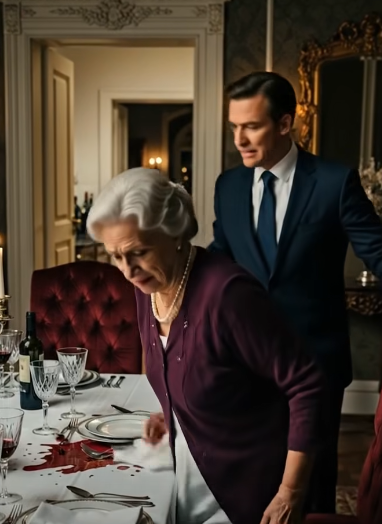
A server offered dessert. My mother, nervous under Margaret’s glare, fumbled. Her glass of cranberry punch tipped, spilling a bright red stain across the pristine white tablecloth.
“Oh, God, forgive me,” Lydia stammered, grabbing a napkin. Her hands shook, smearing the red liquid further.
Silence descended. Margaret looked at the stain as if it were a crime scene. Victor stopped laughing. His face turned to stone. He stood up slowly, pushing his chair back.
“Mom,” he said, his voice ringing with irritation. “Why are you so careless? It’s like you’re not even in a civilized home.”
“I didn’t mean to, Vic,” she whispered, shrinking into herself.
Victor looked around the room, performing for his audience. “No harm done. The tablecloth is ruined, of course. But perhaps, to avoid further… incidents… you would be more comfortable finishing your dinner elsewhere.”
I stopped breathing.
“The servant’s place is in the kitchen,” Victor enunciated, every word a lash. “You can eat there. Our dog is having his dinner right now, so you won’t be lonely. Watch him so he doesn’t steal from the table.”
He grabbed my mother’s elbow, pulling her up. Margaret nodded, a smirk playing on her lips.
That was the moment the love died. It didn’t fade; it was executed.
I stood up. The chair scraped loud and harsh against the floor. I walked over, intercepted them, and gently took my mother’s hand from Victor’s grip.
“Victor. Stop.”
He turned, eyes blazing. “What now? I’m solving the problem.”
“You are the problem,” I said. My voice was quiet, but it carried across the room. I led my mother back to the table—not to her corner seat, but to the head. I stood right behind Victor.
“Sit,” I ordered him.
He blinked, confused by the sudden shift in power dynamics. He sat.
“You called my mother a maid,” I said, looking at the guests, then at him. “You decided you had the right to humiliate her. You decided you were the man in charge here.”
I leaned down, placing my hands on his shoulders. He flinched.
“Well, Vic, you were wrong. You are no one here.”
My mother began to cry—a soft, broken sound. “Let’s go, honey,” she whispered. “Please, just let’s go home.”
The fury inside me cooled into absolute clarity. I looked at the devastation in my mother’s eyes. This house was poisoned.
“Yes, Mom,” I said. “Let’s go.”
I turned to my father. “Dad, we’re leaving.”
Arthur stood up, buttoned his jacket, and cast one look at Victor—a look that promised annihilation. We walked out.
I put them in their car. “Go home. I have one thing left to finish.”
When I walked back inside, the party was disintegrating. Guests were murmuring, grabbing coats, fleeing the awkwardness. Within fifteen minutes, the house was empty save for the three of us: Victor, Margaret, and me.
“You ruined everything!” Victor hissed, pacing the living room. “You embarrassed me in front of my partners!”
“I embarrassed you?” I let out a bitter laugh. “You told my mother to eat with the dog.”
“She acted like a country bumpkin!” Margaret shrieked from her armchair. “People like that don’t belong in polite society!”
I looked at them. The veil was gone. I saw them for what they were: parasites.
“I’m going to bed,” I said calmly.
I locked my bedroom door and cried for an hour. Not for him, but for the ten years I had wasted. Then, I wiped my face and looked in the mirror. The woman looking back was a stranger—harder, colder.
I opened the door and walked downstairs. Margaret was sipping brandy. Victor was sulking.
“Dad, it’s time,” I said into my phone.
“Understood,” Arthur replied.
I hung up and looked at them. “Margaret, you’ve always been proud of your sophistication. And you, Vic, proud of your business. Today, you’re going to find out what that success is really worth.”
The next morning, I didn’t go to my office. I went to my father’s private study.
Arthur opened the massive safe and pulled out a leather folder labeled TransGlobal.
“It’s all here,” he said.
I opened it. The founding agreement: 99.9% of shares owned by an offshore firm belonging to Arthur Hayes. Victor owned 1%—a figurehead. The bank statements showing millions infused by my father. The deed to the house: Owner, Arthur Hayes. The car title: TransGlobal property.
“Why, Dad?” I asked.
“I wanted you to be proud of him,” Arthur sighed. “I created a warm bath for him, and he forgot who turned on the tap. It’s time to pull the plug.”
I went home and dug deeper. I accessed the public records on Margaret. She claimed she sold her apartment to help Victor. The records showed she did sell it—but immediately bought a luxury condo in a high-rise, which she was currently renting out for income while mooching off us.
Then, the bank records. Victor had taken out three personal loans totaling $150,000 without my knowledge. He was servicing them with company funds.
I compiled a digital folder titled Judgment Day.
On Friday, the hammer fell.
An unscheduled audit team from the parent company descended on TransGlobal. Victor called me in a panic.
“Alana! There are people here! They want everything!”
“It’s standard procedure, Vic,” I said, filing my nails. “You have nothing to hide, right?”
I went to the bank and froze our joint accounts. I transferred my share to a private account. When Victor tried to pay for a conciliatory lunch at a steakhouse, his cards were declined.
He stormed home, purple with rage. “You blocked the money! I had to borrow cash from a waiter!”
“Poor baby,” I said, sipping tea. “Welcome to the real world.”
Just then, Margaret ran in, pale as a sheet. “My tenant called! A realtor put a ‘For Sale’ sign on my apartment! What is happening?”
“I listed it,” I said. “Since you sold your old place to ‘help the family,’ I assumed you’d want to liquidate this secret asset to help Victor with his legal fees.”
“What legal fees?” Victor whispered.
“The ones for the embezzlement charges.”
The meeting at Arthur’s office was short and brutal.
Victor sat across from us, sweating. The auditors had found the $150,000 he siphoned for personal luxuries, plus another $350,000 in fraudulent invoices.
“I can explain,” Victor stammered.
“You stole half a million dollars from the man who made you,” Arthur said. “Here are your options. Option A: We go to the police. Fraud, embezzlement. Ten years, easy. Your mother goes too, since you used her name for some shell accounts.”
Victor made a choking sound.
“Option B,” Arthur continued. “You sign a divorce settlement waiving all assets. You leave my house with one suitcase. I take back the firm. You acknowledge the debt and will repay every cent through garnished wages from your new job.”
“What new job?” Victor asked.
“Sales associate. Entry level. We have a spot in the warehouse.”
Victor looked at me, pleading. “Alana, please. We’re family.”
“You told my mother to eat with the dog,” I repeated. It was the only answer he needed.
He signed.
“You have two hours to pack,” I told him. “Go live with your mother. I hear she has a vacancy.”
My final stop was Margaret. I walked into the apartment she had hidden from us.
“I have the tax documents regarding your undeclared rental income,” I told her. “And the proof of complicity in Victor’s fraud. You will write a letter of apology to my parents. A sincere one. And then you will disappear from our lives. If you ever badmouth me or my family to your socialite friends again, I will send this file to the IRS.”
She wrote the letter with a shaking hand.
Six months later.
I sat in my new loft downtown. It was an industrial space—exposed brick, high ceilings, full of light. I had sold the suburban house; it smelled too much of lies.
I wasn’t a marketer anymore. I was the Vice President of my father’s company. The baptism by fire had hardened me.
Victor was working the warehouse floor, paying off his debt one paycheck at a time. He lived with Margaret in the small condo. I heard they fought constantly, blaming each other for the fall of their empire.
I poured two cups of tea as the doorbell rang.
Arthur and Lydia walked in. Mom looked happy, lighter. She sat on my velvet sofa, and we ate apple pie, laughing about nothing. There was no pretense, no fear of judgment.
Later that night, as rain lashed against the windows, I looked down at the street. A figure stood there, huddled under the awning, looking up at my lights. It was Victor. He looked older, broken.
He saw me in the window and took a step forward, raising a hand.
I didn’t feel anger. I didn’t feel love. I felt the indifference one feels for a stranger in a crowd.
I closed the blinds, turned back to my warm, bright home, and poured myself another cup of tea. The dog was sleeping on the rug, and my mother was humming in the kitchen.
Finally, everything was exactly where it belonged.