Thursday afternoon settled lazily over Fifth Avenue.
Traffic roared below, but high above the noise, on the third floor of a commanding glass building, Victoria Harrington studied Manhattan through her office windows as if it were a chessboard.
Every move calculated. Every negotiation precise. At fifty-eight, Victoria had transformed a respectable family company into a corporate powerhouse that dominated multiple industries.
Silver streaked through her dark hair, and she wore them like medals. Her sharp gaze intimidated seasoned executives.
Her presence silenced rooms. Yet beneath the polished authority lived a wound no success had ever healed. Thirteen years earlier, her eldest daughter had vanished.
Isabella had disappeared without a trace. No struggle. No clues. Just absence.
Victoria still remembered their final conversation—an argument about work. Isabella had wanted her attention, needed to talk.
Victoria had been consumed by a merger she insisted couldn’t wait. “Later,” she had promised. Later never came.
Police investigations. Private detectives. Endless searches. Nothing. And Isabella had been wearing the ring that day—a white gold and platinum piece with a rare blue sapphire encircled by tiny diamonds.
Victoria’s late husband, Alejandro, had commissioned two identical rings: one for his wife, one for their daughter. A symbol of belonging. Protection.
If something terrible had happened, the ring would have surfaced.
It never did.
The phone rang. “Mrs. Harrington, Mr. Grant is waiting at the restaurant,” her assistant informed her.
Her son, Daniel Grant—twenty-six, ambitious, disciplined—was all the family she had left. Their relationship, like so much else, had been reshaped by Isabella’s disappearance.
Victoria arrived at an elegant restaurant in the Upper East Side, a place where deals were made over wine and quiet discretion. Daniel stood as she approached.
“We should accept the construction proposal,” he said immediately.
“We’ll discuss it after we order,” she replied, businesslike as always.
They spoke of contracts and expansion, carefully avoiding the ghost between them.
Then the atmosphere shifted.
Whispers near the entrance. A few uneasy glances. Security guards moving quickly.
A little girl had slipped inside.
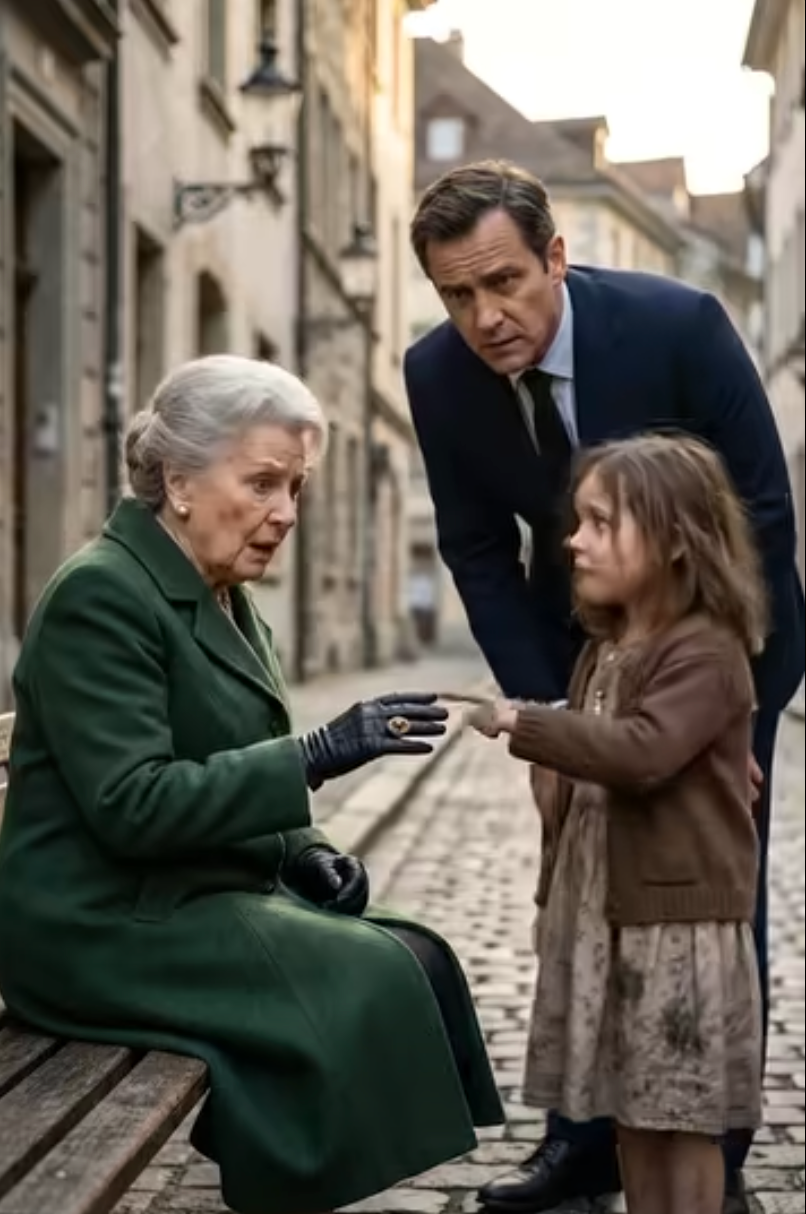
She was thin, dressed in stained, torn clothing. Her brown hair was tangled, her face smudged with dirt. But her eyes—large, dark, alert—were impossible to ignore. She moved slowly between tables, not reaching for food, just looking.
The guards approached to escort her out.
As she passed Victoria’s table, she stopped.
She wasn’t staring at the food.
She was staring at Victoria’s right hand.
At the ring.
“My mom has one just like that,” the girl said softly, but with total certainty.
Silence swallowed the room.
Daniel shifted uncomfortably. The guards stepped closer. Victoria felt the world tilt. That ring was unique. Only two existed.
“Wait,” Victoria said sharply.
Daniel stared at her. “Mom, this is ridiculous.”
Victoria ignored him. “What do you mean?” she asked the girl, her voice trembling. “Where is your mother?”
The child hesitated. “She’s sick. We live far from here. She always wears the ring. She says it’s important. She says she can’t ever lose it.”
Victoria’s legs weakened.
“What’s your name?” she asked gently.
“Sophia.”

Victoria knelt in front of her. “Sophia, can you show me where your mother is?”
Sophia reached into her pocket and pulled out a worn photograph. “She told me to keep this safe.”
Victoria’s hands shook as she turned it over. Before even seeing the image, she saw the faded handwriting on the back.
“I’ll come back when it’s safe. I promise. Isabella.”
Tears fell freely. She flipped the photo over.
Isabella. Older. Thinner. Marked by hardship—but unmistakable. And beside her stood Sophia.
“You’re my granddaughter,” Victoria whispered, collapsing to her knees. “Isabella is my daughter.”
The restaurant stood frozen.
Within the hour, Victoria, Daniel, and security were driving to Queens. The city changed as they moved farther from Manhattan’s polished skyline. Sophia sat wrapped in a coat, guiding them.
They stopped at a worn apartment building. Third floor. Apartment 3B.
The door opened.
Isabella stood there.
Pale. Exhausted. Alive.
Their eyes met, and Isabella swayed. Victoria caught her, holding her daughter for the first time in thirteen years.
“I’m here,” Victoria whispered. “You’re safe now.”
Later, in the small apartment, Isabella explained. Years ago, she had fallen under the influence of a dangerous man seeking leverage against the family business. When threats escalated, she disappeared to protect them. Fear and shame kept her away. Then Sophia was born, and survival became everything.
Victoria listened, torn between guilt and relief.
“I don’t need you to fix everything,” Isabella said quietly. “I just need you here.”
So Victoria stayed.
The months that followed were fragile but transformative. Sophia moved into Victoria’s home. Therapy. School. Nightmares slowly replaced by laughter. Isabella rebuilt her life at her own pace. Daniel confronted his resentment and began to heal.
Out of their shared scars grew something new: The Sophia Grant Foundation, dedicated to supporting vulnerable children and mothers starting over.
Years later, on Sophia’s fifteenth birthday, surrounded by music and celebration, Victoria placed a new ring on her granddaughter’s finger—a modern design echoing the original sapphire.
When Sophia finally wrapped her arms around her and said, “Grandma,” Victoria understood a truth she had learned too late.
Some things can’t be controlled. They can’t be purchased or negotiated.
They must be rebuilt—day by day—with presence, humility, and love.
The sapphire caught the light softly, no longer a symbol of loss, but of return. And for the first time in thirteen years, Victoria Harrington felt whole.