If I had to pinpoint the exact moment my life fractured, it wasn’t when the divorce papers were signed, nor was it when I moved into a house that felt too quiet. It was a Tuesday morning, under the bright, deceptive glare of the sun hitting the terminal glass, fueled by five whispered words from a five-year-old boy.
My life, up until that Tuesday, was a masterpiece of curated happiness. I was Emily Carter, wife of Daniel Carter—a successful consultant, a devoted father, and the man who still held doors open for me after seven years of marriage. We lived in a sprawling colonial in a neighborhood where lawns were manicured to the millimeter and neighbors exchanged fruit baskets during the holidays. It was safe. It was enviable.
It was a lie.
That morning, the air was crisp, hinting at the coming autumn. Daniel was packing for a conference in Denver. He moved through our bedroom with the practiced efficiency of a seasoned traveler, folding his crisp white shirts and placing them into his leather carry-on.
He kissed our son, Noah, on the forehead, lingering just a second longer than usual. Then he turned to me. He smelled of Santal 33—his signature scent—woodsy, clean, familiar. It was the smell of safety.
“I’ll be back Friday night,” he said, his blue eyes crinkling at the corners. “Try not to have too much fun without me.”
I laughed, adjusting his collar. “I’ll try to survive. Call me when you land?”
“Always,” he promised.
I drove him to the airport, the radio playing softly in the background. Noah was in the back seat, staring out the window, clutching his favorite toy dinosaur. The drive was routine. We talked about the grocery list, Noah’s upcoming soccer practice, the mundane connective tissue of a shared life.
I pulled up to the curb at the departure terminal. The chaos of travelers rushing with luggage swirled around us, but inside the car, it felt calm. Daniel squeezed my hand, a gesture that anchored me.
“Love you, Em. Be good, Noah.”
He stepped out, slung his bag over his shoulder, and walked toward the sliding glass doors without looking back.
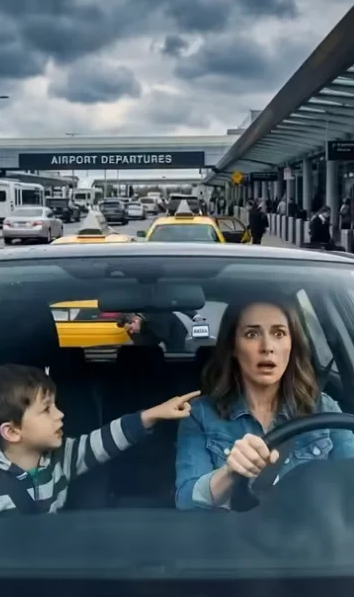
I put the car in drive, ready to merge back into traffic. That was when I felt a tug on my sleeve.
I turned. Noah was leaning forward as far as his seatbelt would allow, his large, dark eyes wide with a peculiar intensity.
“Mom…” he whispered, his voice trembling slightly. “You should watch Dad.”
My hand froze on the gear shift. A cold prickle of confusion danced down my spine. “What do you mean, sweetheart?”
He pointed a small finger toward the terminal entrance. “I don’t know. Just… watch him.”
Children say strange things. They have imaginary friends; they see monsters in closets. But Noah wasn’t an imaginative child in that way. He was observant. Quiet. The kind of child who noticed when you moved a vase two inches to the left.
Something in his tone—a gravity that didn’t belong to a five-year-old—made my chest tighten.
I didn’t merge into traffic. instead, I pulled into a temporary waiting spot just fifty yards up, hidden partially by a shuttle bus. I killed the engine.
“Okay,” I breathed, mostly to myself. “We’re watching.”
I stared at the automatic doors, my heart beating an erratic rhythm against my ribs. This is ridiculous, I told myself. He’s going to security. He’s going to buy a coffee. He’s going to Denver.
Three minutes passed. Then four.
Then, the doors slid open.
Daniel stepped out.
He wasn’t holding his phone to his ear in a panic, suggesting a cancelled flight. He looked calm. He scanned the curb, not looking for me, but looking for something else. He walked past the airport shuttles, past the confused tourists, and raised his hand.
A yellow taxi, waiting near the end of the rank, pulled up.
Daniel opened the door, tossed his bag in, and climbed into the back seat.
My breath hitched. Why would he take a taxi? We lived forty minutes away. If his flight was cancelled, he would have called me. If he forgot something, he would have called me.
“Follow him, Mom,” Noah said softly.
It wasn’t a request. It was permission.
My hands shook as I turned the ignition. I pulled out, keeping two cars between us and the taxi. The world suddenly felt surreal, like I was watching a movie of someone else’s life.
Where are you going, Daniel?
The taxi didn’t head back toward the highway that led to our suburb. It drove cross-town, weaving through the industrial district and into a part of the city we rarely visited—a cluster of older, modest neighborhoods on the west side.
My mind raced through excuses, each more desperate than the last. Maybe he’s picking up a colleague? Maybe he’s stopping at a specialty store to buy me a surprise gift? Maybe he’s secretly sick and going to a specialist?
I clung to these fabrications because the alternative was a darkness I wasn’t ready to touch.
After twenty minutes of driving, the taxi slowed down. It turned onto a street lined with maple trees and small, well-kept bungalows.
It stopped in front of a house with bright blue shutters and a neatly trimmed lawn. A child’s bicycle lay on its side near the driveway.
I parked three houses down, my knuckles white on the steering wheel.
“Stay down, Noah,” I instructed, my voice sounding foreign to my own ears.
I watched Daniel step out of the taxi. He didn’t look like a man on a business trip anymore. His shoulders were relaxed. He looked… home.
Then, the front door of the house with the blue shutters opened.
The air left my lungs.
A woman stood there. She was younger than me, perhaps late twenties, with blonde hair pulled back in a messy bun and wearing an oversized cardigan. But it wasn’t the woman that made my vision blur.
It was the little girl beside her.
She looked to be about three years old. She had curly hair and Daniel’s nose.
The girl squealed—I couldn’t hear it through the glass, but I saw her face light up—and ran straight down the walkway.
She ran into my husband’s arms.
Daniel dropped his bag and scooped her up effortlessly, spinning her around. He laughed, a genuine, open-mouthed laugh that I hadn’t seen in years. He kissed her cheek, then her hair.
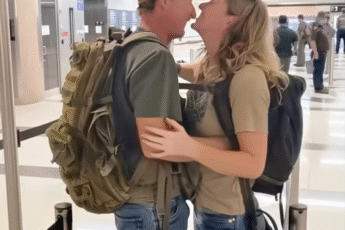
Then he looked at the woman. He walked up to her, still holding the child, and leaned in. She met him halfway. It wasn’t a polite peck. It was a kiss of familiarity, of comfort, of established intimacy.
My blood didn’t just freeze; it turned to lead. I felt heavy, sinking into the driver’s seat.
Daniel Carter—my husband, the father of my son—had a second family.
I sat there for what felt like an eternity, though it must have only been a few minutes. I watched them go inside. The door closed, shutting out the world, shutting out me.
Noah shifted in the back seat. “Mom? Is Dad okay?”
I turned to look at him. My brave, intuitive boy. I couldn’t tell him the truth. Not yet.
“He’s fine, baby,” I choked out. “He just… he has work to do here.”
I needed to think. I needed to scream. But mostly, I needed to know.
I drove Noah to a nearby park, a few blocks away. I handed him my phone with his favorite game loaded.
“Mommy needs to go talk to Dad for a second. It’s boring work stuff. You stay here in the car, locked. Do not open it for anyone but me. Understand?”
He nodded solemnly.
I drove back to the house with the blue shutters.
I didn’t park down the street this time. I parked right in the driveway, blocking Daniel in.
I walked up the concrete path. I noticed a planter with dead marigolds by the door. I noticed a tricycle. I noticed the stillness of the street.
My hand hovered over the doorbell. I could hear muffled sounds from inside. A cartoon playing on a TV. Daniel’s voice.
I pressed the button.
A moment later, the door opened.
It was the blonde woman. Up close, she looked tired but kind. Her eyes widened in surprise.
“Yes?” she asked.
I forced a smile that felt like razor blades. “Hi. I’m looking for Daniel.”
Her face went pale. Confusion warred with a dawning, terrible realization. “Daniel? Who… who are you?”
“I’m his wife,” I said simply.
The color drained from her face so fast I thought she might faint. She gripped the doorframe.
Before she could speak, Daniel’s voice came from the living room. “Rachel? Who is it? Did the food order come already?”
He walked into the hallway, holding the little girl—Lily, I would learn later—on his hip.
He looked at Rachel’s face, then followed her gaze to me.
The man I had slept beside for seven years stopped dead. His eyes bulged. His mouth opened, but no sound came out. He looked like a ghost who had just been exorcised.
“Emily,” he whispered. The name sounded like a curse.
“Daddy?” the little girl asked, sensing the tension. “Who is that?”
I looked at the child. She was beautiful. She was innocent. She was the living proof of his betrayal.
“I think,” I said, my voice terrifyingly calm, “we need to talk.”
The inside of the house was warm. Cozy. It was filled with the clutter of life that my pristine house lacked. Drawings taped to the fridge with magnets. A pile of laundry on the sofa.
It was a home.
Rachel sat on the armchair, weeping silently, her hand covering her mouth. Daniel stood in the center of the room, looking between the two of us, looking for an exit that didn’t exist.
“How?” he finally managed.
“Does it matter?” I asked. I remained standing. I didn’t want to sit on their furniture. I didn’t want to be part of this tableau.
“I was going to tell you,” he started, the classic liar’s opening gambit. “I was… I was trying to figure out how.”
“How long?” I asked.
He looked down. “Four years.”
Four years.
Noah was five. This started when our son was a baby. When I was up at 3:00 AM nursing, exhausted, Daniel was building this.
“She didn’t know,” Daniel said quickly, gesturing to Rachel. “Emily, please. She didn’t know about you. I told her… I told her I was a widower.”
A gasp escaped Rachel. She looked up at him, her eyes red and swollen. “You told me she died in a car accident, Daniel! You showed me a grave!”
My stomach churned. He hadn’t just cheated. He had killed me off to build a fantasy life. He was a sociopath.
“And the trips?” I asked. “Denver? Seattle? Chicago?”
“Here,” he admitted. “Mostly here. Sometimes we went away. But mostly… I just came here.”
He looked at me, his eyes pleading, desperate. “I love you, Emily. I do. But I love them too. It started as a mistake, a one-night thing, and then… then I had a daughter. I couldn’t leave her. I didn’t know how to stop.”
He took a step toward me. “I take care of both of you. I provide for both families. I’ve never missed a payment. I’ve been a good father to Noah!”
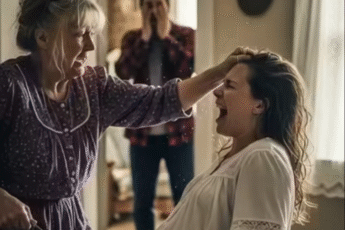
“A good father doesn’t lie to his son’s face,” I snapped.
The little girl, Lily, began to cry, frightened by the raised voices. Rachel pulled her into her lap, rocking her.
I looked at this man—this stranger wearing my husband’s clothes—and I felt something inside me snap. It wasn’t a break; it was a release. The anxiety I had carried for years, the suspicion I had buried, the feeling that I was never quite enough for him… it all made sense.
It wasn’t me. It was him.
“I’m done,” I said.
“Emily, wait. We can work this out. We can—”
“There is no ‘we’ anymore, Daniel. There is you, and the mess you made.”
I turned to Rachel. “I’m sorry,” I said. And I meant it. She was just as much a victim of his psychological warfare as I was. “You deserve better than a ghost.”
I walked out.
I didn’t slam the door. I closed it firmly, with a definitive click.
I walked back to my car, my legs feeling like jelly. I drove to the park, unlocked the doors, and climbed into the back seat next to Noah.
He looked up from his game. “Did you finish the work stuff?”
I pulled him into my arms, burying my face in his neck, inhaling the scent of baby shampoo and innocence. I let one single tear fall, then I wiped it away.
“Yes, baby,” I said. “I finished it. We’re going home now.”
The next few weeks were a blur of legal violence.
Daniel didn’t come home that night. He stayed at the Blue House, or maybe a hotel. I didn’t care. I changed the locks the next morning.
When he finally tried to return, begging, crying, carrying flowers as if that could fix a nuclear impact, I handed him a card for my lawyer.
“I don’t want to do this,” he sobbed on the front porch. “I’ll leave her. I’ll never see them again. Just let me come home.”
I looked at him through the screen door. “You would abandon your daughter? Just like that?”
He hesitated. “If it means keeping you and Noah… yes.”
That was the nail in the coffin. A man who could abandon his child to save his own skin was a man worth nothing.
“Go away, Daniel.”
The divorce was brutal.
My lawyer, a shark named Karen Vance, uncovered the financial reality. Daniel hadn’t just been “working hard.” He had been siphoning funds from our joint savings, hiding bonuses, and taking out credit cards in his name to support the second household.
The “modest” house with the blue shutters? He bought it. The car Rachel drove? He leased it.
Every document Karen showed me was a fresh wound. Tuition for Lily’s preschool. A diamond necklace for Rachel’s birthday. A family trip to Disney World that he claimed was a ‘client retreat’.
I sat in the depositions, stone-faced, while Daniel squirmed. Rachel was there too, separate counsel. She looked broken. We never spoke during the proceedings, but occasionally our eyes would meet across the mahogany table. There was no hatred there. Only a shared, hollow grief.
Noah struggled.
He asked why Daddy couldn’t come inside. He asked why we were selling the house.
I sat him down one evening, amidst the boxes.
“Daddy made some bad choices,” I told him gently. “And because of that, we can’t live together anymore. But he still loves you.”
Noah looked at me, his gaze piercing. “Is it because of the other lady?”
I froze. “How…?”
“I heard him on the phone once,” Noah said, shrugging. “In the bathroom. He said, ‘I love you, Rachel.’ I thought maybe it was work. But then… at the airport… I just knew.”
My heart broke for my son. He had been carrying this secret, this intuition, alone.
“You were brave to tell me,” I said, hugging him tight. “You saved us, Noah. You helped Mommy see the truth.”
“Was it bad?” he asked, his voice small. “That I told?”
“No,” I said fiercely. “The truth is never bad. Lies are bad. Hiding is bad. Knowing the truth is the only way to be free.”
We moved into a smaller place. A townhome near the city. It didn’t have a sprawling lawn, but it had light. It had honesty.
I went back to work full-time. I had been a marketing executive before Noah was born, and stepping back into that world felt like waking up from a coma. I was sharp. I was hungry. I channeled all my anger, all my betrayal, into my career.
Six months after the divorce was finalized, I was promoted to Vice President of Strategy.
Life stabilized. The silence in the house stopped feeling empty and started feeling peaceful.
Daniel drifted to the periphery. He ended up alone. Rachel, once the fog of his manipulation lifted, left him too. She moved back to her parents’ state with Lily. Daniel was left with his freedom, the very thing he had abused, and found it was a cold companion.
He sees Noah on scheduled weekends. He tries. He brings gifts. He acts the part of the fun dad. But Noah sees him clearly now. The hero worship is gone, replaced by a polite, guarded wariness.
One Saturday afternoon, three years later, I was gardening in our small patio. Noah, now eight, was helping me plant hydrangeas.
A car pulled up. It was Daniel, dropping off Noah’s soccer cleats he had forgotten.
He walked up the path, looking older. Grayer. The charm had worn off, revealing a tired, lonely man.
“Hey,” he said, lingering awkwardly. “Place looks good.”
“Thanks,” I said, not looking up from the dirt.
“I… I miss this,” he said suddenly. “I miss us. Emily, is there ever a chance… even a small one… that we could try again? I’ve changed. I’ve learned.”
I stopped digging. I stood up, wiping the soil from my hands. I looked at him, really looked at him.
I remembered the smell of his cologne that morning at the airport. I remembered the feeling of safety I thought I had. I remembered the sight of him spinning another woman’s child in the air.
“Daniel,” I said, my voice steady. “You mourn the life you lost. I don’t.”
He flinched.
“I mourned the man I thought you were,” I continued. “But that man never existed. You’re just a cautionary tale now.”
He stood there for a moment, waiting for me to soften, to offer a crumb of the grace he had exploited for years.
I picked up my trowel and went back to the hydrangeas.
He walked away.
That evening, Noah and I ordered pizza and sat on the floor of the living room, watching a movie. We laughed until our sides hurt at some silly joke.
In the middle of a quiet moment, Noah looked at me.
“Mom?”
“Yeah, bud?”
“You seem happier now,” he said.
I looked around our small, imperfect, honest home. I looked at my son, who was growing into a man of integrity, learning from his father’s mistakes rather than repeating them.
“I am,” I smiled. “I really am.”
I realized then that the “coup d’état” hadn’t been Daniel stealing my life away. It had been me, taking it back.
I had walked through the fire of betrayal and come out the other side not hardened, but clarified. I had learned to trust my gut. I had learned that the worst truth is better than the best lie. And I had learned that sometimes, the hero of the story isn’t the knight who saves you, but the little boy who whispers a warning in the back seat of a car.
Life isn’t perfect now. It’s messy. It’s loud. It’s hard work.
But it’s mine.
And as I looked at my reflection in the dark window that night, I didn’t see a victim. I saw a woman who had faced the thing she feared most—the collapse of her world—and found that she could build a better one on top of the rubble.
If you want more stories like this, or if you’d like to share your thoughts about what you would have done in my situation, I’d love to hear from you. Your perspective helps these stories reach more people, so don’t be shy about commenting or sharing.