As an architect, I have spent my entire adult life studying stress points. I know exactly how much weight a beam can hold before it snaps, how a hairline fracture in a foundation, if left unchecked, will eventually bring down a skyscraper. People, I’ve learned, are no different. They have load-bearing walls—lies, egos, secrets—and if you tap them at the right angle, with just enough pressure, the whole structure collapses.
I stood on the marble terrace of my estate, watching the sun dip below the horizon, casting long, bruised shadows across the manicured lawn. The air smelled of expensive lilies and imported champagne, a cloyingly sweet mixture that made bile rise in my throat. For the past five months, this scent had become the smell of deceit.
“David! Darling, come here! You’re missing the toasts!”
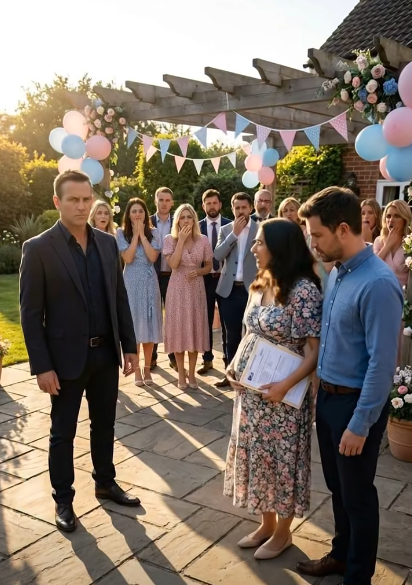
Sarah’s voice rang out, crystal clear and performatively joyous. I turned to see my wife standing in the center of the garden, bathed in the soft glow of fairy lights. She was wearing a flowing pastel dress designed to accentuate the five-month swell of her stomach. She looked radiant. She looked like the Madonna. She looked like the most expensive fraud I had ever invested in.
I adjusted the cuffs of my bespoke suit, masking the tremors of adrenaline that had been coursing through me for hours. “Coming, my love,” I called back, my voice a carefully honed instrument, capable of masking the hurricane within.
Beside the makeshift bar, Mike was holding court. My best friend since our freshman year at university. The man who had borrowed money from me to start three failed businesses. The man who was currently slapping my back with a little too much force as I approached.
“Here he is! The man of the hour!” Mike slurred slightly, raising his glass. His face was flushed, his eyes glassy with envy thinly veiled as affection. “To David! The architect who finally built something that’s going to last—a legacy!”
The crowd cheered. My colleagues, our families, even Mike’s wife, Jessica, who looked tired and worn down by Mike’s constant unemployment, raised their glasses. Her eyes flickered towards me, a hint of sympathy that was quickly drowned in her own resignation.
I smiled. It was the same smile I wore during high-stakes contract negotiations. “Thank you, Mike,” I said, my voice steady, devoid of the chaos burning in my gut. “A legacy is exactly what we’re here to discuss today.”
I looked at Sarah. She beamed at me, rubbing her belly possessively. It was a masterclass in manipulation. Five months ago, when she sat me down, tears in her eyes, to tell me the “miracle” had happened, I hadn’t said a word. I had just hugged her. A cold, mechanical embrace, while my mind was already drafting blueprints.
Because I knew.
I had known since I was twenty years old. A brutal case of mumps followed by severe orchitis had left me completely, irrevocably sterile. The doctors had been clear: the factory was closed. There were no miracles coming from me.
But I didn’t tell her then. I didn’t scream. I didn’t file for divorce immediately. That would have been messy. That would have allowed her to spin the narrative—to claim she was the victim, that I was the neglectful husband, that it was a “mistake.”
No. I needed blueprints. I needed evidence. I needed to build a trap so intricate, so inescapable, that when the walls came down, they would bury only the guilty.
“Shall we open the gifts?” Sarah chirped, clapping her hands. “I’m dying to see what everyone brought for little… well, we’ll see!”
The guests gathered around a mountain of pastel-wrapped boxes. I stood back, leaning against a pillar, watching the performance. I caught the eye of Helen, my divorce attorney, who was standing discreetly near the back, nursing a sparkling water. She gave me a microscopic nod. The paperwork was in the car. The assets were frozen. The locks on the penthouse were already changed.
Everything was ready.
Sarah tore through the gifts with feigned surprise. Designer onesies, silver rattles, a stroller that cost more than Mike’s car. She squealed. She cried. Mike hovered nearby, playing the role of the “doting uncle,” his hand lingering a little too long on Sarah’s shoulder when he thought no one was looking. That gesture, too intimate, too casual, was one of a hundred tiny fractures I had documented for months.
Finally, only one box remained. It was a large, sleek black box. No bow. No card on the outside. I had placed it there myself while the caterers were setting up.
“Oh, this one is heavy,” Sarah said, frowning slightly as she lifted it. “Who is this from? There’s no name.”
“Open it,” I said softly.
The chatter died down. My voice hadn’t been loud, but it carried a strange resonance that cut through the garden party atmosphere. Sarah looked at me, a flicker of confusion crossing her perfect features.
“Go on,” Mike urged, leaning in. “Maybe it’s the big surprise David’s been hinting at.”
Sarah ripped the black paper. She opened the lid.
Her smile faltered.
Inside, there were no clothes. No toys. Just a thick, bound stack of documents.
“What is this?” she laughed nervously, looking around. “Is this… a college fund? An insurance policy? You’re always so practical, David.”
“Read the cover sheet, Sarah,” I commanded. This time, my voice wasn’t soft. It was cold steel.
She pulled the file out. The logo of the St. Jude’s Fertility Institute was stamped in bold red ink at the top.
Sarah froze. Her eyes scanned the page. I saw the blood drain from her face in real-time, leaving her skin the color of old ash.
“Read it,” I said again, my voice now echoing in the cavernous silence of the garden.
“I… I don’t understand,” she stammered, her hands trembling.
“It’s a medical evaluation,” I told the crowd, stepping away from the pillar. “Dated fifteen years ago. Reconfirmed last month.” I pointed at the paper. “Read the conclusion.”
Sarah’s voice was a whisper, barely audible. “Diagnosis: Azoospermia. Prognosis… absolute sterility.”
A gasp rippled through the crowd. Mike dropped his glass. It shattered on the patio stones, the sound like a gunshot in the silence.
Sarah looked up at me, her eyes wide with terror. “David, I can explain… miracles happen… the doctors can be wrong…”
“Doctors can be wrong,” I agreed, taking a step closer, my shadow falling over her and Mike. “But math isn’t. And neither is biology. Keep looking in the box, Sarah. You haven’t found the real gift yet.”
The silence in the garden was suffocating. The wind rustled the leaves, sounding like hushed whispers of judgment. Sarah’s mother, a woman who had always looked down on me as “new money,” was clutching her pearls, her mouth agape. Her father, a man who built his empire on cold handshakes, just stared, his face an unreadable mask of shock and calculation.
Sarah reached back into the black box. Her trembling fingers brushed against a second, thinner envelope. It was sealed with red wax.
“You see,” I began, pacing slowly in front of the gathered guests like a professor giving a lecture. “When Sarah announced her pregnancy, I didn’t get angry. I got curious. I’m an architect. When numbers don’t add up, you don’t guess. You investigate.”
I stopped directly in front of Mike. He was sweating profusely now, large beads rolling down his temples. He tried to meet my gaze but failed, looking down at his shoes—the ones I’d bought for him.
“Open the envelope, Sarah,” I said.
She tore it open. A single sheet of paper fluttered out. It was a Non-Invasive Prenatal Paternity Test (NIPT).
“I hired a private investigator five months ago,” I continued, my voice calm, almost conversational. “He’s very good. He retrieved a hair sample from your hairbrush, Sarah. And he retrieved a used coffee cup from a ‘friend’ you’ve been spending a lot of lunch breaks with.”
Sarah stared at the paper. She was hyperventilating.
“What does it say?” Jessica, Mike’s wife, stepped forward. Her voice was trembling, but her eyes were laser-focused on her husband. “Mike, what does it say?”
I answered for Sarah. “It says that the probability of paternity is 99.99%.” I paused, letting the number hang in the air. “But not for me.”
I turned to Mike. “Congratulations, Mike. You’re going to be a father.”
The reaction was visceral. Jessica let out a strangled sob and lunged at Mike, shoving him hard in the chest. “You bastard! You told me you were at job interviews! You were with her?”
Mike stumbled back, his hands raised in a pathetic surrender. “Jess, wait, it’s not… it’s complicated… David, you have to listen…”
“I don’t have to listen to anything,” I cut him off. “I’ve been listening to you both whisper and plot behind my back for months.”
I pulled a small remote control from my pocket.
“You see, the problem with betrayal isn’t just the act,” I said, looking at the stunned guests. “It’s the planning. It’s the premeditation.”
I pointed the remote at the projection screen set up near the gazebo, which had been displaying a slideshow of cute baby animals.
Click.
The image changed. It was no longer a teddy bear. It was a grainy, high-definition photo of Sarah and Mike arguing in a hotel lobby.
Click.
A screenshot of an email chain. The subject line: Re: Prenup Modification.
“Read that one aloud, Mike,” I suggested.
Mike was paralyzed. So I read it for him, my voice ringing out in the dead silence.
“Once the baby is born, David will be too emotional to think straight. We push for the post-nuptial agreement to secure the trust fund for the ‘heir.’ Then we file for divorce in two years. Half his firm is ours.”
The crowd gasped again. This wasn’t just adultery; this was a conspiracy. It was planned theft.
Sarah’s mother fainted—genuinely this time—collapsing into the arms of a waiter. Sarah stood amidst the torn wrapping paper, the evidence of her greed scattered around her like debris from a bomb blast.
“You wanted my life, Mike,” I said, my voice dropping to a dangerous whisper. “You always hated that I succeeded while you stalled. You didn’t just want my wife; you wanted my money. You wanted to raise your child on my dime.”
Mike looked at me, his face a mask of ruined pride. “You think you’re so much better than me? You’re just a cold machine, David! You neglected her!”
“I gave her everything,” I replied instantly. “Including the rope to hang herself.”
I turned my back on them, walking toward the DJ booth where the microphone sat. I wasn’t done. I picked up the mic, the feedback whining slightly.
“There is one last thing,” I addressed the crowd. “Since this party is technically for the father…” I reached into my jacket pocket and pulled out a set of keys. I tossed them through the air. They clattered onto the patio at Mike’s feet.
Mike looked down at the keys. They weren’t car keys. They were house keys.
“Those are the keys to this house,” I announced, my voice booming through the speakers.
Sarah’s head snapped up. “What?”
“I sold the estate this morning,” I said, checking my watch. “Or rather, the company that owns the estate sold it. To a developer who plans to bulldoze it next week. You have until midnight to vacate the premises.”
“You can’t do that!” Sarah shrieked, her facade finally cracking completely into hysteria. “This is my home! I have rights!”
“Actually,” Helen, my lawyer, stepped forward, her voice crisp and professional. “You signed a prenuptial agreement that explicitly states any act of infidelity resulting in paternity fraud voids all claims to the marital residence and spousal support. We have the DNA test. We have the emails admitting conspiracy.” She held up a folder. “And you have absolutely nothing.”
I watched as the reality crashed down on them. Sarah wasn’t just losing a husband; she was losing the lifestyle she worshipped. Mike wasn’t gaining a fortune; he was gaining a dependent and a child he couldn’t afford, while losing his own wife.
Jessica had already pulled off her wedding ring and thrown it into the punch bowl. She marched past Mike without a glance. “I’m taking the kids to my mother’s. Don’t call me.” She paused at the gate, turned to me, and said a single, quiet word, “Thank you, David.” Then she was gone.
Mike stood alone, sandwiched between a sobbing, pregnant mistress and the ruins of his marriage. He stared at the keys, the final symbol of his failed usurpation.
I walked over to the gift table, picked up the medical file, and tucked it under my arm. I didn’t look back at Sarah. I didn’t look back at the friends who had eaten my food and drank my wine while whispering behind my back. I saw only the structure of rotten relationships, ready for demolition.
I walked to my car, where Helen was waiting.
“Did you sign the papers?” she asked as I slid into the passenger seat.
“Signed and dated,” I said, exhaling a breath I felt I had been holding for five months. “Let’s go.”
As we drove down the long, winding driveway, I looked in the rearview mirror. The lights of the party were still twinkling, but the atmosphere was dead. It was a beautiful ruin. A perfectly executed demolition.
One year later.
I stood on the balcony of my new penthouse, overlooking the city skyline. The wind here was different—crisper, cleaner. It didn’t smell of lies.
My architecture firm had just won the award for the new City Library. I was busy. I was focused. My life was built on clean lines and solid purpose.
“David?”
A soft voice called from the living room. I turned to see Elena. We had been dating for six months. She was a pediatric surgeon—brilliant, kind, and fiercely independent. She didn’t know how much money I had when we met, and she didn’t care when she found out. She cared about the blueprints I sketched and the stories behind them.
“Ready for dinner?” she asked, smiling.
“Just a minute,” I said.
I looked back at the city. I’d heard through a former mutual acquaintance that Mike was working double shifts at a warehouse to pay child support. Sarah was living in a small apartment with her mother, raising a colicky baby, drowning in legal fees from the counter-suits Mike’s ex-wife had filed.
They had mistaken my silence for weakness. They had mistaken my patience for ignorance. They didn’t realize that while they were digging a small trap for me, I was designing the demolition of their entire world.
I wasn’t a victim. I was an architect. I had recognized a structure that was rotten to the core, and I had controlled the demolition perfectly.
“Coming,” I said to Elena, turning my back on the view.
I didn’t have a child. But for the first time in years, I had a future. And it was built on solid ground