The July heat pressed against my skin like a physical weight as I stepped out of the air-conditioned car, my hand instinctively moving to cup the underside of my swollen belly. Nine months pregnant. My ankles were swollen to the size of grapefruits, my back throbbed with a dull, rhythmic ache, and yet my husband, Trevor, had insisted we attend his family’s annual reunion at the Reeves Estate in Connecticut.
The sprawling property looked like a spread from Architectural Digest—all manicured emerald lawns, white columns that screamed old money, and hydrangeas that bloomed with unnatural perfection. But I had learned early in my three-year marriage that beautiful exteriors often conceal rot.
“Remember what we talked about,” Trevor whispered, squeezing my hand a little too tight as we approached the main house. “Just stay calm. Don’t engage if my mother starts anything. Please, Elena. For me.”
I wanted to laugh at the absurdity of his words, but the tension in my chest wouldn’t allow it. His mother, Constance Reeves, had made my existence a living nightmare since the day Trevor brought me home. I was a public school teacher from a working-class neighborhood in Queens; in her eyes, I was a genetic error polluting the pristine Reeves lineage.
The backyard was already a sea of linen and pastels when we arrived. Long tables covered in crisp white cloths stretched across the lawn, and the scent of expensive cuts of meat grilling on charcoal hung heavy in the humid air. Trevor’s father, Gerald, stood near the bar, holding court with his brothers, while Constance floated between groups of guests like a queen surveying her subjects, her smile tight and practiced.
My bladder, compressed by the seven-pound baby girl waiting to make her entrance, screamed for relief. I scanned the area. Every bench was full, but I spotted a high-backed, cushioned wicker chair in the shade of a massive oak tree. It was empty.
I waddled over, practically collapsing into the plush cushion. For a moment, I closed my eyes, letting the shade cool the sweat on my forehead.
“What do you think you’re doing?”
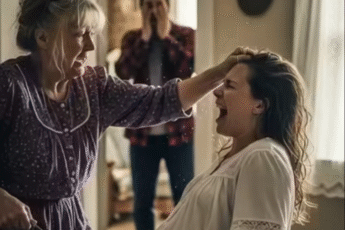
The voice cut through the pleasant hum of conversation like a serrated knife. My eyes snapped open to find Constance standing over me, her face a mask of cold fury. The pearls at her throat seemed to tremble with her rage.
“I… I’m sorry?” I struggled to sit up, confused. “I just needed to sit down, Constance.”
“That is my chair,” she hissed, loud enough for the nearest tables to go silent. “It has been my chair at these gatherings for twenty-five years. Did Trevor not teach you anything about our traditions?”
I felt the heat flood my cheeks, hotter than the summer sun. I could feel dozens of eyes boring into me—cousins, aunts, business partners. “I didn’t know. I’m sorry. I’ll move.”
“You have no respect,” Constance’s voice rose to a shriek, abandoning her usual icy whisper. “You waltz in here with your belly out, taking what isn’t yours. You will be punished for this disrespect.”
Gerald appeared at her elbow, his face flushed with bourbon and indignation. “Some women just have no manners,” he muttered, loud enough to be heard. “Raised in a barn, clearly.”
Trevor rushed over, his face pale, looking like a child caught between two warring parents. “Mom, Dad, please. She didn’t know. Elena is nine months pregnant. She just needed a minute.”
“Then she can sit on the grass,” Constance snapped, smoothing her silk dress. “I won’t have an outsider usurping my place.”
I hauled myself up, using every ounce of dignity I had left to keep from crying. Trevor tried to take my arm, but I pulled away. The humiliation was a physical thing, a nausea in my gut.
“I need the bathroom,” I whispered to Trevor, unable to look at him. “I can’t be out here.”
I walked toward the house, feeling their gazes on my back like lasers. I entered through the french doors, the house blessedly cool and silent compared to the theater outside. I found the powder room near the back staircase. After I finished, I stood at the sink for a long time, splashing cold water on my blotchy face, staring at the woman in the mirror. I looked exhausted. Defeated.
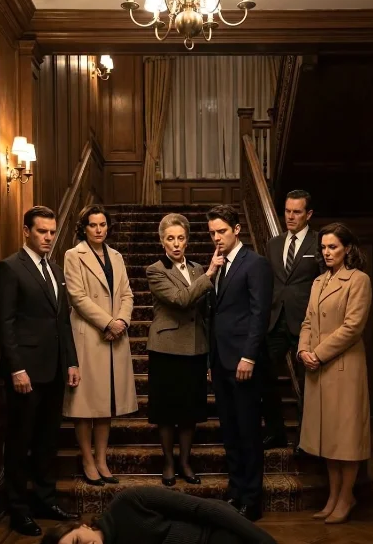
I decided to use the main staircase to exit the front way and wait in the car. I couldn’t face the backyard again. The stairs were wide, carpeted in a plush runner, with a polished mahogany banister.
I was halfway up the first flight when I heard the heavy, deliberate click of heels behind me on the marble foyer floor.
“You think you can just walk away?” Constance’s voice echoed in the hallway.
I didn’t turn. I just wanted to leave. I took another step.
Then, I felt it. Not a bump. Not an accident. Two hands, flat and forceful, slammed into the small of my back with tremendous, calculated power.
Gravity took over. My feet left the carpet. My hands scrambled for the banister but found only empty air. The world tilted, spun, and shattered. I was falling forward, my body twisting instinctively in a desperate bid to protect my stomach.
I hit the stairs hard—shoulder first, then hip. Pain exploded in bright white flashes. I kept tumbling, unable to stop the momentum, a ragdoll in a maternity dress.
Through the chaos of motion, I heard another scream—a higher pitch, coming from above me. A sickening collision. Someone else falling.
When I finally stopped moving, I was crumpled at the bottom landing against the wainscoting. Every inch of me throbbed. My vision swam. But my hands flew to my belly. Move, I prayed. Please move.
Above me, on the stairs, Trevor’s sister, Adrienne, was sprawled across the steps, moaning, clutching her ankle. She had been coming down as I was pushed up; my body had undercut her legs like a bowling ball.
Constance descended the stairs. She didn’t look at her daughter. She stepped over Adrienne’s legs as if she were a piece of luggage. She came straight for me.
Her face wasn’t horrified. It was contorted with a hate so pure it looked demonic.
“Look what you’ve done!” she shrieked. “You hurt Adrienne! You clumsy, stupid cow!”
“You… you pushed me,” I wheezed, the air gone from my lungs. I felt a warm, terrifying wetness spreading between my legs.
“Liar!” Constance screamed.
Then, the unthinkable happened. She pulled back her leg, clad in a sensible designer pump, and she kicked me. Hard. Right in the side of my stomach.
The pain was unlike anything I had ever known—sharper than the fall, deeper than the bone bruises. I screamed, a raw, animal sound, curling into a ball to shield my child.
“Mom! Stop!” Trevor’s voice came from the entryway, filled with panic.
“She did this!” Constance yelled, breathless, landing another kick to my thigh, then my ribs. “She threw herself down the stairs to ruin the party! She hurt your sister!”
I saw Trevor run forward, finally grabbing his mother by the shoulders and physically hauling her back. Gerald was there too, helping Adrienne, ignoring me completely as I bled on their expensive rug.
“Call 911!” Trevor shouted, his voice cracking. “Someone call 911!”
“Don’t you dare!” Constance hissed, shaking off Trevor’s grip and straightening her dress. “This is a family matter. We will handle it privately. The last thing we need is police cars in the driveway causing a scene.”
I looked up through a haze of tears and saw Trevor freeze. He held his phone, his thumb hovering over the screen, looking from his bleeding wife to his raging mother.
For a heartbeat, he hesitated. And in that heartbeat, my marriage died.
The ambulance arrived only because Trevor finally defied her, though his hands shook the entire time he dialed. The EMTs loaded me onto a stretcher in the foyer. Constance stood by the grandfather clock, arms crossed, loudly telling anyone who would listen that I was hysterical and had tripped over my own feet.
None of the relatives who had crowded into the hallway contradicted her. They watched me bleed with the same passive interest one gives a car wreck on the highway.
At the hospital, the world dissolved into the bright lights of the trauma bay.
“Fetal heart rate is dropping,” a doctor shouted. “She’s abrupted. We need to go. Now!”
I was rushed into surgery. The placenta had torn away from the uterine wall due to the trauma. My baby girl was ripped from me via emergency C-section, six weeks early.
I woke up hours later in a recovery room, my body feeling like it had been run over by a truck. My ribs were taped, my wrist splinted, and a jagged line of fire burned across my abdomen.
“The baby?” I rasped, the oxygen mask fogging.
Trevor was there, sitting in the dark corner. He looked like a ghost. “She’s alive,” he whispered. “They named her Grace. Like you wanted.”
Grace. My survivor.
“She… she has a fractured clavicle,” Trevor continued, his voice breaking. “And she’s in the NICU. But the doctors say she’s stable.”
A fractured clavicle. My baby had broken bones before she had even taken her first breath.
“Where is she?” I asked, trying to sit up, but the pain forced me back down. “Where is your mother?”
Trevor moved to the side of the bed, taking my hand. I flinched away.
“Elena, listen,” he began, the words rushing out. “Mom is… she’s beside herself. She says she was trying to help you up and you panicked. She says it was an accident.”
“She kicked me, Trevor,” I said, my voice cold and hard. “She pushed me down the stairs, and then she kicked me while I was on the floor. You saw her.”
“I saw… a chaotic situation,” he stammered, looking away. “It happened so fast. Mom says—”
“I don’t care what she says.”
“The police are coming,” he interrupted. “Officer Hayes. He’s outside.”
“Good.”
Trevor knelt, his face desperate. “Elena, please. Think about this. If you press charges… my father will cut us off. The scandal will destroy the family business. Mom could go to jail. Do you really want Grace’s grandmother in prison?”
“She tried to kill us,” I whispered.
“She’s old. She was confused. It was the heat.” He was grasping at straws, repeating the lies they had already cooked up. “Please. For Grace. We can’t start her life with a war.”
Before I could answer, Officer Nathan Hayes entered. He was a stocky man with kind eyes but a jaw set in stone.
“Mrs. Reeves,” he said. “The hospital reported injuries consistent with assault. I need you to tell me exactly what happened.”
I looked at Trevor. He was pleading with his eyes, begging me to be the silent, compliant wife he wanted. Then I thought of Grace, alone in a plastic box, nursing a broken bone because of that woman’s vanity.
“She pushed me,” I said clearly. “Constance Reeves pushed me down the stairs, and then she assaulted me.”
Trevor put his head in his hands.
But as the days went on, the reality of my situation set in. Officer Hayes returned three days later, looking frustrated.
“Mrs. Reeves, I believe you,” he said, sitting heavily in the chair. “But we have a problem. I’ve interviewed twelve people who were in or near the house. Every single one of them—including your sister-in-law Adrienne—corroborates Constance’s story. They say you tripped. They say the bruising on your stomach was from the fall.”
“They’re lying,” I said, tears of frustration stinging my eyes.
“Without an independent witness or video, it’s he-said-she-said,” Hayes admitted. “The DA is hesitant to prosecute a prominent figure like Mrs. Reeves on circumstantial evidence. We can file, but… it will be an uphill battle.”
The Reeves family had closed ranks. The Omertà of the wealthy suburbs. They were going to let her get away with it.
“So she wins?” I asked.
“Not necessarily,” Hayes said, lowering his voice. “Criminal court requires proof beyond a reasonable doubt. Civil court… that’s just a preponderance of the evidence. And money is the only language people like that understand.”
Grace came home on a Tuesday. She was tiny, fragile, and wore a soft harness to immobilize her shoulder. Every time she whimpered, my heart broke anew.
Trevor was useless. He floated around the house like a specter, terrified of his phone. Constance called daily. He would take the calls in the garage, speaking in hushed tones.
“She wants to visit,” he told me one night. “She wants to see her granddaughter.”
“If she steps foot on this property, I will shoot her,” I said calmly, folding a onesie.
“Elena, stop it. She’s threatening grandparents’ rights. She says she’ll sue for custody if we keep her away. She has the money to do it.”
That was the moment the fear turned into cold, calculating rage. They wanted a war? I would give them a nuclear winter.
I hired Garrett Mills. He wasn’t a society lawyer; he was a personal injury shark with cheap suits and a terrifying win record.
“We sue,” Garrett said during the consultation in my living room. “For medical expenses, pain and suffering, emotional distress, and punitive damages. We hit them for everything.”
“Trevor says they’ll destroy me in court,” I said.
Garrett smiled, a sharp, predatory thing. “Let them try. The burden of proof is lower. And we have something they don’t have.”
“What?”
“The truth. And eventually, rats always jump from a sinking ship.”
We filed the lawsuit. The number we demanded was staggering: five million dollars.
The reaction was immediate. My phone exploded with venomous texts from Trevor’s aunts and cousins. Gerald left a voicemail calling me a “gold-digging whore.” Constance started a whisper campaign in town, telling everyone I was mentally unstable and had thrown myself down the stairs for attention.
Trevor moved into the guest room. “You’re destroying this family,” he said.
“Your mother destroyed it,” I replied. “I’m just burying the body.”
The discovery phase was brutal. Their lawyers requested my entire life history—medical records, therapy notes, high school report cards. They hired a Private Investigator to follow me. I would see a gray sedan parked down the street when I took Grace for walks. They were looking for anything to paint me as an unfit mother.
But then, the crack in the armor appeared.
It wasn’t Adrienne. It was Jasper, a second cousin I barely knew. He had been smoking on the side porch that day, hidden by the trellis.
Garrett called me, his voice buzzing with energy. “Jasper Reeves just contacted my office. He’s willing to be deposed.”
“Why?”
“He has a pregnant wife,” Garrett said. “He said he hasn’t slept in weeks thinking about what he saw. He saw the shove, Elena. He saw the kick. And he’s willing to swear to it.”
Jasper’s deposition changed the atmosphere from a battle to a slaughter. He described, in vivid detail, the look on Constance’s face. The deliberate nature of the shove.
The Reeves’ lawyers called for an emergency settlement conference the next day.
They offered $400,000 and a non-disclosure agreement.
“Take it,” Trevor begged me that night. “Please, Elena. It’s a lot of money. It pays the bills. It stops the fighting.”
I looked at my husband. Really looked at him. I saw the weakness that rotted his soul. He would sell his wife and child for a quiet Sunday dinner.
“I’ll take the settlement,” I said quietly.
Trevor slumped with relief. “Thank God. I knew you would be reasonable.”
“On one condition.”
“Anything.”
“I want a divorce. And I want full custody.”
The color drained from his face. “What? No. We can fix this.”
“There is no fixing this, Trevor. You watched your mother beat me while I was carrying your child, and you did nothing. You are an accessory to my trauma. I will take the money, I will take Grace, and I will leave. If you fight me on custody, I will take this to trial, and Jasper’s testimony will be on the front page of the Times.”
He stared at me, and for the first time, he realized that the woman he married was dead. I was something else now. Something harder.
The settlement was signed. $400,000. Plus medical bills. Plus a written admission of “regret” from Constance—not an apology, but close enough to be humiliating for her.
The divorce was uglier. They fought for custody to save face. They used the PI’s photos of me crying in my car as proof of “instability.” But the judge, a woman with eyes like flint, read the police report and Jasper’s deposition.
She awarded me primary physical custody. Trevor got visitation every other weekend, with a strict stipulation: The paternal grandparents, Constance and Gerald Reeves, are not to be within 500 feet of the minor child at any time.
It was a restraining order wrapped in a custody decree.
But Constance Reeves didn’t believe laws applied to her.
Six months after I moved out, I had settled into a small rental house on the other side of the state. I changed Grace’s daycare to a facility with a keypad gate and armed security.
One afternoon, the daycare director called me.
“Ms. Reeves? There’s an older couple here. They say they are Grace’s grandparents. They tried to bypass the front desk to get to the playground.”
My blood ran cold. “Did they see her?”
“No. Our security stopped them. They are refusing to leave.”
“Call the police,” I said. “I’m on my way.”
By the time I arrived, Officer Hayes—who had transferred districts but kept an eye on my case—was already there. Constance was in handcuffs, screaming at a terrified daycare worker. Gerald was trying to bribe an officer.
“She violated the court order,” I told the officers, handing them the paperwork I kept in my glovebox. “Arrest her.”
Constance saw me. “You can’t keep her from me! She’s my blood!”
“She is my daughter,” I said, my voice steady. “And you are nothing to her. You are the monster under her bed.”
The judge was not lenient this time. Violation of a protective order involving a minor. Constance spent a weekend in county jail—no private cell, no special treatment. It broke her. The humiliation of the mugshot being leaked to the local paper destroyed her social standing.
Gerald had a stroke a month later from the stress. The Reeves dynasty was crumbling, not from an outside attack, but from the rot within.
Three years have passed since that day on the stairs.
I live in Oregon now. The rainy weather suits us. I bought a small house with a big yard where Grace can run. She is three years old, a whirlwind of energy with a laugh that sounds like bells. The scar on her collarbone is gone, healed by time and growth.
I used the settlement money to get my Master’s degree. I teach at a school where the parents are kind and the coffee is cheap.
Trevor visits once a month. He flies out, stays in a hotel, and takes Grace for ice cream. He looks older, tired. He remarried a woman his mother approved of, but I hear they are miserable. He loves Grace, in his own weak way, but he knows he is a visitor in her life, not a father.
I was sitting on my porch swing last week, watching Grace chase a butterfly, when my phone pinged. A Facebook message.
It was from Adrienne.
I hadn’t spoken to her since the fall. I hesitated, my thumb hovering over the delete button. But curiosity won.
Elena,
I know I have no right to write to you. But I wanted you to know that I remember. I remember seeing Mom follow you to the stairs. I remember her face. I was coming down to warn you because I saw the look in her eyes. I was too late.
I lied to the police because I was afraid of her. She threatened to cut me off. She threatened to take my trust fund. I sold my integrity for money.
I have a daughter now. Her name is Rose. And when I hold her, I think of you on that floor. I think of what I allowed to happen.
I don’t expect forgiveness. I just wanted to say… you were right. About everything. I’ve cut contact with Mom. I hope you and Grace are safe.
I read the message twice. I felt the old anger flare, hot and sharp. She had watched me bleed and said nothing. She had let me be branded a liar.
But then I looked at Grace. She had tripped over a tree root. She fell, scraped her knee, and looked up at me, her face crumbling.
“I’m okay!” she yelled before I could move. She brushed off her knees, stood up, and kept running.
She was resilient. She was strong. Because I had made her that way.
I looked back at the phone. I didn’t reply to Adrienne. I didn’t need her apology to be whole. I didn’t need the Reeves family’s validation.
I closed the laptop and walked out into the grass.
“Mama, look!” Grace shouted, holding up a dandelion. “I made a wish!”
“What did you wish for?” I asked, scooping her up.
“I wished for ice cream!”
I laughed, burying my face in her neck. “Well, that’s a wish we can make come true.”
Constance Reeves had tried to push me down. She had tried to crush me under the weight of her wealth and her cruelty. She wanted me to disappear.
Instead, I had risen. I had built a fortress of peace around my daughter, brick by brick.
The scar on my stomach from the C-section is silver now, a faint line on my skin. It doesn’t hurt when it rains anymore. It is simply a mark of where life entered the world, and where I survived the fall.
We survived. We won. And the silence of my peaceful life is the loudest victory scream I could ever make.